


February 6, 2026
First RAB, Now Signify. Is This Patent Real or a Reach?
Invictus Lighting files a selectable wattage lawsuit against a second industry titan
In a case that challenges whether a basic feature of modern LED lighting is really proprietary tech, a small North Carolina firm is suing Signify — the world’s largest lighting company — over its use of internal wattage selectors in 0-10 volt commercial fixtures.
Filed February 5 in New Jersey federal court, the lawsuit marks the second time Invictus Lighting has asserted U.S. Patent No. 9,801,245, while taking aim at a lighting industry heavyweight. The same patent is already in play against RAB Lighting in a separate federal case in New York, where discovery deadlines loom this May.
Now, Invictus is testing the same infringement theory against a company whose legal team alone may outnumber its entire staff.

Small Company, Big Accusation
Based in Hickory, North Carolina, Invictus Lighting is a small operation that actually makes and sells LED fixtures — a detail that distances it from the legion of non-practicing entities that typically file these types of suits. The company reported just five employees in 2021, five years ago — a stark contrast to the global manufacturers it’s now taking to court. But that hasn’t spared it from skepticism. Its claim? That it owns the intellectual property covering a hybrid system allowing installers to pre-select wattage levels internally, in tandem with 0–10V dimming.
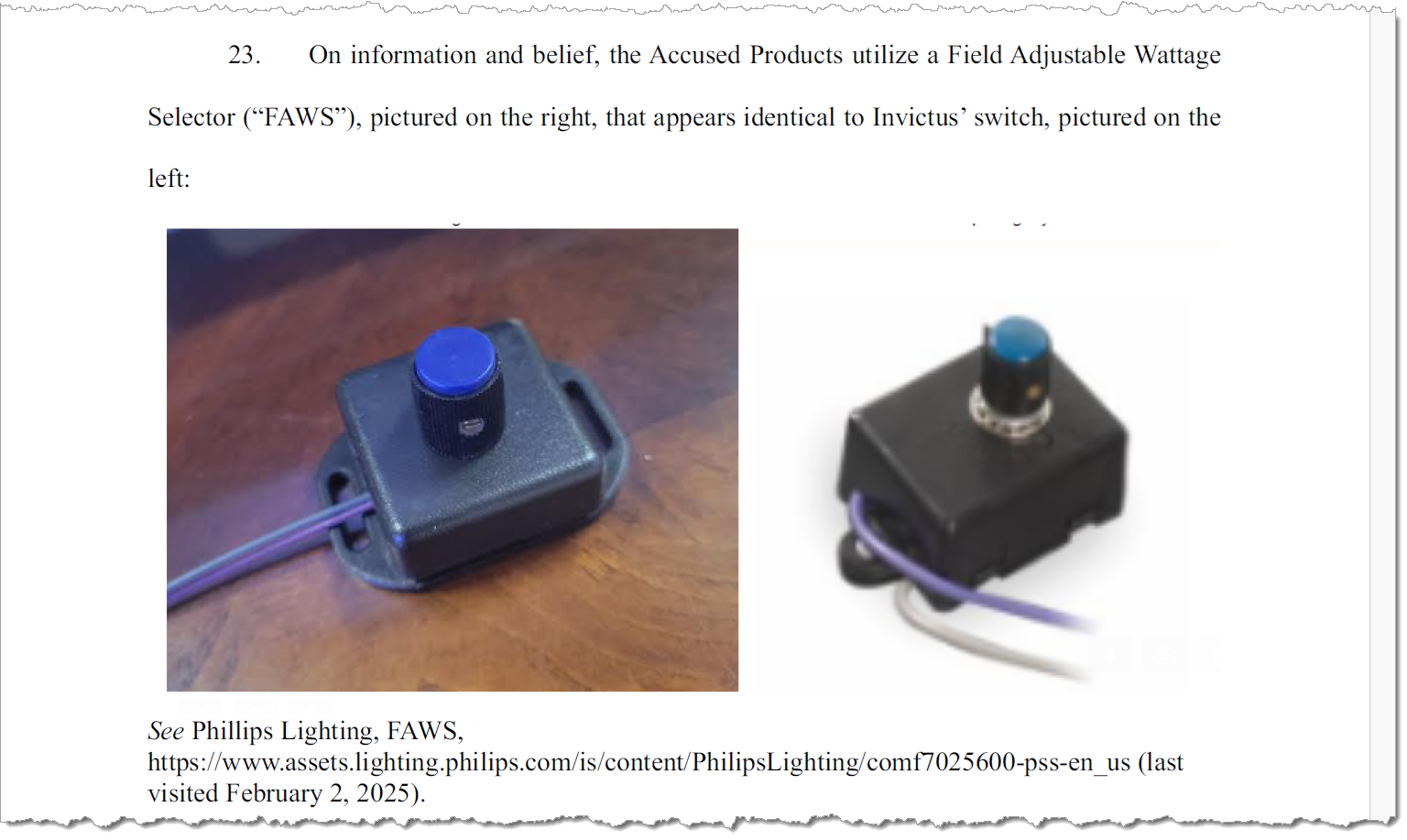
Above: Excerpt from Invictus Lighting vs. Signify complaint
Invictus says Signify’s Day-Brite, FluxPanel, DSRT, and SlimFlood product families use an internal Field Adjustable Wattage Selector (FAWS) that operates in virtually the same way — a switch set by the installer to cap maximum output, combined with dimming functionality to adjust brightness within that range.
To industry eyes, it all sounds... familiar. Maybe too familiar.
How This Got Patented
Invictus’s ’245 Patent was issued in October 2017. The application it stems from was filed in July 2014 — though it claims priority to provisional filings dating back to 2013 .
That matters, because selectable wattage — or at least something like it — has existed in some form for well over a dozen years. The feature is now found across countless downlights, panels, troffers, and wraps, installed in schools, offices, and warehouses across the country.
So is Invictus’s patent a narrow technical innovation, or is it staking claim to a feature that was already public domain?
That’s now a live question for two federal courts.
Why the Lawsuits Matter
If the courts agree with Invictus — or if manufacturers agree just enough to settle — the implications could ripple across much of the commercial lighting landscape. The architecture at issue is used in products from many established lighting brands. If Invictus prevails, companies may face licensing demands or have to reengineer fixtures to sidestep the patent.
What makes this latest filing against Signify so notable isn’t just the size of the defendant — it’s the posture. Signify, known for wielding one of the lighting industry’s most expansive patent portfolios, is typically the plaintiff, not the accused.
Now, the behemoth is on defense. And a courtroom in Newark, New Jersey (Exit 142A) could determine whether Invictus’s patent is a narrowly drawn piece of genuine innovation — or an overreach built on a common industry feature.
Either way, what looked like a footnote from Hickory could soon have a bigger wattage footprint than anyone expected.