


March 18, 2026
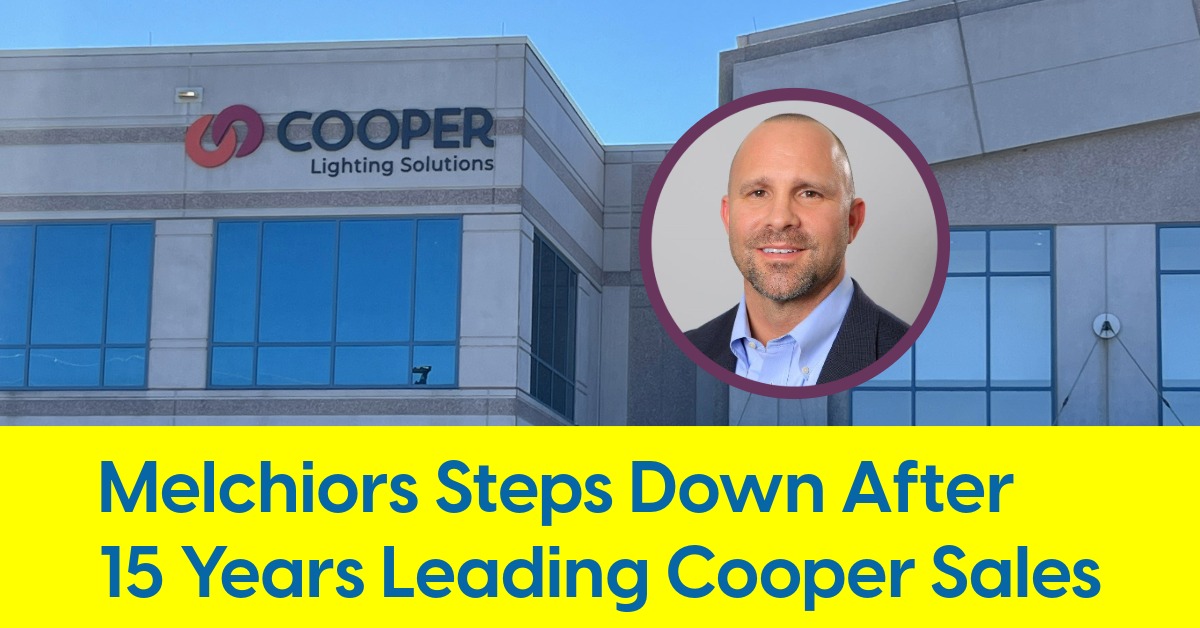
Melchiors Steps Down After 15 Years Leading Cooper Sales
Responsibilities shift to Larkin and Moreman in shared leadership model
For more than 15 years, Joe Melchiors occupied a role that, in Cooper Lighting lore, rarely sat still for extended periods of time. Vice Presidents of Sales came and went, often ascending, sometimes exiting, but almost never lingering. Konnerth. Bauer. Bucar. Toney. Castillo. The list reads less like a lineage and more like a relay. And then there was Melchiors, who simply stayed and consistently showed up.
Until now.

Joe Melchiors
Cooper confirmed that Melchiors, Executive Vice President of Sales, will depart effective April 1. He will join a private equity-backed business outside the lighting industry. The move closes one of the longest tenures in the role the company has seen, and, by many accounts, one of the most stable. If there is disruption here, it is not the kind that suggests fracture. It is the quieter kind, the kind that comes when someone who expected to finish the race suddenly decides to leave the track.
“I expected to retire from here,” Melchiors told us, describing a career defined by an almost stubborn loyalty. He claims that he never took recruiter calls. Not once. Not even a polite LinkedIn acceptance.

The Two Calls That Mattered
There were, however, two voices that could reach him.
One was Kraig Kasler, a former GE Lighting colleague and now President of Cooper Lighting Solutions, who first nudged Melchiors toward Cooper over fifteen years ago. The other was Carl Will, another former GE colleague who more recently became CEO of a Genstar Capital portfolio company. If Kasler opened the door to Cooper, Will quietly reopened it to this new opportunity in private equity.
Will’s pitch was not immediate. It unfolded slowly, almost strategically, over many weeks. A business within Genstar’s portfolio. A need for operational rigor in sales. A chance to build, not compete. That last point mattered. Melchiors was explicit, almost emphatic: he will not return to lighting, and he will not compete against Cooper. “I would never, ever do that,” he emphasized. A clear signal that he is not biding time outside the industry to wait out a noncompete.
Genstar Capital, a San Francisco-based firm with 49 portfolio companies, offered a different arena. Not lighting. Not even adjacent. But familiar in structure: integration, process discipline, sales architecture. The work, he noted, is sales leadership and strategy functions, “what I do in my sleep.”
The Handoff to Larkin and Moreman
Melchiors’ tenure tracked Cooper’s transformation from its Cooper Industries roots through Eaton ownership and into the Signify era. Along the way, he navigated the industry’s most consequential shifts, from the rapid ascent of LEDs and connected lighting to the growing complexity of controls and a fundamental reshaping of the agent and channel landscape.
That longevity now creates a different kind of transition challenge: not replacing a role, but redistributing it.
Cooper is not naming a successor. Instead, Melchiors’ seven direct reports are being split between Ed Larkin and Keith Moreman. Larkin, now Senior Vice President of Sales, appears to take the heavier share, including regional sales leadership and channel functions. Moreman, elevated to Senior Vice President of Strategic Accounts, expands across enterprise, infrastructure, and international segments. Both will report to Kasler.
The EVP role itself effectively dissolves.
“Ed and Keith are highly experienced leaders who know our business well and have built strong relationships across our sales organization, agent network, and customer base. They have been instrumental in our success and are well prepared to step into these expanded responsibilities.”
— Kraig Kasler, President, Cooper Lighting Solutions
Continuity, Not Chaos
Melchiors was careful, almost protective, in how this moment is framed. He worried aloud that some might spin the narrative into something darker, something about instability or doubt. He pushed back against that interpretation repeatedly.
And the facts support him. This is not a sudden exit. It is a structured transition, aligned with succession planning that began more than a year ago. Larkin and Moreman were already carrying significant responsibilities. Now they carry more.
Still, the departure lands with weight of its own. Not because Cooper is losing direction, but because it is losing a constant.
For a company accustomed to motion in this role, the unusual story is not that Melchiors is leaving. It is that he stayed long enough to make leaving feel unfamiliar.