October 26, 2026
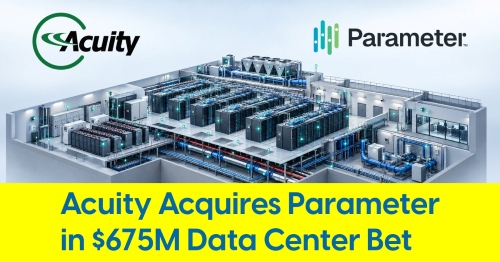
Acuity Acquires Parameter in $675M Data Center Bet
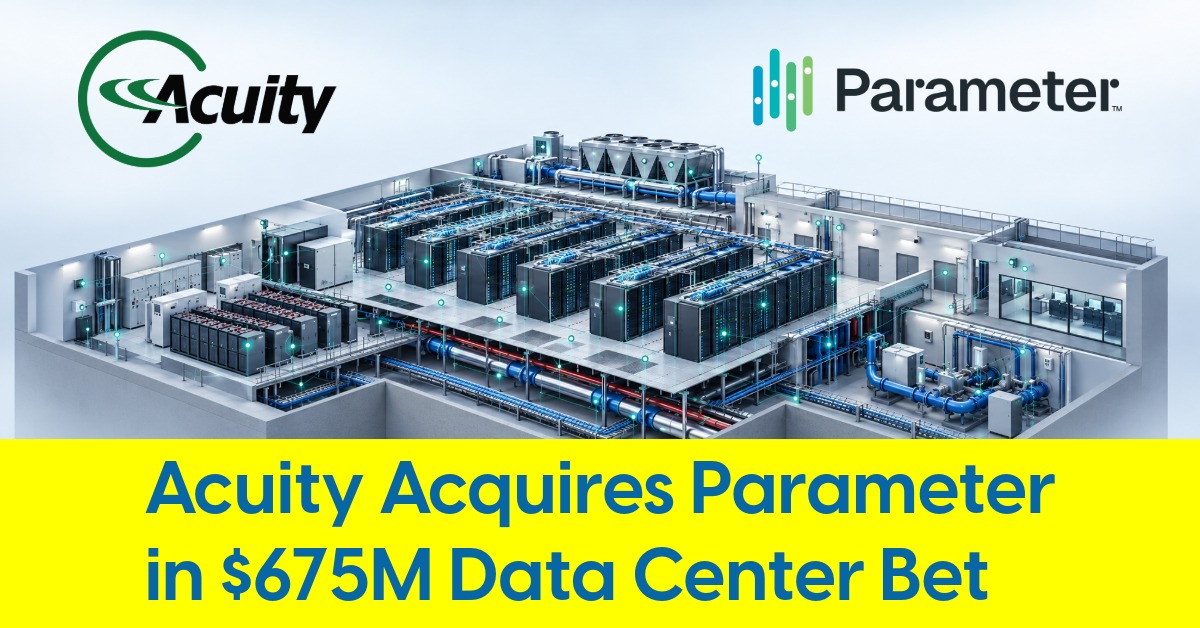
A 16-times forward earnings multiple reflects ambitious expectations for Parameter Technologies
The most valuable thing Acuity bought this week will never hang from a grid ceiling.
On October 26, Acuity Inc. announced its plans to acquire Parameter Technologies, a Fort Collins, Colorado, company, for $675 million. Through its RLE Technologies and CellWatch brands, Parameter detects leaks, monitors batteries and tracks environmental conditions inside data centers. None of it emits a lumen.
It is the second-largest acquisition in Acuity’s history, behind only the $1.215 billion purchase of QSC that closed January 1, 2025. When the deal closes, Parameter will join Distech Controls inside Acuity Intelligent Spaces (AIS). Five days ago, we wrote that every signal pointed Acuity’s next big check toward controls, software and AV rather than another fixture maker. That check is arriving sooner than expected.
Following the Construction Money
For lighting people, where the money goes matters more than how much it is. Acuity is again sending its largest capital commitments away from luminaires, and this time into the one corner of nonresidential construction that is still expanding. In July, the American Institute of Architects (AIA) Consensus Construction Forecast panel projected that data center spending will rise 33.0% in 2026 and 24.7% in 2027. That would make data centers about 8% of all nonresidential building spending by 2027.
Associated Builders and Contractors (ABC) attributed all of July’s increase in nonresidential spending to data centers. Dodge Construction Network’s commercial planning index drops 14.9% year over year once data centers are excluded. Acuity Brands Lighting (ABL) sells mostly into that flatter commercial and industrial market. With Parameter, Intelligent Spaces gets a ticket to the growing one.
The largest electrical contractors are busy on projects that rarely run through a lighting catalog, and everyone else pays more for wire and gear in a flat market. Parameter gives Acuity a direct share of the boom instead of waiting for it to reach the strip light aisle.
What Acuity Is Actually Buying
Parameter’s products work at every level of a data center. Leak-detection cables and sensors run along cooling loops and fluid lines and pinpoint where a leak has started. CellWatch monitors the health of the batteries in uninterruptible power supplies and backup power systems, and environmental sensors track airflow and humidity.
The timing reflects a change in how data centers are cooled. AI processors run hot enough that operators are piping liquid close to the chips, and a leak beside a rack of GPUs is an expensive event. Peter Han, president of Acuity Intelligent Spaces, said the combination will “expand our capabilities in data centers and deepen relationships with channel partners.” For lighting readers, the simplest version is this: Distech’s controls tell the cooling system what to do, and Parameter tells everyone when something has gone wrong.

Parameter is less than two years old. May River Capital, a Chicago private equity firm, bought RLE Technologies in 2023. A year later it added NDSL, the Raleigh-Durham maker of Cellwatch, and put both under the Parameter name. May River never disclosed what it paid for either one, so its gain from the sale can’t be calculated. The playbook is a familiar one: build a niche platform, add to it, rename it, and sell it to a strategic buyer once its market heats up. Here the market was AI cooling.
Parameter has about 115 employees. It is headquartered in Fort Collins, with engineering and service operations in Raleigh, North Carolina, and sales and service in Milton Keynes, United Kingdom. Parameter’s own announcement says the deal should close in late 2026. Acuity points to the second quarter of its fiscal 2027, which runs December through February, once the Hart-Scott-Rodino antitrust waiting period expires.
The Price of Growth
Acuity expects Parameter to bring in about $100 million in calendar 2027 sales, more than 30% above this year, at a margin of about 40% on EBITDA (earnings before interest, taxes, depreciation and amortization). Acuity’s deck puts the price at about 16 times Parameter’s estimated calendar 2027 EBITDA. The company will borrow $500 million, cover the rest with cash, and expects the deal to add to fiscal 2027 adjusted earnings per share.
That 16x multiple is forward-looking, so it prices in earnings Parameter has not yet produced. By our math, growing more than 30% to $100 million means calendar 2026 sales below about $77 million. At the same 40% margin, current-year EBITDA would be about $31 million or less, which puts the price at roughly 22 times or more.
What Acuity Paid for Three Landmark Deals Over Last 12 Years
| Deal | Price | Earnings multiple | Basis |
|---|---|---|---|
| Juno Lighting Group (2015) | ~$385M | ~12x | Price ÷ Juno’s 2014 EBITDA of $32M, per seller Schneider Electric |
| QSC (2025) | $1.215B | ~14x | $1.1B net price (after ~$100M in tax benefits) ÷ trailing 12-month EBITDA through August 31, 2024, per Acuity |
| Parameter Technologies (pending) | $675M | ~16x forward; ~22x+ current-year |
Forward multiple is Acuity’s, based on estimated CY2027 EBITDA. Current-year multiple is an Inside Lighting estimate based on CY2026 EBITDA of about $31M or less, assuming 2026 margins match the ~40% projected for 2027 |
Note: These multiples measure different things. Juno’s is the seller’s trailing figure. QSC’s is trailing and net of tax benefits. Parameter’s 16x is forward. Read the trend, not the decimals.
Even with different bases, the trend is clear: about 12 times for Juno, about 14 times for QSC, and about 16 times forward for Parameter. Acuity keeps paying more, and what it buys has changed along with the price. Juno brought scale in downlighting. Parameter brings growth and margin, and its roughly 40% EBITDA margin is about double ABL’s 18.1% adjusted operating margin in fiscal 2026. The two measures are not identical, but the gap is wide enough to make the point.
Two CEOs, Two Playbooks
Parameter will plug into a business that previous Acuity CEO Vernon Nagel bought. Acuity paid about $240 million at closing in September 2015 for Distech Controls, and said at the time that Distech would help make the company less dependent on new construction. Eleven years later, CEO Neil Ashe is adding $675 million to that business, nearly three times what Distech itself cost. The new money is aimed squarely at the one kind of new construction that is booming.
Acquisitions Under Neil Ashe, CEO: 2020 to present
| Company (year closed) | What it did | Where it went |
|---|---|---|
| Rockpile Ventures (2021) | Edge-AI startup accelerator | Intelligent Spaces |
| ams OSRAM North American Digital Systems (2021) | LED drivers, light engines, ballasts (Optotronic) | Lighting |
| KE2 Therm Solutions (2023) | Smart commercial-refrigeration controls | Intelligent Spaces (Distech) |
| Arize horticultural lighting, from Current (2024) | Greenhouse LED luminaires | Lighting (Verjure) |
| QSC, LLC (2025) | Audio, video and control platform; pro audio | Intelligent Spaces |
| M3 Innovation (2025) | Modular LED sports lighting | Lighting |
| Parameter Technologies (pending; expected Q2 FY2027) | Data center leak detection, environmental and battery monitoring | Intelligent Spaces (Distech) |
Previous CEO Nagel closed 21 acquisitions in a little over 15 years, mostly small lighting and controls tuck-ins that filled out a catalog: drivers, optics, sensors, downlights, skylights. Counting Parameter, Ashe has made seven in under seven years. Cumulatively, his deals are far larger, and the two biggest went to Intelligent Spaces. He has also pruned: Sunoptics, a Nagel-era daylighting purchase, was sold in 2022.
What It Means for the Lighting Channel
Start with the channel. According to Acuity, Parameter sells through system integrators, distributors and cooling-equipment OEMs, and neither company’s announcement mentions independent sales agents. That widens a gap we flagged last week. ABL now moves 75.6% of its lighting sales through the independent sales network, up from 73.0% in fiscal 2021. Meanwhile, the growth capital keeps flowing to channels where agents rarely work.
Then there is the money. Acuity spent fiscal 2026 paying down two-thirds of its QSC borrowings in cash, on operating cash flow of $825.6 million, in a year when ABL produced about 72% of segment profit. Now it is borrowing $500 million more. As we put it last week, lighting pays the bills. The bills just got larger.
Finally, share. Add Parameter’s expected $100 million to AIS’s fiscal 2026 sales of $1.11 billion and Intelligent Spaces reaches roughly a quarter of Acuity’s total. The math is rough because it mixes calendar and fiscal years, but it changes last week’s estimate. With Intelligent Spaces growing at its guided pace and ABL flat, Spaces would reach a third of sales in closer to three years than four.
What to Watch
The first thing to watch is the Hart-Scott-Rodino review, and whether the deal closes on Acuity’s December-through-February schedule. The second is commercial. Will Distech and Parameter start appearing in data center specifications alongside Acuity luminaires, or will the two segments keep selling to different buyers through different channels?
There is also concentration risk. Acuity’s newest growth engine depends on AI-driven data center spending, which is exposed to an investment pullback, power constraints, rising input costs and interest rates that stay higher for longer. A fast-growing business bought at 16 times expected earnings has less room for disappointment than a downlight line bought at 12.
Then there is the next deal. Ashe has said the acquisition pipeline targets Intelligent Spaces, and Parameter fits that pattern exactly. For lighting people, the open question is whether Acuity eventually sells its luminaires into the same buildings its sensors now protect, or whether the company’s two halves keep growing toward different job sites.