October 23, 2026
Signify Beats on Tariff Refund, Warns U.S. Projects Cooling
A government refund boosts earnings while North American lighting demand shows cracks
Signify’s third quarter got a lift from an unusual source: a refund from the U.S. government.
The world’s largest lighting company earned €145 million ($162 million) in operating profit, comfortably ahead of the €113 million ($127 million) analysts expected, according to a consensus Signify compiled. About €28 million ($31 million) of that came from tariffs Signify had paid on products imported into the United States and has now gotten back.
The more important news for North American readers is in the outlook. Signify now expects U.S. project demand to soften in the fourth quarter. That is the same project business the company said held up well through September, and the stakes are significant: the United States accounts for roughly a third of Signify’s sales, according to its 2025 annual report.
Take Away the Refund and Profit Slipped
Without the €28 million ($31 million) refund, Signify’s operating profit would have been about €117 million ($131 million), roughly 14% below the €136 million ($152 million) it reported a year earlier. That is a back-of-the-envelope comparison, but the direction is clear. Signify’s own numbers put the underlying profit margin at 8.5% of sales, down from 9.7%. The actual business beat analysts’ expectations by a few million euros, not a few dozen.
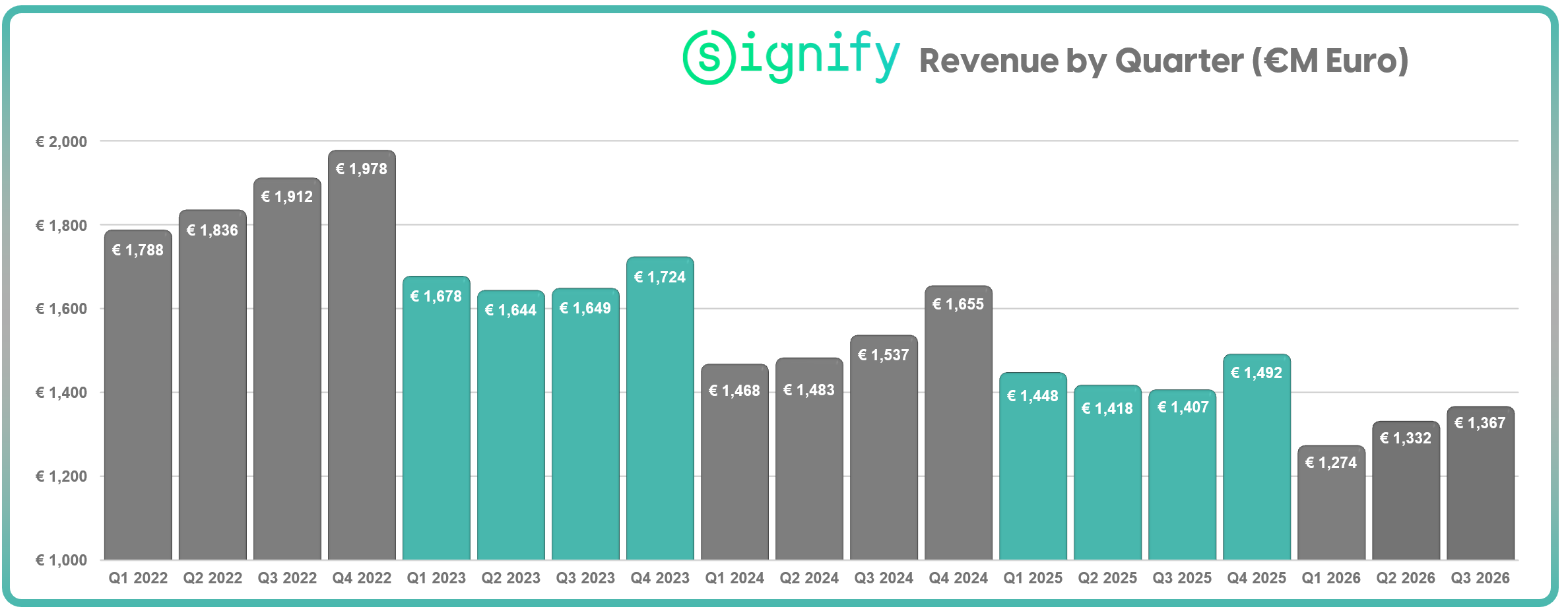
Signify’s third-quarter sales were €1.37 billion ($1.53 billion), down 2.9% from a year earlier, or 3.4% once currency swings and acquisitions are set aside.
The refund figure is also what remained after Signify shared some of the money. The company said it first deducted settlements with suppliers, credits to customers and related employee bonuses, and it did not say how large the refund was before those deductions. It has not said which customers received credits or whether North American distributors were among them, a question many of our readers have a direct financial interest in. Signify said much of the refund process is complete but did not say whether more money is coming.
The full-year forecast reflects the gap. Counting the refunds, Signify expects its profit margin to finish near the top of its 7.5% to 8.5% target range. Without them, it expects the bottom, which means the business itself is running at the low end of what management promised. For the fourth quarter, Signify expects sales to decline at about the same pace as the third quarter’s 3.4% drop, or slightly faster.

Resilient in September, Softening by December
Signify’s Professional business, which includes its commercial lighting operations, posted €921 million ($1.03 billion) in sales, down 1.5% once currency swings are set aside. The company said U.S. project work held up, while stock-and-flow business, the everyday volume that moves through distribution, stayed soft in most markets. Signify also said prices rose across all of its businesses, which helped protect margins as material costs climbed.
The division’s profit looks better on paper than underneath. Professional reported €115 million ($129 million) in operating profit, up from €97 million ($109 million), but Signify credited part of that improvement to the tariff refund. By our calculation, the refund accounted for roughly €18 million ($20 million), which leaves Professional’s underlying profit essentially flat.
The softening warning concerns the months ahead; U.S. project numbers held up this quarter. But project work has been the dependable engine in Signify’s North American story, and it was the bright spot we highlighted after the second quarter. For agents and distributors, project softness usually shows up first in quoting activity and specification volume, well before it reaches anyone’s sales figures. The release does not say whether Signify is seeing slower releases, thinner backlogs or tighter bid pricing.
Genlyte Gets a Rare Shout Out
Genlyte Solutions, the North American business behind brands such as Lightolier, Day-Brite and Gardco, rarely appears by name in Signify’s quarterly reports. This time it showed up in CEO As Tempelman’s opening statement in the release, which credited Genlyte and Signify’s OEM components business with “delivering improved profitability.”
Genlyte came up again within the first three minutes of Tempelman’s remarks on this morning’s earnings call, where he described the work there as “simplifying product portfolio” and “reducing SKUs.” That points to at least one source of the improvement, a leaner catalog, which agents and distributors carrying Genlyte brands will want to watch closely.
Signify did not say what that means for Genlyte. It could mean a higher profit margin, more profit in absolute terms, or both, and the company provided no Genlyte sales or profit figures to settle the question. Genlyte is not reported separately; its results sit inside the Professional business, where sales fell and stock-and-flow volume stayed soft. More profitable is not the same as growing, and nothing in the release says Genlyte grew. And because Professional’s underlying profit was flat, any Genlyte improvement means either another part of Professional lost ground or Genlyte’s gain was too small to show up in the totals.
OEM in Focus
OEM, the other business under the rebuilding moniker, came with numbers. Its sales fell 5.5% to €88 million ($99 million), while operating profit rose to €5 million ($5.6 million) from €4 million ($4.5 million), lifting its margin to 5.9% from 4.7% and beating the 4.2% analysts expected. On the earnings call, Tempelman cited OEM improvents in all global regions with U.S. and Europe cited specifically.
Signify groups both Genlyte and OEM in what it calls its Harvest portfolio, businesses it is managing for turnaround and profit, while growth spending goes to Build businesses such as India and Consumer. For the agents, distributors and specifiers who carry Genlyte brands that label is useful context for where Signify’s priorities lie.
Commissions Up, Headcount Down
One cost item deserves attention from the rep community. Signify said its cost-cutting program saved €37 million ($41 million) in the quarter, yet its overhead still rose €12 million ($13 million) to €451 million ($505 million). Among the reasons it gave were higher commissions and more spending on advertising and promotion. Commissions went up in a quarter when total sales went down 2.9%, and Signify did not explain why. Is more of its U.S. project work flowing through independent reps, or is something else at work, such as changes in incentive plans or other channels? The release does not say, and it is a fair question to put to the company.
Headcount kept falling. Signify ended September with 24,961 employees, measured as full-time equivalents, down 3,103, or about 11%, from a year earlier, and roughly 900 fewer than at the end of June. The company tied the decline to reduced factory staffing as production volumes fell, along with the cost-cutting program announced in January.
The questions that matter most on this side of the Atlantic: how large the refund was before Signify shared it, whether more refunds are coming, and what Signify is seeing in U.S. projects now that it was not seeing in September. Full-year results arrive February 5, when the underlying business will be easier to judge on its own.