October 21, 2026
Acuity Still Leads Lighting. Lighting No Longer Leads Acuity.
Lighting still delivers the profits, but Intelligent Spaces increasingly commands the investment and ambition
In July 2021, Acuity Brands, Inc. spent a striking share of a three-hour virtual Investor Day on a business unit that produced about 6% of company sales. We noticed. Our lead takeaway that day was “Watch Out for the 6-Percenters,” a bet that the newly carved-out Intelligent Spaces Group would get a disproportionate share of Acuity’s money, attention and acquisitions.
Five years later, the corporate identity itself has changed: in March 2025, Acuity Brands, Inc. officially dropped "Brands" to become Acuity Inc., signaling its broader posture as an industrial tech company. Today, the 6-percenters are closing in on a quarter of the overall business. Acuity Inc. reported fiscal 2026 net sales of $4.64 billion on October 1. Acuity Intelligent Spaces (AIS) reported segment sales of $1.11 billion, or 23.6% of segment sales, up from 5.5% in fiscal 2021. Acuity Brands Lighting (ABL) is still the largest lighting manufacturer in North America, and it still generates most of the money. It just no longer generates most of the story.
One Baseline, Five Years
Fiscal 2021 makes a clean yardstick. It was Neil Ashe’s first full fiscal year as CEO and the year Acuity began reporting the two segments. Hold it against fiscal 2026 and the shape of the company has changed almost everywhere you look.
How Acuity Made Money in 2021
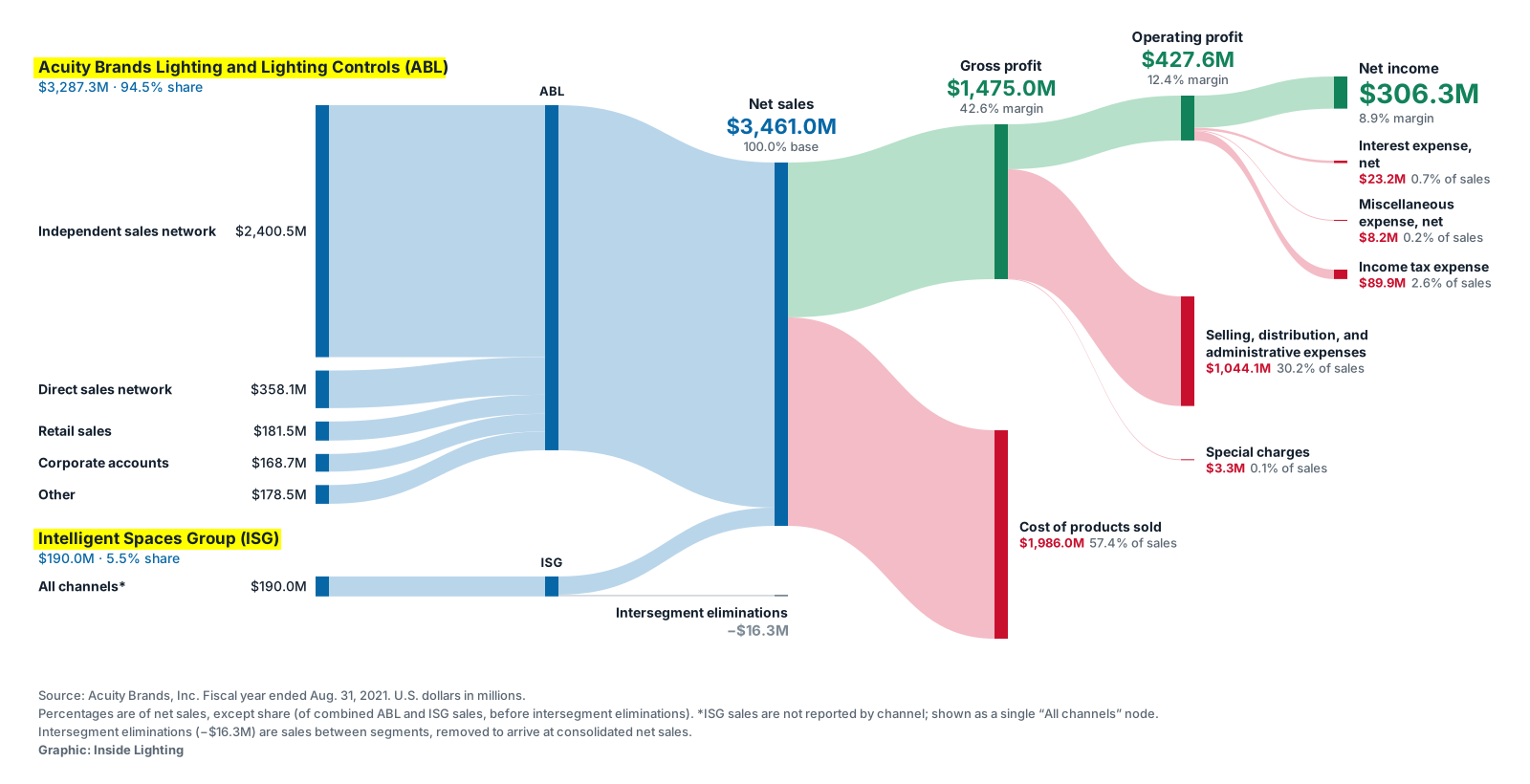
Back in 2021: Acuity was almost entirely a lighting company. Intelligent Spaces was just a $190 million sliver of the $3.46 billion pie, and gross margins were sitting at 42.6%.
How Acuity Made Money in FY 2026
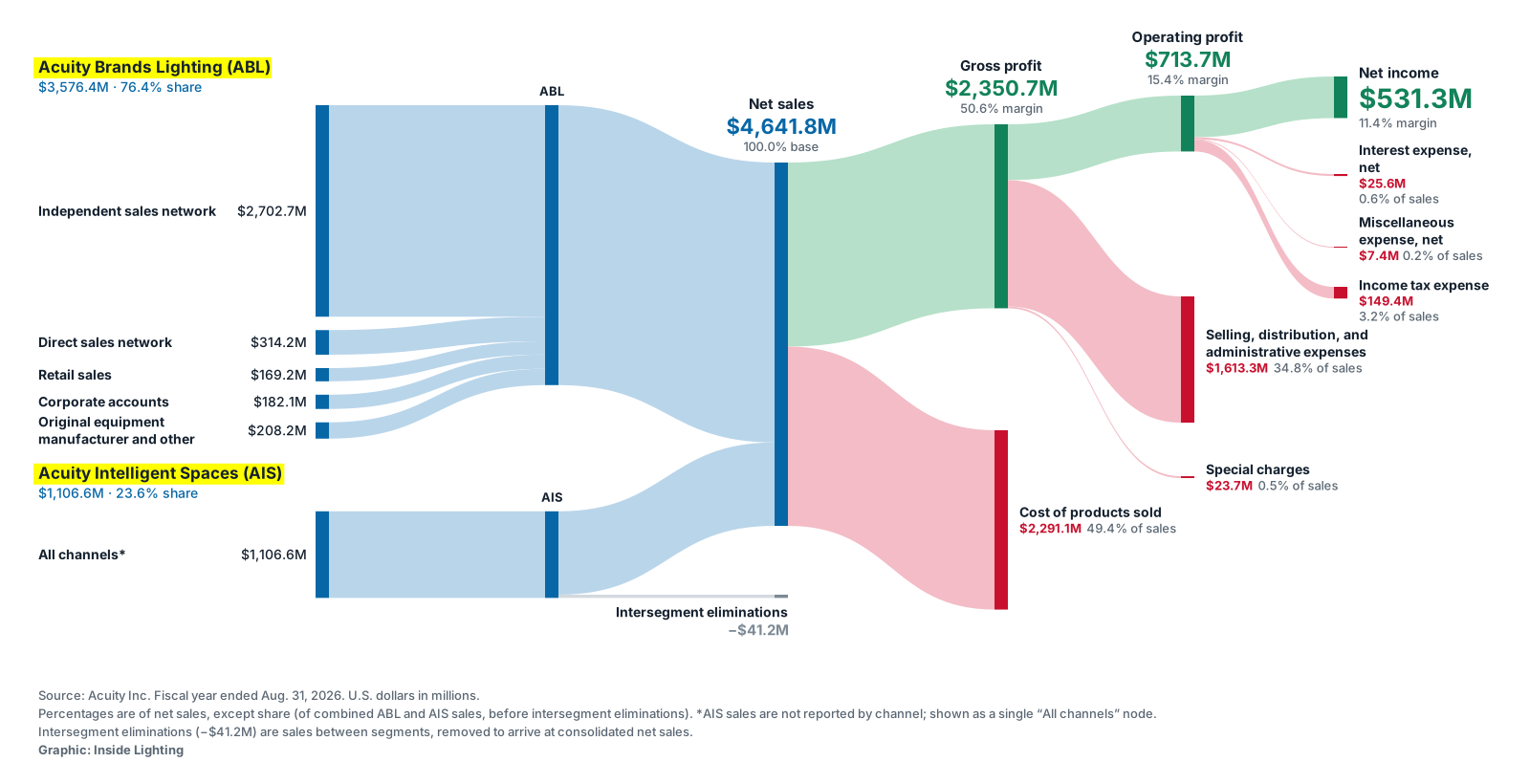
Fast forward five years: total revenue hit $4.64 billion, with Intelligent Spaces expanding to $1.11 billion. Higher margins (50.6%) and higher overhead (34.8%) reflect, in part, a company selling far more software and AV.
From 2021 to 2026 total sales rose 34%, from $3.46 billion to $4.64 billion. Lighting sales rose 8.8%, from $3.29 billion to $3.58 billion, or about 1.7% a year. Intelligent Spaces went from $190.0 million to $1.11 billion, nearly six times as large. Gross margin climbed from 42.6% to 50.6%, while selling, distribution and administrative expenses rose from 30.2% to 34.8% of sales. Net income rose 73% to $531.3 million.
Both the fiscal 2026 margin and the profit figure include $44.9 million in fourth-quarter tariff refunds, which Acuity strips out of its adjusted results. Higher gross margins paired with heavier overhead partly reflect a company selling more software, controls and AV alongside its fixtures. Amortization of QSC’s acquired intangibles also adds to overhead, and ABL’s own pricing and productivity work lifted gross margin.

We Called the Destination, Not the Route
Honesty requires a footnote to our own 2021 call. By June 2022, we were writing that Intelligent Spaces had not delivered substantial growth and was still only about 5.5% of revenue. Distech Controls and Atrius grew steadily after that, but most of the climb from roughly 7.6% of sales in fiscal 2024 to about 24% today came from a single check.
That check went to QSC, the Costa Mesa, California audio, video and control company Acuity bought for $1.215 billion, the largest deal in its history, which closed January 1, 2025. QSC contributed $428.6 million in its first eight months. QSC president Jatan Shah told the Orange County Business Journal at the NAMM Show in January that Acuity bought the company for “our talent, our people, our technology.” Organic growth in Intelligent Spaces has been respectable. The transformation itself was purchased.
Everyone Else Sold the Lighting
What makes Acuity unusual is its direction of travel. Over the past decade, the big diversified electrical names left lighting by selling it, and Acuity was the buyer in one instance. Schneider Electric went first, selling Juno Lighting Group to Acuity in 2015. General Electric sold Current, its commercial luminaire and lamp business, to private equity firm American Industrial Partners in 2019, then sold its consumer bulb business to Savant Systems in 2020. Eaton sold its lighting division to Signify in 2020. Hubbell sold its commercial and industrial lighting business in 2022 to Current, owned by American Industrial Partners, and finished leaving in 2024 by selling Progress Lighting, its residential brand, to Kingswood Capital Management.
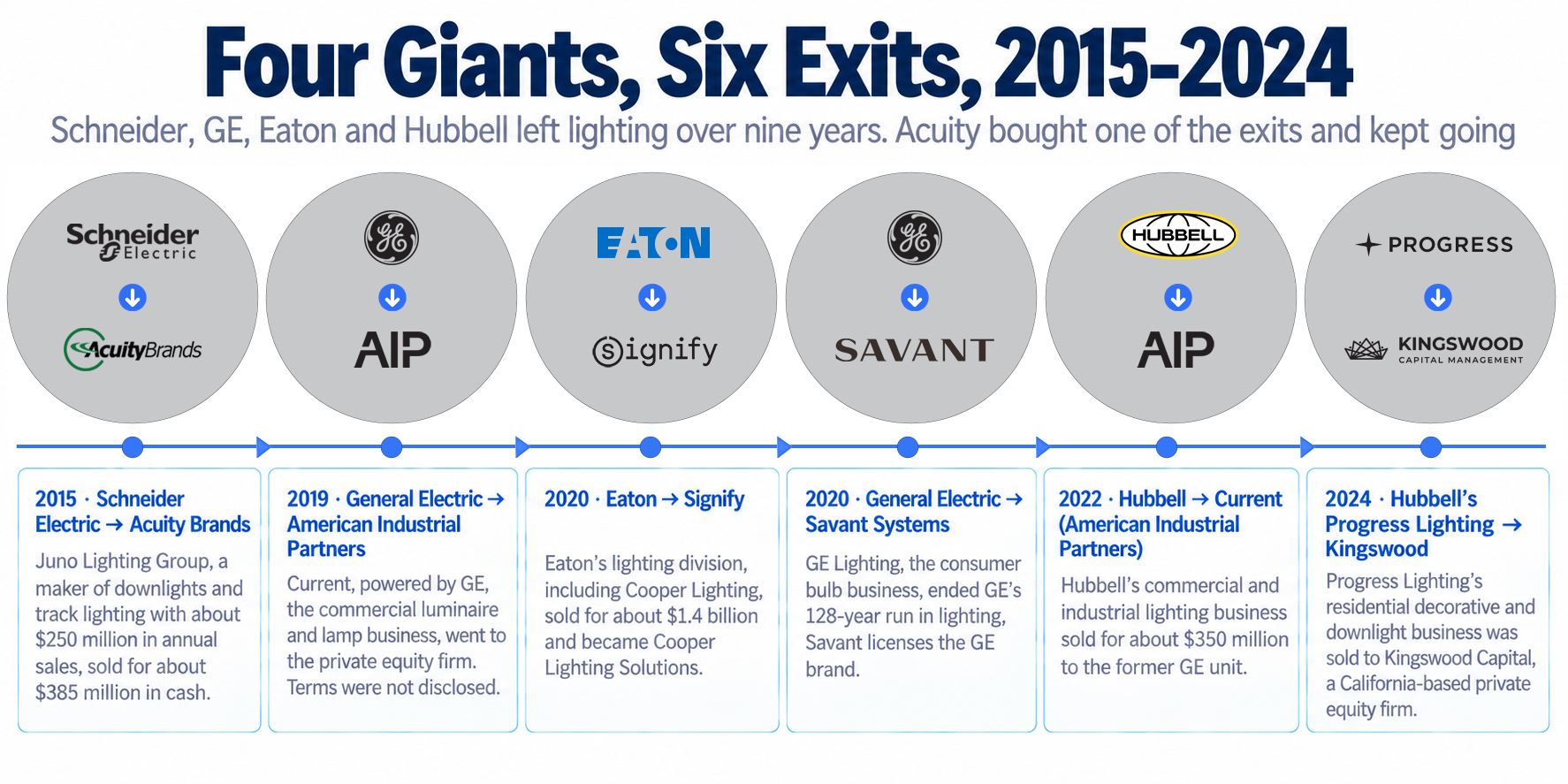
The building-technology giants, meanwhile, now mostly stay out of luminaires. Legrand is a notable exception.
Siemens, Honeywell and Schneider compete in controls and automation, the tier Acuity now wants to join. Acuity is attempting the trip from the opposite side, keeping the fixture business, including the Juno downlights Schneider let go, and building an automation business on top of it. The September 2025 opening of a digital center in Cork, Ireland, and the recent hire of former Siemens, Hubbell and GE executive Ruth Gratzke to run ABL both fit that pattern, in our reading.
Scale keeps the comparison honest. At $1.1 billion a year, Intelligent Spaces is a meaningful business and a modest competitor in automation. Acuity is a large lighting company and a small building-technology company, and it will remain both for some time.
Lighting Pays the Bills
None of this means Acuity is walking away from lighting. On the October 1 call, Ashe called the lighting business “incredibly durable” and said it is essential to every built space. The numbers support him on profit, if not on growth. ABL produced $646.0 million in adjusted operating profit in fiscal 2026 at an 18.1% margin, about 72% of segment profit. Operating cash flow of $825.6 million helped Acuity pay down two-thirds of its QSC borrowings in cash and refinance the rest.
The less flattering read is volume. Lighting sales grew 8.8% over five years that included several price increases and cumulative inflation of roughly 20%. By our math, the lighting segment likely sold fewer units in real terms than it did in 2021. Ashe says ABL is taking share. If so, the overall market shrank faster than Acuity’s slice of it, which also seems accurate.
For rep agencies, one shift stands out. Sales through the independent sales network rose from $2.40 billion to $2.70 billion, growing from 73.0% to 75.6% of lighting sales, while the direct sales network fell from $358.1 million to $314.2 million. As Acuity’s attention drifts toward Spaces, its lighting business leans harder on agents than it did five years ago.
What Lighting People Should Watch
Acuity’s fiscal 2027 guidance assumes flat to low-single-digit growth for ABL and low- to mid-teens growth for Intelligent Spaces, which again places nearly all the growth on the 6-percenters’ side of the ledger. William Blair downgraded the stock in late September, arguing that a stalled lighting core still caps the company until Spaces is large enough to carry it.
At Intelligent Spaces’ guided pace and a flat ABL, Spaces would need roughly four more years to reach a third of sales without another large acquisition. Ashe has repeatedly said the deal pipeline targets Intelligent Spaces, and every signal points to controls, software and AV, not the next tape-light or wall-pack maker.
The exits are the backdrop, not the story. Schneider, GE, Eaton and Hubbell each looked at lighting and decided it belonged in someone else’s portfolio. Acuity looked at the same business and made the opposite call.
Its bet is that the fixture business can finance a much larger technology company without surrendering its lead in lighting. Fiscal 2026 shows the financing half is working. The leadership half doesn't appear vulnerable, but it is the one lighting people will continue to watch.