


August 27, 2026
Winners and Losers of the U.S. - Canada Tariff War
Our excruciating analysis reveals which lighting stakeholders face the most disruption and cost
A linear fixture assembled in Ontario and a competitor's "or equal" twin assembled in New Jersey have competed on price, performance and lead time for decades. Now, they compete on one more thing: which side of the border they were built on.
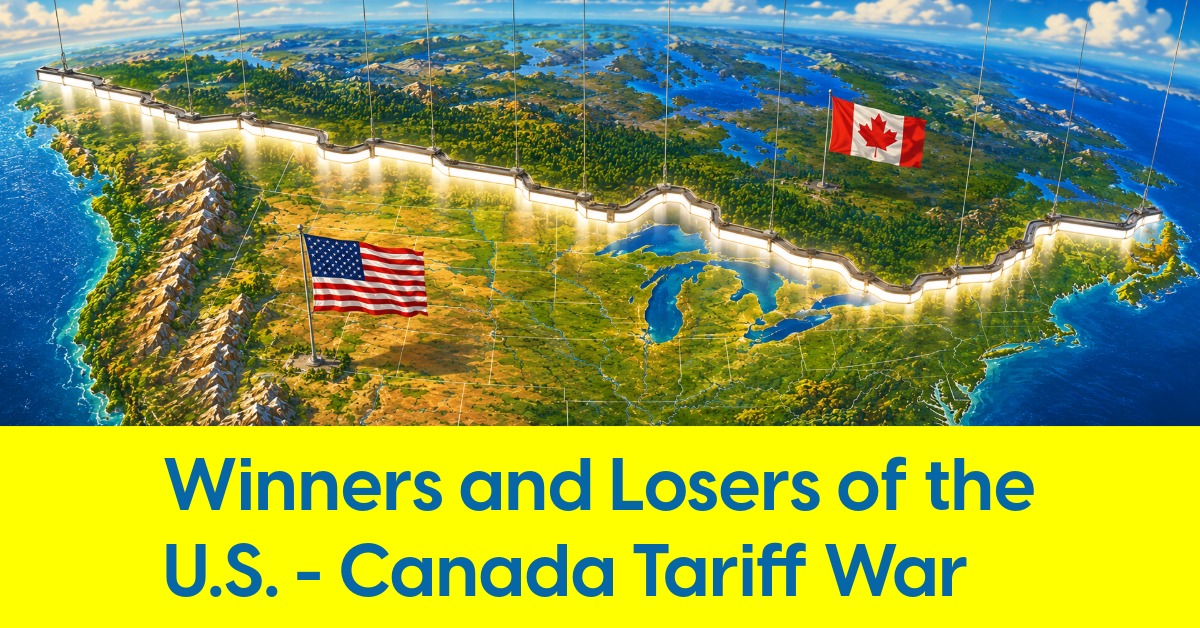
Here's the mechanism: Section 338 tariffs put a 50% duty on Canadian-made fixtures entering the U.S., effective August 22. Canada's countermeasures, effective September 8, mirror it dollar for dollar, a 50% duty on U.S.-made fixtures entering Canada. Same rate, same product category, opposite directions, two and a half weeks apart. The schedule doesn't ask who owns the brand or where the company is headquartered. It asks one question: where was this fixture built.
That question, not the tariff rate, is what actually separates this industry's winners from its losers. The more useful lens here is maneuverability, not exposure. Some stakeholders can shift a factory, swap a supplier, or requote a job within weeks. Others are locked into decisions made years ago and can't undo them before the next invoice comes due.
This piece stays inside commercial lighting, though the same 50% logic now reaches other building materials like windows, doors, furniture and flooring, too.

Origin, Not Ownership
Both tariffs run on country of origin, not corporate nationality, and that complicates the easy read. A U.S. lighting company importing fixtures made in China into Canada isn't shielded just because the company is American.
A Canadian-owned manufacturer building product in Mexico isn't automatically penalized just because the ownership is Canadian. What matters is the fixture’s country of origin under the applicable customs rules. That question is about to carry more weight in spec and procurement than a logo or a headquarters address ever did.
Who Can't Escape This: Most Impacted Stakeholders
Six stakeholders sit closest to the blast radius, and for a specific reason: none of them can fully route around the tariff on short notice.
Exposure isn't uniform across manufacturers, and footprint is doing a lot of the explaining.
- Acuity Brands Lighting sourced 57% of its finished goods from Mexico in fiscal 2025. The company still builds Eureka fixtures out of the former TLG factory in Quebec, but that Canadian production sits within a much broader manufacturing network spanning Mexico and the U.S.
- Signify's Canadian operations include Lumec and Ledalite, running alongside its U.S. and Mexico plants.
- LMPG's brand family spans the border on its own: Lumenpulse out of Montreal and Fluxwerx in British Columbia on one side, Sternberg in Illinois and Vode and ALW in Northern California on the other.
- Lumenwerx, a Montreal-based manufacturer with reported shipments over $100 million, most of it believed to reach U.S. customers, fits that description. So do Beta Calco and 3G Lighting, both based in the GTA. All three look like companies whose growth has depended on a market they can't build into duty-free.
- Axis Lighting's acquisition of tiny Picasso Lighting in New Jersey last year gives it a domestic U.S. manufacturing option it didn't have before. But shifting meaningful production across the border is no quick pivot; tooling, specialized equipment and manufacturing expertise take time to relocate and ramp up.
None of these setups is a verdict on any one company's strategy. It's a reminder that "cross-border manufacturer" describes a spectrum, not a single condition, and where a company sits on it now matters more than it did in July.
Specifiers and owners land on the same table for a reason but sit at different rows for another: one group manages the disruption, the other pays for it. Owners bear the largest aggregate cost across a project.
A single cross-border manufacturer, meanwhile, can face something closer to an existential threat if a large share of its revenue runs the wrong direction across the border. Scale and survivability are different measures, and this table tracks both.
The Rest of the Scorecard
None of this should read as an endorsement of the winning side. A tariff-advantaged position is a market condition, not a merit badge, and it can reverse as quickly as it appeared.
Where It's Actually Made
Every fixture spec sheet is about to get a new line item that has nothing to do with delivered lumens, CRI, or wattage: country of origin. Two governments spent recent weeks building tariff walls meant to protect their own interests. Yet other options in Monterrey or Shenzhen could possibly undercut the American option and the Canadian one at the same time.
That's the outcome nobody wrote into an executive order. For lighting people sourcing from across North America, the practical fallout is that origin verification just became as central to procurement as photometrics. The industry didn't ask for this. It's getting it anyway.