


July 2, 2026
When Streetlight Lab Performance Meets Reality
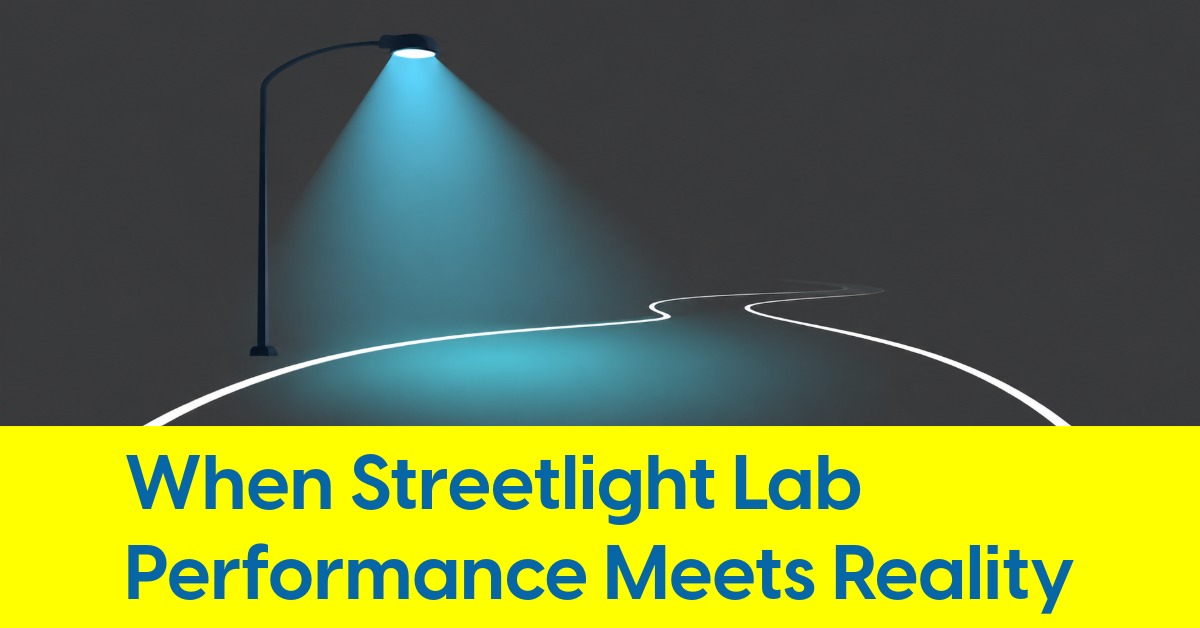
Cooler LEDs deliver promising lab results, but real-world adoption is more complicated
A blue-green LED and a standard streetlight can deliver the same visual brightness at night while pulling very different amounts of power from the grid. That is the premise behind a new study out of Warsaw University of Technology, and it is the kind of claim that tends to get attention in a market still chasing every available point of energy savings: up to 20% to 30% less electricity for the same roadway, just by changing the color of the light.
It is also a claim the people who write America's roadway lighting standard have already considered, and quietly declined to act on. And it points the industry toward exactly the wavelengths that a separate, vocal set of constituencies has spent the last decade trying to push roadway lighting away from.

The researchers tested six LED colors, from blue-green to amber, under conditions that mimic how the human eye actually behaves at night. In low light, eyes shift sensitivity toward shorter wavelengths, the reason a dim parking lot can make a green exit sign pop while a red one fades. Exploit that shift with the right colored light, the study argues, and a road could be lit to the same effective brightness using meaningfully less wattage.
The standout performer was a blue-green wavelength that, by the study's own measure, was more than ten times as efficient at low light levels as the warm white LEDs increasingly common on American streets.
RP-8 Has Already Heard This One
ANSI/IES RP-8-18, the governing U.S. standard, is not ignorant of this science. It addresses how human night vision shifts at low light levels in some detail. The committee read the same research this new paper builds on. It came down on the side of caution anyway, concluding that drivers moving at typical roadway speeds are lit and adapted closely enough to daytime vision that the standard's existing calculations should hold, color tricks aside.
That is not a dismissal. It is a standards body declining to bless something it has not yet seen proven safe.
The Fight This Study Doesn't Mention
Here is what lighting people will clock immediately, even if the paper never raises it: the most efficient wavelengths in this study, 495 to 520 nanometers, sit on the blue-green end of the spectrum, exactly where a decade of dark-sky advocacy, environmental groups, traffic engineers and public health voices have told municipalities to stop pointing their outdoor lighting.
The American Medical Association's 2016 guidance on outdoor lighting specifically warned against high-CCT, blue-rich LED streetlights, citing concerns about glare, circadian disruption, and melatonin suppression, and recommended municipalities favor warmer color temperatures of 3000K or below. Dark-sky organizations have made the same argument from a different angle: shorter wavelengths scatter more in the atmosphere, contributing disproportionately to sky glow, which is why most dark-sky-compliant ordinances cap CCT well below what blue-green LEDs would require. Environmental researchers, separately, have flagged blue-heavy light as more disruptive to nocturnal wildlife than warmer alternatives.
None of that appears in the Warsaw paper, and RP-8 doesn’t relitigate it either. But any municipality, utility, or DOT reading this energy-savings number has to clear that hurdle before installation, not after. A 20% reduction in kilowatt-hours is not going to carry much weight in front of a planning commission that adopted a dark-sky ordinance five years ago, or a constituency already primed to associate blue-rich streetlighting with health concerns the AMA itself put in writing.
This distinction also matters to traffic engineers who judge roadway lighting by how well it helps drivers detect hazards, not simply by how efficiently it produces light.
What the Study Didn't Test
The energy numbers come from a lab, not a road. The paper does not address glare, how evenly the light spreads across pavement, or how well a driver can read contrast between a road surface and an obstacle. Notably absent is Small Target Visibility, the metric RP-8 actually leans on to judge whether a given lighting setup helps a driver spot trouble in time to react.
The researchers acknowledge as much. Their own writeup flags this as a first step, with real-world testing, glare, and driver perception left for later work. One of the most efficient options they tested also came with a noticeable greenish cast, the kind of thing that reads fine in a spectroradiometer and less fine to a driver's eye, let alone a planning board already skeptical of blue-rich light.
What This Means Going Forward
The gap between a promising lab result and a standard practitioners can specify with confidence runs through more than visibility testing. It runs through every dark-sky ordinance, every AMA-citing public health argument, safety considerations and every wildlife advocacy group that has spent years steering outdoor lighting in the opposite direction from where this paper's best numbers live.