


June 9, 2026
At NeoCon, Lighting Gets a Seat at the Table
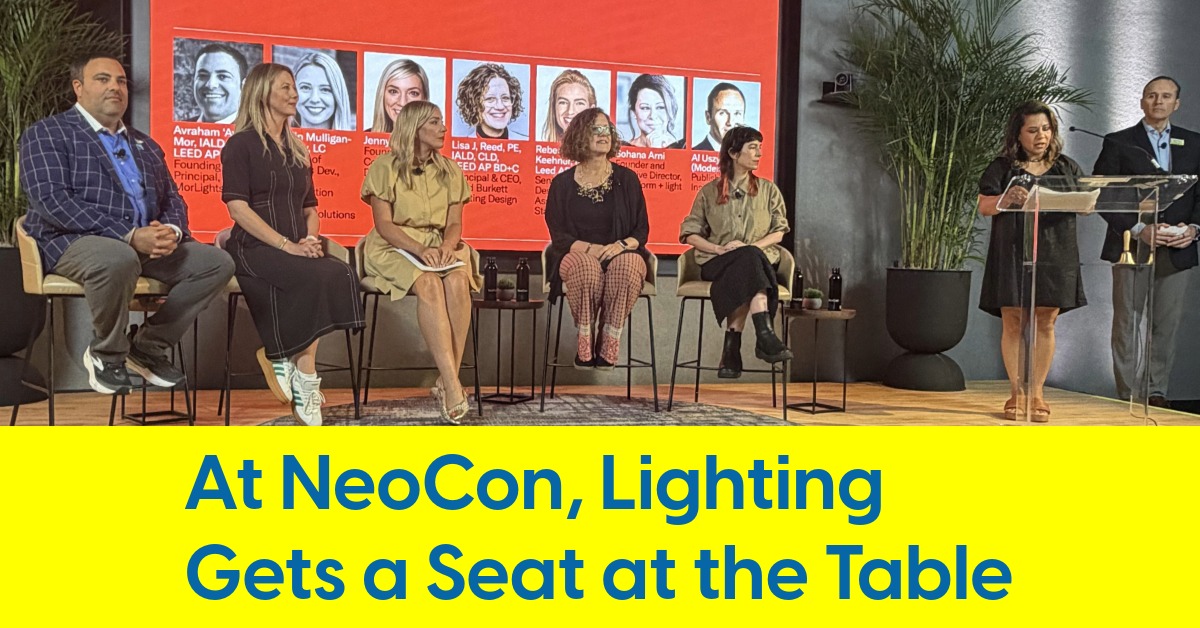
Photo Credit: Stella Lambrecht
Illuminate elevates lighting's role in the commercial interiors conversation
NeoCon has long been a destination for commercial interiors professionals. Lighting was part of the mix, but seldom a main attraction.
Manufacturers with showrooms on The Mart's upper floors, product launches designed for the contract interiors crowd, a few lighting companies mixed in among the seating, surfaces, and material vendors. For years, that arrangement suited everyone well enough.
This year’s Chicago event felt different. NeoCon launched Illuminate, a dedicated lighting section designed not as a revenue line or an afterthought but as a genuine architectural argument: that light belongs in the same conversation as the materials, the furnishings, and the ceiling heights it ultimately reveals. We've been covering lighting long enough to notice when a show starts treating the subject like it matters. Illuminate was a meaningful step.
Sohana Arni, of line + form + light and lighting strategy consultant to The Mart for the Illuminate initiative, opened Monday afternoon's session "Lighting that Shapes Design" with a direct claim: "Lighting shapes how people feel, focus, work, gather, and connect in space."
That framing carried over to the panel discussion. Moderated by Al Uszynski, publisher of Inside Lighting, the program brought together two architectural lighting designers, a commercial interior designer, a workplace strategist, and a manufacturer's rep for an hour-long conversation that produced more candor than a typical conference session tends to allow.
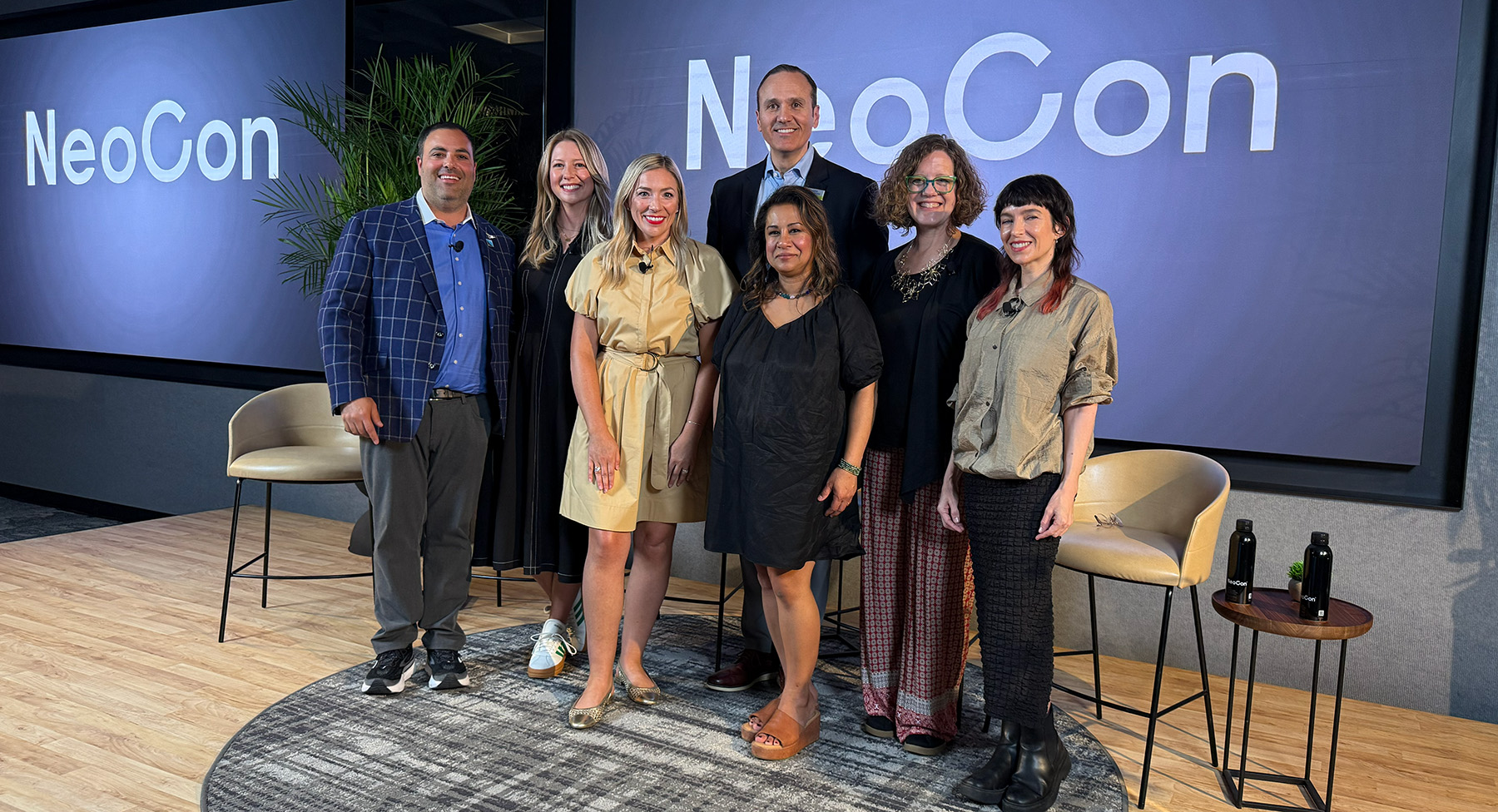
"Lighting that Shapes Design" during Illuminate at NeoCon.
Left to right: Avi Mor, Caitlin Mulligan, Jenny West, Al Uszynski, Sohana Arni, Lisa Reed, and Rebecca Keehner.
Takeaway #1: Early Is Better, and Design Stakeholders Know It
The panel's most consistent refrain was also its most practical one: lighting decisions made late in a project are harder to execute, harder to defend, and more likely to be compromised. The structural argument, made by Rebecca Keehner, a senior interior designer with Stantec, was that the design team's real unit is a triad. "The interior designer, the lighting designer, and electrical," she said, "they're going to have some overlap, and the lighting designer is a bridge of the technical knowledge to make the design that the interior designer conceives of to be executed in a technically excellent way."
That bridge metaphor did a lot of work. Without a dedicated lighting designer, Keehner suggested, the interior designer and the electrical engineer end up covering for each other across a shared gap, each slightly outside their area of deepest competence. It isn't necessarily a disaster, but it tends to produce a cloud of slight inefficiency, as she put it, where no one is fully wrong and nothing is fully right.

Avi Mor, founding principal of MorLights and a former president of the Chicago IES section, made the point more bluntly. Someone, he noted, is always making the lighting decisions. "Is it going to be the architect, the engineer, the rep agency, the owner, the manufacturer? Somebody has to manage it." The question isn't whether lighting gets designed. It's whether it gets designed with the attention the rest of the project receives.
Takeaway #2: Lighting Is About More Than Visibility
Lisa Reed, principal and CEO of Reed Burkett Lighting Design, framed the wellness question with unusual precision. "It's about an experience," she said, "and it's about creating that emotion." Reed's benchmark isn't foot candles or uniformity ratios. It's whether occupants physically relax when they enter a space her firm has designed.
That's an ambitious standard, and not one you hear often at industry events. Reed also identified two fundamentals she worried the wellness conversation was skipping past: glare and flicker. Both affect how people feel in a space, often in ways they can't name. Imperceptible flicker, she noted, is real, measurable, and worth designing around even when clients don't ask about it.
Jenny West, a Gensler-pedigreed designer turned founder of West Consulting and a workplace strategist, connected the same fundamentals to neurodiversity. "Tunable colored lighting can be very comforting when you have sensory overwhelm," she said. West works regularly with neurodivergent populations and brought a less familiar angle to a conversation that can otherwise stay inside the experience economy.
Takeaway #3: Good Lighting Has a Dollar Value
West reframed the client conversation in terms that tend to land better with building owners and developers than any aesthetic argument. "Instead of asking what's this going to cost me for good lighting, I would flip that and reframe it," she said. "What is poor lighting already costing you?" Absenteeism. Workers choosing remote arrangements over poorly lit offices. Tenants who leave. Patients who rate their experiences lower.
Caitlin Mulligan, a manufacturer's rep with SCI Lighting Solutions which works across thousands of commercial projects annually, applied the same logic to leasing value. "You're going to be able to lease multifamily for a higher cost if your amenity spaces and your corridors are a little bit nicer and thoughtful," she said, "and for office spaces, you're going to be able to get a higher cost per square foot lease price if there's a little bit more intention with the lighting." That language, cost per square foot and patient satisfaction scores, is the vocabulary that moves budgets. West put a finer point on it: end users, she observed, are not buying lumens. They're buying outcomes.
Takeaway #4: Wellness Starts With the Basics
The panel was notably restrained about circadian lighting as a concept. The discussion didn't reach for it as a centerpiece. Instead it returned repeatedly to glare, flicker, personal control, daylight access, and color consistency maintained through the building's full life cycle. That's a more grounded conversation, and more useful for the commercial practitioners in the room.
Keehner raised a point that often gets dropped from the wellness discussion: what happens after the project closes. "It's a full life cycle of the design to maintaining the building," she said. Facilities teams that swap out specified lamps for whatever's cheapest produce color temperature drift that can undo years of careful design work. The lighting designer's responsibility, in her view, extends to communicating with facilities staff in advance, not just handing over a spec sheet.
Mor, building on the same point, argued that the nature-connection argument for dynamic lighting doesn't require an oversized budget with current LED and controls technology. "It's really straightforward," he said. A hospital project he described offered the clearest example: his firm looked at a floor of patient waiting rooms laid out with four fluorescent fixtures each, asked what activities actually happened there, and cut the fixture count in half. No dramatic intervention. One question.
Looking Ahead
Near the start of the session, we took an informal show of hands from the audience. First question: how many people in the room were interior designers? Close to half raised their hands. Second question, to that same group: how many had worked with an architectural lighting designer on a commercial project in the last twelve months? The hands dropped to a small fraction.
The panel wasn't convened as a sales pitch for the lighting design profession. But that moment did more to frame the conversation's stakes than any single answer from the stage. The designers in that room were not uninformed or indifferent. They were the exact audience the industry needs to reach, and most of them had spent the previous year making lighting decisions without a dedicated lighting specialist at the table.
Whether Illuminate becomes a fixture at NeoCon or simply a well-timed opening bid, that gap is the real subject. The conversation on Monday moved it forward. Whether the profession closes it is a different question entirely.