


April 29, 2026
Museum Designers Reframe the Meaning of Good Light
The 12 factors driving museum lighting choices after LED adoption
Even during the lighting industry’s lumens-per-watt obsession, museum lighting has long been aimed at priorities beyond efficiency.
A new study published in LEUKOS, the journal of the Illuminating Engineering Society, offers the first comprehensive look at U.S. museum lighting practice since LEDs were still novelties in gallery cases. Researchers from Pennsylvania State University and Virginia Tech surveyed 54 professionals across the country, and their findings confirm something the lighting industry should probably absorb beyond the museum walls: when a technology matures, the conversation shifts from adoption to judgment.

LEDs Won. Now What?
The LED headline is real but unremarkable. Survey respondents reported that LEDs account for roughly 73 percent of primary light sources in their institutions. The transition is, for most practical purposes, complete. More interesting is what persists at the margins: halogen and incandescent sources still represent about 10 percent of museum lighting, and daylight accounts for 12 percent on average, with wide variability. Legacy preferences, fixture constraints, and the irreplaceable qualities of natural light have not entirely yielded to solid-state efficiency.
That is a texture worth noting. Post-conversion does not mean monolithic.
The Fixture Schedule Priority Stack
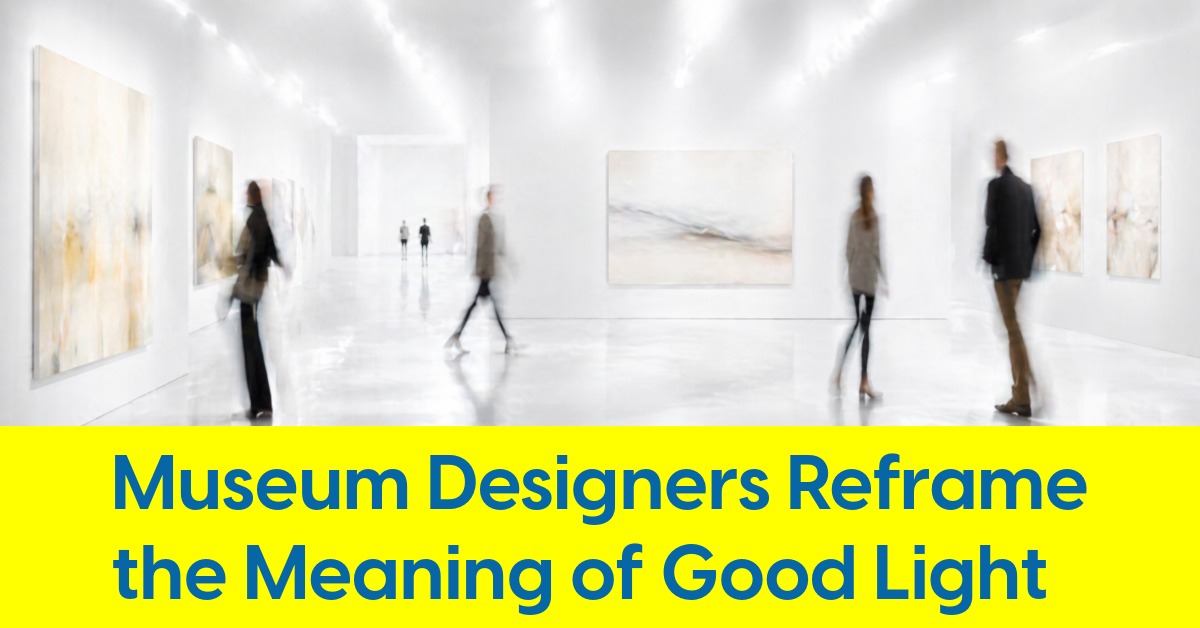
Here is the finding that should travel beyond museum corridors. When researchers asked practitioners to identify the factors driving lamp selection, damage potential from ultraviolet, infrared, and short-wavelength radiation ranked first, cited by 83 percent of respondents. Initial cost came next at 80 percent, followed by correlated color temperature at 78 percent and dimming capability at 74 percent. Efficacy, the metric that defined the LED era's first chapter, ranked lower at 63 percent.
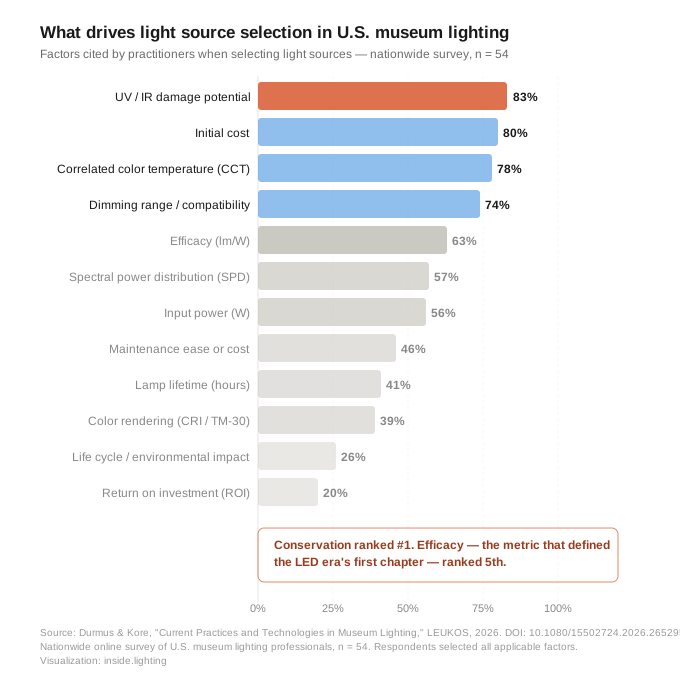
In institutions where replacing older technology with LEDs already guarantees energy savings, the question of what light does to a Caravaggio canvas matters more than how much electricity it consumes. The efficiency argument, powerful when the comparison was LED versus halogen, weakens when both options on the table are LEDs.
A Standards Patchwork No One Has Solved
The survey found that ANSI/IES RP-30 is the dominant guideline, cited by 72 percent of respondents. CIE 157 and Canadian Conservation Institute guidance each drew considerably lower adoption rates. Many institutions described relying on loan agreements, on-site conservator expertise, and foundational conservation texts assembled into institution-specific frameworks.
Formal standards provide the baseline. What fills the gap is improvised.
For specifiers working in premium commercial, hospitality, and cultural projects, the museum context offers an early signal. When energy efficiency becomes assumed rather than achieved, quality of light, spectral control, and conservation outcomes move to the front of the brief. The debate over what those terms mean, and how to measure them, is just beginning.
LED adoption may be settled. What constitutes good light clearly is not.