


April 25, 2026
5 Things to Know: April 25
Signify keeps it corporate machinery humming. Plus, a reverse takeover brings niche lighting company to the stock exchange.
Here's a roundup of some of the week's happenings curated to help lighting people stay informed.
1. Signify Maintains Course with Key Corporate Updates
Signify’s first-quarter earnings may have owned the Friday spotlight, but another real story occurred signaling control and consistency.
At its Annual General Meeting in Eindhoven, shareholders approved every proposal on the table. That included a €1.57 per share dividend tied to 2025 performance, along with board continuity through the reappointment of Bram Schot and the addition of Barbara Holzapfel and Jeroen Hoencamp. Nothing flashy, nothing contentious. Just a steady hand on governance at a time when the broader lighting market remains anything but steady.
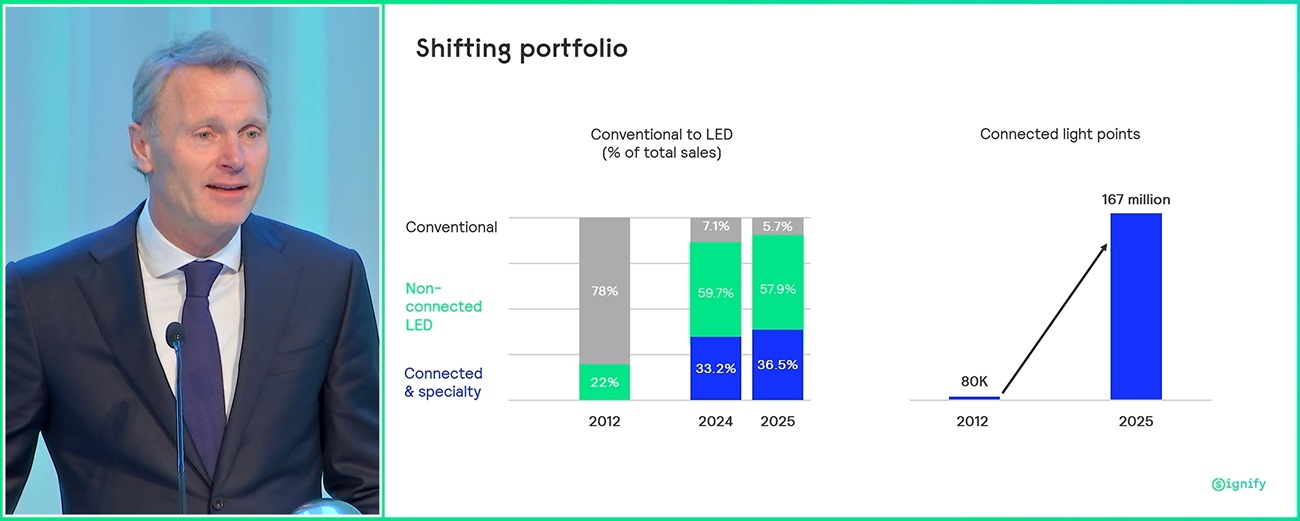
Above: CEO As Tempelman speaks at Signify’s 2026 Annual General Meeting on Friday
Also on April 24, Signify confirmed it had wrapped its latest share repurchase program, buying back 725,000 shares for €13.9 million between mid-February and late April. These shares will be used to meet obligations tied to long-term incentive and employee share plans.
Taken together, the AGM and buyback tell a familiar story. Signify isn’t chasing bold moves right now. It’s reinforcing structure, returning capital, and keeping the machinery running with precision. With its Capital Markets Day occurring in 60 days, we may witness less-routine announcements then.
2. A New Publicly Traded Lighting Company
There’s a new publicly traded lighting company in Canada. And while that sounds impressive, the underlying structure tells a more familiar junior-market story.
The entity called Illumisoft Lighting Corp. didn’t exactly grow into the public markets. It stepped into them by renaming a shell. Gstaad Capital Corp., a capital pool company with no real operations, changed its name and then completed a reverse takeover with Claranova Technologies. The result is straightforward once you strip away the legal choreography: Claranova is the actual business, now operating inside a publicly traded wrapper.
The transaction raised about $6.44 million at $0.30 per share, leaving roughly 46 million shares outstanding and just over 50 million fully diluted. That framing matters. This wasn’t a strategic acquisition or a consolidation play. It was a financing and listing event designed to get a small, early-stage company onto the board quickly.
As for what Ottawa-based Illumisoft actually does, the messaging leans on a hybrid identity: commercial LED lighting paired with UVC air disinfection through its Sanilume platform. There are patents, some early deployments, and a lot of forward-looking language.
Maybe it scales. Maybe it doesn’t. For now, lighting is part of the story, but not the main bet.

3. Audi Ad Sparks DarkSky Backlash
DarkSky has long been a familiar voice to lighting people, typically focused on streetlights, facades, and the slow creep of skyglow. Recently, it turned its attention somewhere less discussed but arguably just as pervasive: vehicle headlights.
In a pointed social media post, the organization criticized an Audi UK commercial titled “Love at First Sight,” which features a moth drawn to bright headlights. DarkSky’s argument is blunt. What’s framed as poetic imagery glosses over a growing body of research linking artificial light to insect population declines. The group used the moment to push a broader message: the auto industry’s fixation on brighter headlights has outpaced consideration of environmental and human impacts. Their call to Audi was direct, urging collaboration on “smarter” headlight design that balances safety with ecological responsibility.
DarkSky Instagram: "DarkSky is calling on Audi to work with us to help steer the industry toward headlight design that improves road safety while protecting the night. Audi, are you in?"
The response online was unfiltered. Commenters described modern LED headlights as “blinding,” with some drivers saying they actively avoid nighttime travel. Others framed the ad as tone-deaf in the context of biodiversity loss. For an industry accustomed to debating lumens and efficacy, the episode is a reminder that public scrutiny is widening, and not always patiently.
4. LED Streetlights Attract Gamers' Attention
In the lead-up to Grand Theft Auto VI, fans are scrutinizing every frame of the trailer, and lighting hasn’t escaped attention.
As reported by GAMES, users have identified the in-game streetlights as highly accurate replicas of real-world LED streetlights, typically rated between 80W and 120W. Side-by-side comparisons suggest Rockstar Games has closely modeled common roadway and parking lot luminaires, reinforcing the franchise’s reputation for environmental detail.
This kind of hyper-specific analysis is nothing new for GTA’s audience, which has been dissecting everything from vehicle design to character behavior since the first trailer dropped. Still, the focus on lighting specs stands out. It highlights both the technical fidelity Rockstar is aiming for and the depth of engagement from its community. Even routine infrastructure like streetlighting is now part of the realism benchmark.
5. Data Center Lighting Gains Attention as AI Loads Rise
According to The Fast Mode, lighting is starting to command more attention inside data centers just as AI workloads push facilities toward thermal and operational limits. While lighting represents only about 3–5% of total energy use, the report notes that even small inefficiencies can compound cooling demands in high-density environments.
According to the report, three trends are shaping this shift. First, lighting is moving from an afterthought to safety-critical infrastructure. Poor visibility, fixture heat, and high-voltage systems can increase risk during maintenance and emergency response, prompting a move toward low-voltage and PoE solutions that improve safety and control.
Second, according to the report, distributed low-voltage systems with remote drivers are gaining ground. By relocating sensitive components outside high-heat zones, these designs improve reliability, extend lifespan, and integrate more easily with smart data center controls, while also reducing installation labor.
Finally, the report points to a more speculative frontier: space-based, solar-powered data centers. While still emerging, the concept reflects a broader shift toward using light not just for illumination, but as part of long-term energy strategy and infrastructure design.