


March 20, 2026
Ex-Employees File Two Class Action Suits Against Cree Lighting
Workers allege five-month furloughs were disguised layoffs breaching federal notice laws
On March 12, Cree Lighting told employees their jobs were ending. By March 19, employees were telling a federal court that the ending had actually happened months earlier.
That gap, just seven days in real time but six months in legal argument, now defines one of the most consequential employment disputes the lighting industry has seen. Two class action lawsuits allege that Cree Lighting’s long furlough was not a pause, but a strategy. And that when layoffs finally came, they arrived with a second, sharper edge: no 60-day warning.
At stake is more than back pay. It is a test of whether companies can stretch the definition of “temporary furlough” long enough to reshape their legal obligations.

Two Lawsuits: Similar Claims, Different Details
We reported last week that Cree Lighting eliminated 172 positions and shut down manufacturing in Racine, with separations beginning immediately on March 13. The company cited the “faltering company” exception under the WARN Act, allowing it to bypass the typical 60-day notice requirement while it pursued financing.
That explanation may now become central evidence.

One of the newly filed lawsuits focuses squarely on that March moment. It alleges that at least 172 employees were terminated with effectively one day’s notice, despite federal and Wisconsin laws requiring advance warning for mass layoffs. The complaint goes further, arguing the violation was willful and lacked reasonable justification.
The second lawsuit widens the lens. It claims the real trigger date was October 1, 2025, when roughly 92% of the workforce, representing about 580 affected employees, was furloughed without a defined return date. What followed, according to the filing, was not a temporary disruption but a six-month employment loss in slow motion.
Two lawsuits. Two timelines. One underlying question: when did these jobs actually end?
The Theory Beneath the Claims
The legal arguments mirror a tension Inside Lighting identified months ago, when employees had already gone weeks without pay and the workforce was quietly thinning.
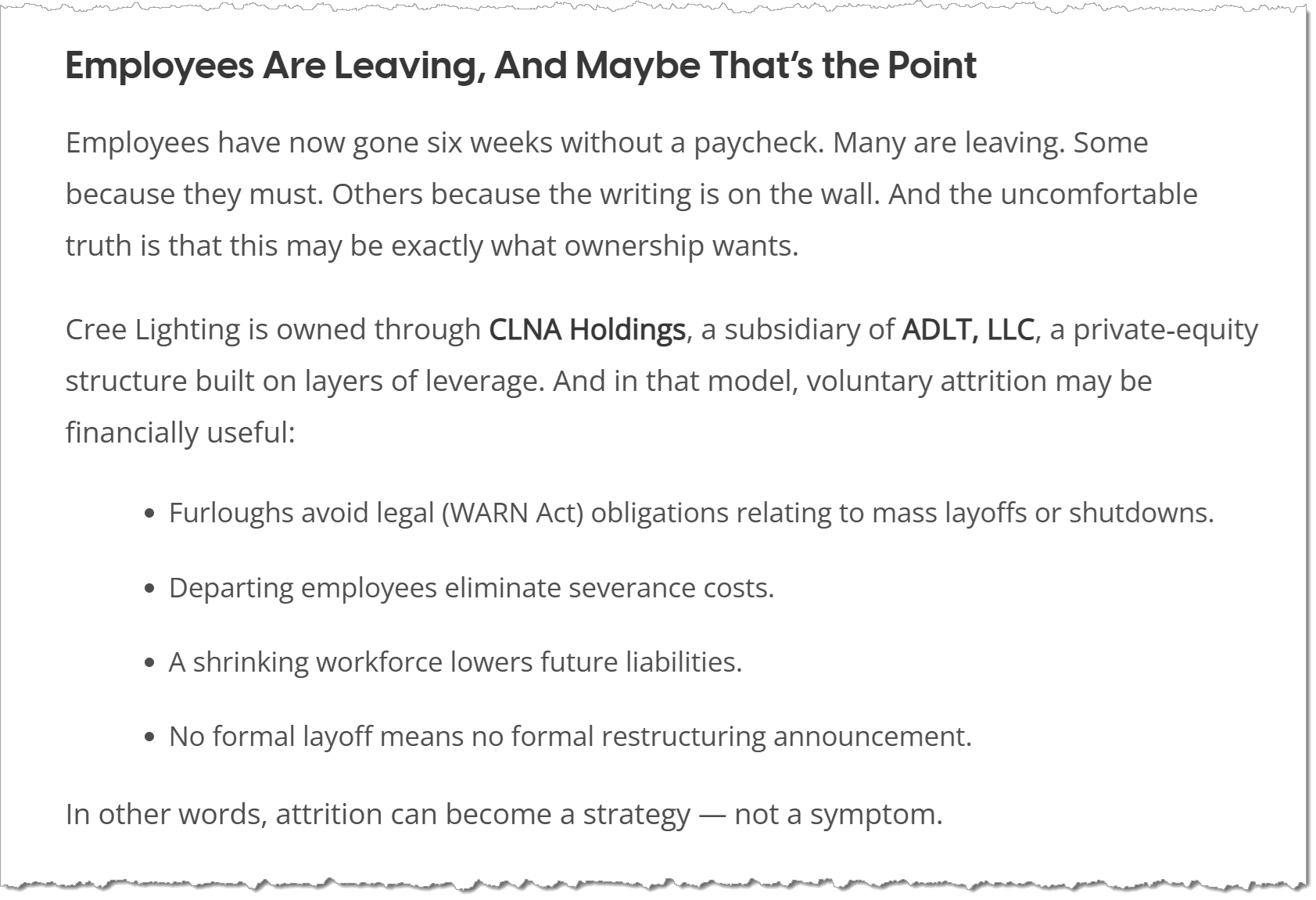
Above: Excerpt from November 14, 2025 Inside Lighting article, “What the Hell Is Going On at Cree Lighting?”
Those questions now sit at the heart of the litigation, even if the lawsuits phrase it more cautiously. Plaintiffs argue, in effect, that the furlough reduced the workforce before WARN thresholds could fully apply, limiting financial exposure.
Then came the second mechanism. When layoffs were finally announced on March 12, they were immediate. Cree Lighting invoked a narrow WARN exception tied to companies actively seeking capital. The result was the same for workers: no 60-day buffer, no transition period, no gradual landing.
If the first phase was about attrition, the second was about timing.
The Company’s Position
Cree Lighting disputes the premise that the furlough was used to manage headcount ahead of layoffs. In a March 17 statement to Inside Lighting, a spokesperson said the extended furlough reflected operational realities, not legal strategy:
Was the furlough period designed to allow employee attrition to reduce the number of employees counted toward WARN thresholds when layoffs were eventually implemented?
"No. We identified manufacturing inefficiencies that created significant financial pressure and uncertainty. Addressing these challenges required thorough analysis and decisive action, which contributed to the extended furlough period. Our objective, then and now, has always been to ensure we can reliably deliver the high-quality, technology-driven products our customers expect over the long term. In fact, we were pleased that there was very little net attrition during the furlough."
The company’s earlier messaging reinforces that stance. Even as layoffs were announced and manufacturing shut down, Cree emphasized continued operations, customer confidence, and a substantial backlog.
That optimism now collides with the legal record. Plaintiffs describe a workforce left unpaid, unrecalled, and ultimately terminated without notice. The company describes a business navigating manufacturing inefficiencies while preserving long-term viability.
Those two versions of events don’t quite line up.
Pressure Beyond the Payroll
The employee lawsuits are not the only legal pressure building around Cree Lighting.
In recent months, suppliers have filed claims totaling more than $1.7 million in alleged unpaid balances, tied to components already delivered and inventory built to Cree’s forecasts. Some vendors are still waiting. Others have decided not to. The difference is now showing up in court.
For those watching closely, the pattern is familiar. When payroll falters, payables are often not far behind. What stands out here is not the sequence, but how visible it has become.
What’s Next?
This case may ultimately turn on definitions that sound deceptively simple. What is a furlough? When does it end? And can a company compress the legal consequences of a six-month workforce reduction into a single day’s notice?
The answers will not just determine damages. They may shape how future restructurings are designed.
For now, the facts are fixed. October 2025, a furlough begins. March 12, 2026, layoffs are announced and executed immediately. March 19, lawsuits are filed.
Everything in between is now up for interpretation.
NOTE: As of publication, no other lighting or electrical industry trade publication has reported on any of the five lawsuits filed in recent months against Cree Lighting. Inside Lighting reached out to Cree Lighting for comment on the two class action complaints. Per usual, the company declined, citing its policy not to comment on open litigation.