


March 28, 2026
5 Things to Know: March 28
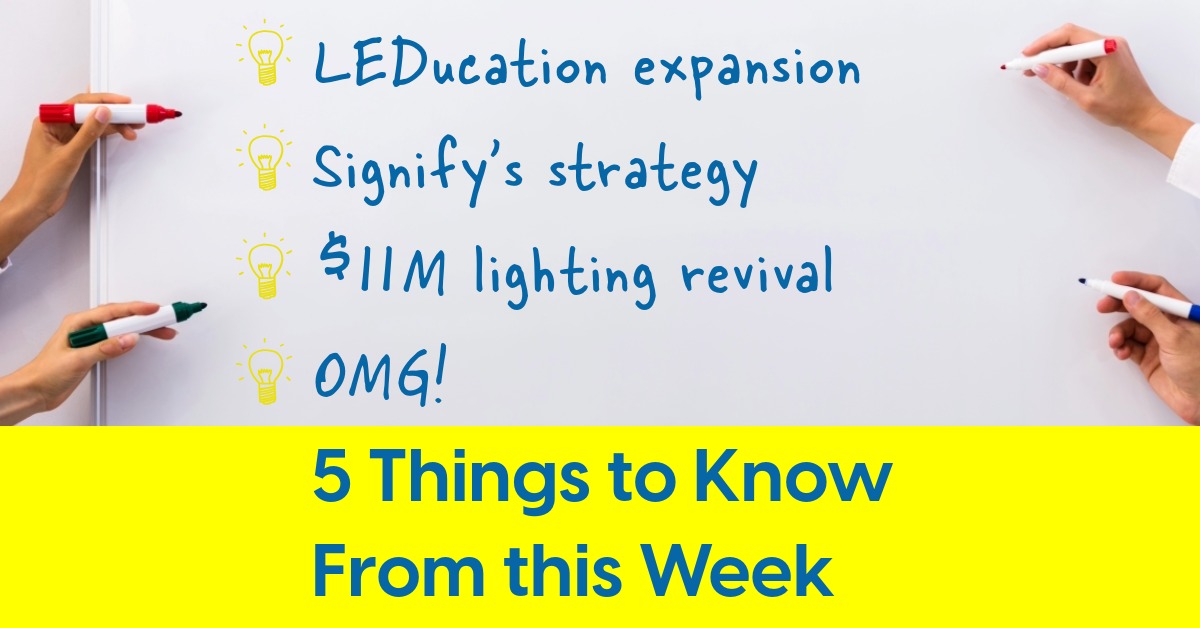
Future trade show dynamics continue to evolve. Plus, here's how Signify is targeting the fastest growing building sector.
Here's a roundup of some of the week's happenings curated to help lighting people stay informed.
1. LEDucation Expansion Signals Shift In Show Strategy
It’s been talked about, dissected, and quietly expected. It’s now effectively official: LEDucation 2026, just 17 days away, may mark the final two-day run before the show expands to three days in 2027.
The shift is subtle on paper, but consequential in practice.
- More elbow room: Expanding to three days could spread attendance more evenly, easing congestion and giving exhibitors and attendees more time to engage.
- Spacing improves: Moving LEDucation 2027 to April 13–15 (previously April 6-7) stretches the gap from Light + Intelligent Building North America 2027 (formerly LightFair) to 26 days, up from 19.
But the calendar has a longer memory.
- March gravity returns: LEDucation’s historical lean toward March resumes in 2028.
- 2029 collision risk: Light + Intelligent Building North America 2029 is set for March 12–15 in Philadelphia. If LEDucation follows its traditional March timing, proximity could become pressure.
For Lighting People, this is less about dates than choreography. The industry’s busiest months may be competing for the same oxygen.
2. Signify’s Data Center Strategy
In “Rewiring resilience: The case for DC-powered lighting in data centers,” published by Data Center Dynamics, Ton van de Wiel, Global Segment Manager for Intelligent Buildings at Signify, offers something more revealing than a typical thought piece. It reads as a quiet blueprint for how the world’s largest lighting company aims to capture market share in the fastest-growing segment of commercial buildings.
Signify’s data center strategy isn’t just luminaires. It’s about getting inside the ecosystem of the fastest-growing building segmenthttps://t.co/X7y1rpgZue
— Inside Lighting (@InsLighting) March 28, 2026
- A Subtle Repositioning Of Power
Signify isn’t selling fixtures here. It’s reframing lighting as infrastructure, embedding itself into the electrical spine of data centers where decisions carry long-term influence. - DC As The Wedge, Not The Destination
By leaning into DC power, Signify finds a strategic entry point. Lighting becomes the safe, early adoption layer that opens doors to deeper system conversations. - The Real Prize Is Data
Beneath the efficiency narrative sits a broader play: turning every luminaire into a sensor node, quietly building a facility-wide data layer that others will have to integrate with. - Following The Money, Not The Spec Sheet
The language is calibrated for executives and CFOs. Copper savings, Power Usage Effectiveness (PUE) improvements, and ESG metrics shift lighting from a line item to a lever. - A Bet On Convergence
The endgame is clear. Lighting becomes part of a unified DC ecosystem, where energy, controls, and data blur into a single platform — and where Signify intends to have a seat early.

3. $11 Million Revives San Francisco Light Display
As reported by NBC Bay Area, San Francisco’s Bay Bridge light display has returned after going dark for nearly three years, sidelined not by lack of interest but by the less glamorous realities of maintenance costs and funding gaps. Reviving it required $11 million in private donations, a reminder that even public-facing spectacle depends on sustained financial backing.
At the moment, the installation is a one-sided experience. The animation plays across the western span, visible from the San Francisco side including the Embarcadero waterfront, while drivers crossing the bridge see none of it. That imbalance isn’t permanent. Organizers have indicated lighting will soon be fully commissioned for the eastbound lanes.
4. French Talk Show Lighting Draws U.S. Fans
As reported by the Wall Street Journal, “Quotidien” is fundamentally a French evening talk show, blending political commentary, cultural segments, and celebrity interviews into a polished, fast-moving broadcast. Its structure is familiar, even conventional, designed to inform and entertain a domestic audience rather than reinvent television.
Yet its growing reputation abroad tells a different story. In the United States, the show’s lighting has taken on a life of its own, turning routine interviews into viral moments. Carefully layered illumination and camera control give guests a refined, almost cinematic presence that stands apart from typical studio setups. The effect is subtle but unmistakable.
What emerges is a quiet shift in audience behavior. American viewers aren’t tuning in for policy debates or cultural insight. They’re watching for the glow, the texture, the precision. Lighting, rarely the headline, has become the unexpected force building a niche but loyal following.
5. NEC 2026 Reorganizes Lighting Device Rules; Requirements Largely Unchanged
According to the Daily Reporter, the 2026 NEC lighting residential outlet requirements remain largely intact, with the clearest emphasis still on dwelling units. The code continues to define where lighting and switching are required in homes, while commercial and industrial spaces rely more on building codes and functional needs.
Notably, structural updates like relocating neutral requirements to Article 406 reflect organizational shifts rather than technical change. For Lighting People, the takeaway is continuity: residential rules stay prescriptive, while nonresidential applications remain shaped by broader design and safety considerations.