



May 14, 2026
Cree Lighting Ex-Workers' Lawsuits Spark Turf Battle
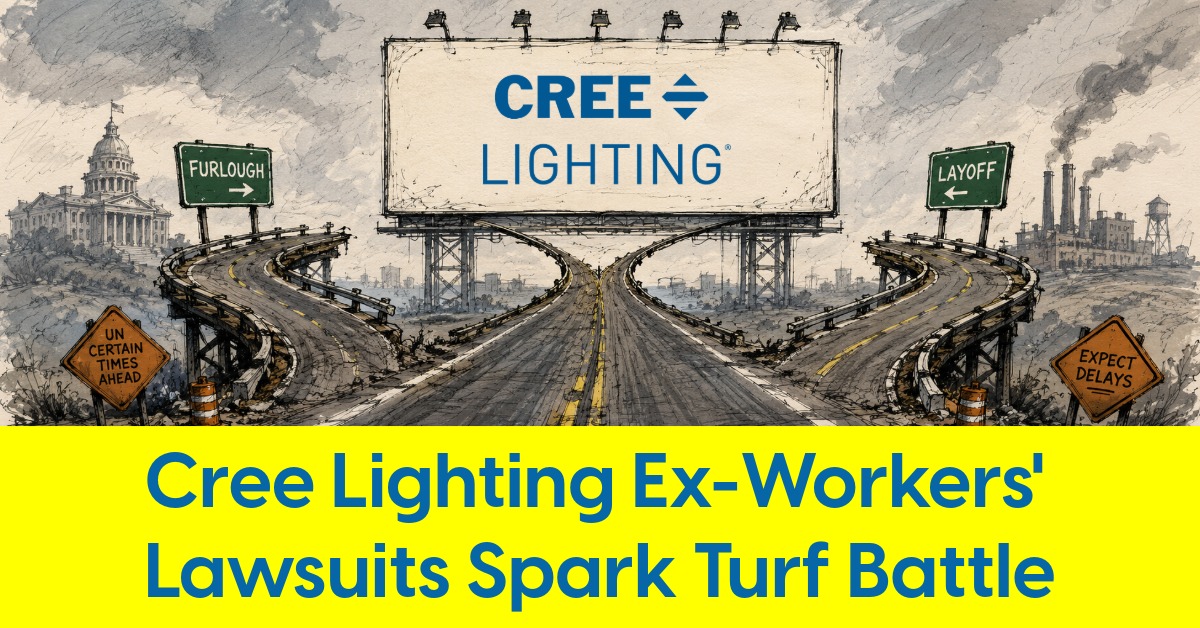
Competing strategies could significantly impact potential worker damages
This article involves Cree Lighting USA LLC, which operates separately from Cree LED brand owned by Penguin Solutions and the consumer Cree Lighting brand owned by Feit Electric.
When two class action lawsuits landed in federal court in Milwaukee on the same day in March, the immediate question was what Cree Lighting USA would do. Eight weeks later, a different question has emerged: which group of workers' lawyers gets to be in charge?
The fight is now on the record. Attorneys for plaintiffs Sarah Adrian and Patricia Borom have filed a Rule 23(g) motion asking Magistrate Judge Stephen C. Dries to appoint their firm, Raisner Roupinian LLP, as sole interim class counsel — and to dismiss the competing Sorenson vs. Cree Lighting case entirely.
Adrian and Borom worked as customer account specialists at Cree Lighting's Racine facility; Sorenson was an engineering manager at the same location.
The motion is pending. No ruling has come down yet. But the arguments are unusually pointed for a court filing, and they signal that the litigation over Cree Lighting's mass layoff has acquired a second dimension that has nothing to do with the company itself.
In class action litigation, lead counsel typically controls litigation strategy, settlement negotiations, and potentially millions in legal fees.

580 vs. 172: The Headcount Number That May Define The Stakes
The two lawsuits share a target but not a theory.
The Sorenson complaint focuses on the 172 employees who received termination notices on March 12, 2026, with separations effective the following day. The Adrian team argues the clock started ticking much earlier, tracing the claimed employment loss to October 1, 2025, when Cree Lighting furloughed roughly 92% of its workforce without a defined return date.
The legal basis cited in the Adrian filing is a Department of Labor regulation, 20 C.F.R. § 639.4(b), which holds that a furlough extending beyond six months is treated as an employment loss from its original start date.
That distinction is the strategic center of the Adrian case. If that theory survives, the potential class and the potential damages grow considerably. To understand why, some context helps. The WARN Act, the Worker Adjustment and Retraining Notification Act, is a federal law requiring employers to give affected workers 60 days' written notice before a mass layoff or plant closing.
The law carries exceptions, and Cree Lighting invoked one of them when it announced terminations on March 12. The "faltering company" exception permits an employer to shorten or eliminate the notice period when it is actively seeking capital or business that could prevent or postpone a shutdown, and when advance notice would have undermined those efforts. Cree Lighting cited that exception to justify the immediate separations.
Lawyers Taking Aim At Other Lawyers
The Adrian brief does something that stands out in class action practice: it goes after opposing counsel directly. Raisner Roupinian, which claims more than 150 WARN class counsel appointments and recoveries exceeding $250 million for affected workers, argues in its filing that Sorenson's attorneys have never appeared in a reported WARN decision or appeal. The brief states their WARN experience trails Adrian counsel's by a factor of at least ten.
The judge could grant the motion, deny it, consolidate the cases under a different structure, or chart some other course. What is clear is that the arguments for sorting out who leads are already in the record — and that the Adrian team believes controlling the litigation is worth pressing for now rather than later.
What Comes Next
Both cases have been reassigned to Magistrate Judge Dries on the consent of all parties, with a Rule 16 scheduling conference set for June 5. Before that, Cree Lighting's response in the Adrian case is due May 18 and will offer the first substantive signal of how the company intends to defend its position in court.
Cree Lighting’s public position, stated in a March 17 statement to Inside Lighting, is that the extended furlough reflected “manufacturing inefficiencies that created significant financial pressure and uncertainty,” not a deliberate effort to manage headcount ahead of a WARN threshold. The company added, “we were pleased that there was very little net attrition during the furlough.".
For the roughly 580 people who reportedly left the Racine facility in October 2025 expecting to return in two or three weeks, the arguments unfolding in Milwaukee are something more personal than procedural. They are the question of whether a six-month furlough with no recall and no pay was, in the language of the law, always something else entirely.