


May 19, 2026
[UPDATED] Lighting Rep Sues Manufacturer Over Failed Custom Fixtures
Out-of-state rep alleges $620K buy/sell custom order led to falling-components at luxury resort
A federal lawsuit filed yesterday in Arizona lays bare what can happen when custom decorative lighting meets real-world installation conditions at a major hospitality property—and nobody agrees on who owns the consequences.
Independent lighting agent, Hawaii Lighting Representatives (HILR), filed suit against Miami-based manufacturer, Byzantivm Inc., in federal Arizona court, alleging breach of contract, breach of express warranty, and unjust enrichment over a package of custom chandeliers manufactured for the renovation of the JW Marriott Desert Ridge Resort & Spa in Phoenix.
The complaint is notably vivid for a commercial lighting dispute: it alleges that installed chandelier glass "detached from their metal frames and fell from the ceiling," includes photographs of broken glass still in its frames, and invokes life-safety concerns no fewer than a dozen times.
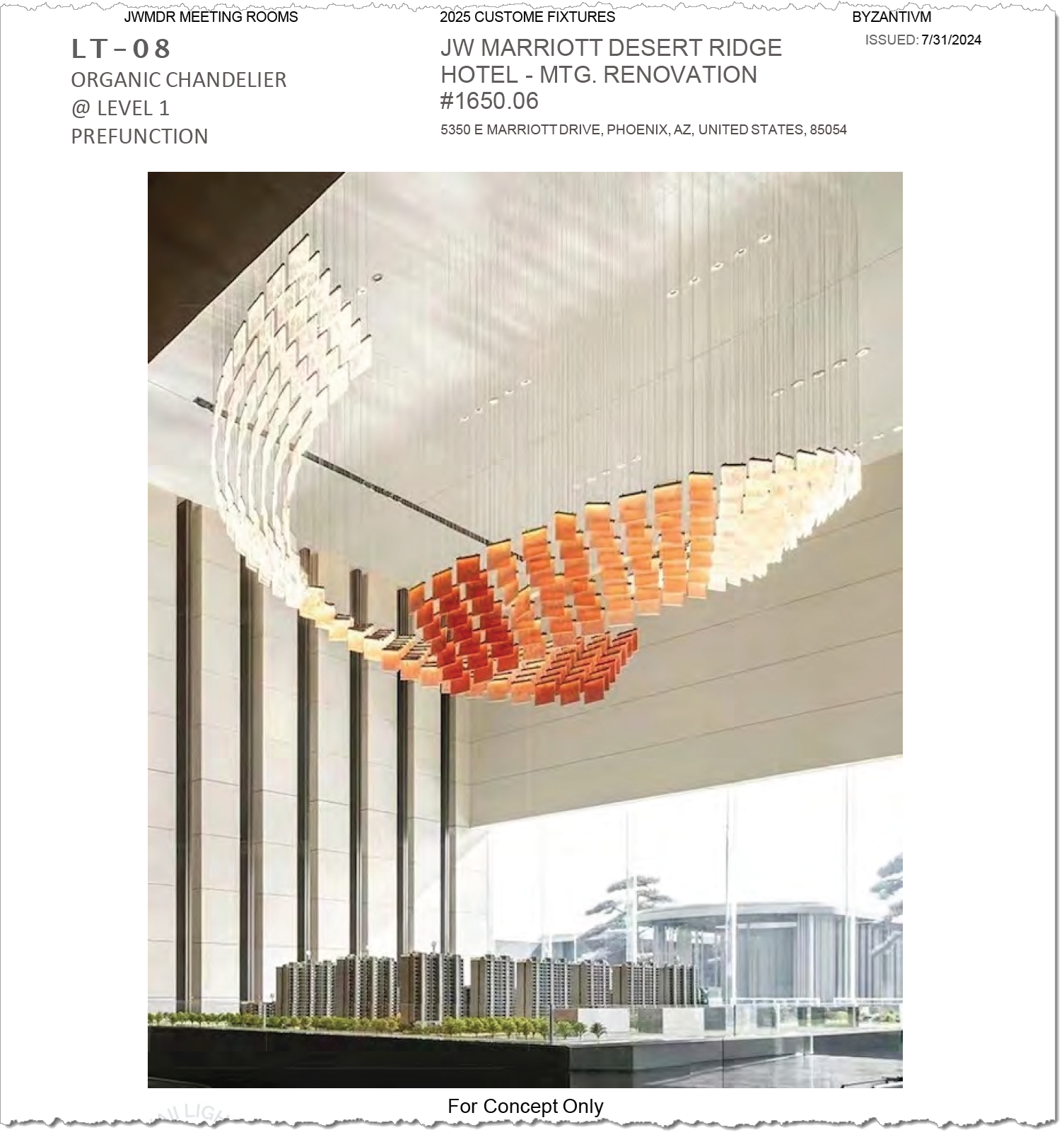
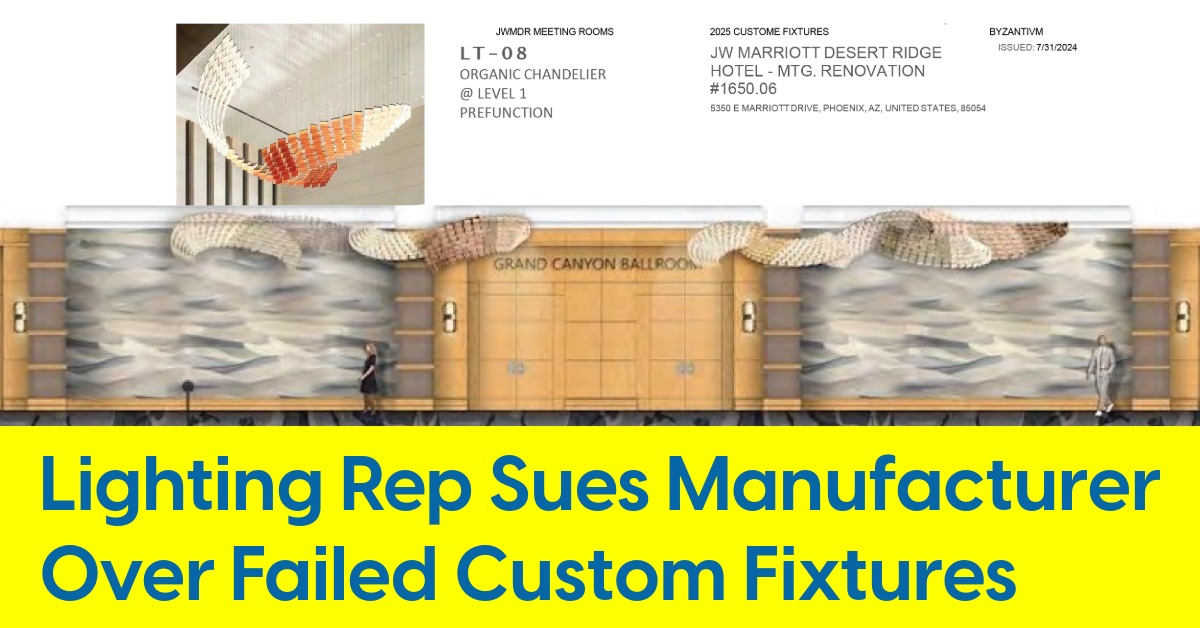
The numbers are significant. The purchase order totals approximately $620,127. Hawaii Lighting Representatives claims to have paid Byzantivm $616,026—inclusive of $163,650 in shipping—and alleges it has received zero functional, compliant fixtures in return for four of the fifteen line items ordered. The disputed fixtures are LT-08, a dichroic acrylic organic chandelier invoiced at $88,280; and LT-09, LT-10, and LT-12, a series of custom ballroom chandeliers totaling $388,540 across six, eighteen, and six units respectively.
HILR alleges it has additionally incurred approximately $142,925 in remediation costs, with more to come.

Manufacturer Responds [Updated May 20]
After publication, Byzantivm provided a detailed response disputing the allegations in the lawsuit.
The company states that:
- installers improperly assembled portions of the fixtures,
- late-stage client-directed design changes created structural deflection concerns the manufacturer says it warned about repeatedly,
- installation instructions and communication procedures were not followed,
- and Byzantivm continued offering remediation efforts throughout the project.
The manufacturer also states it absorbed more than $100,000 in replacement glass costs and denies abandoning the project.
A substantially complete version of Byzantivm’s response can be read here »
How the Deal Was Structured
The Exclusive Representation Agreement between the parties, dated August 26, 2024, is a standard-form rep contract with one commercially meaningful provision: it permits the representative to engage in buy/sell transactions with Byzantivm at a 10% discount off distributor net, then resell at any price of its choosing. That appears to be how this transaction was structured.
On a $620,000 project, the economics are attractive. The buy/sell also effectively bypasses the commission structure that normally allocates payments across specifying (50%), selling (25%), and territory (25%) reps.
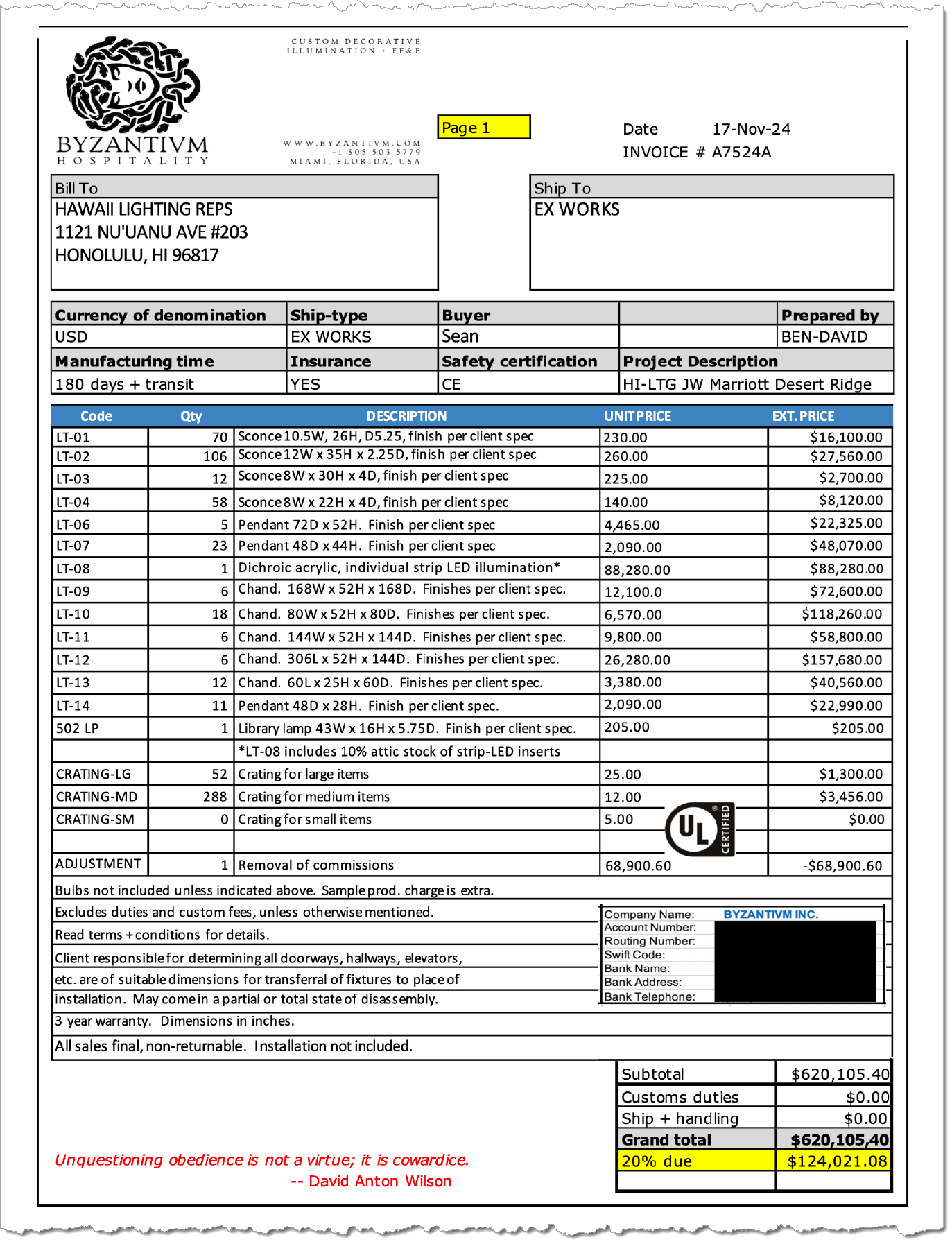
Above: Invoice requiring a 20% down payment deposit; the 10% discount shown is consitent with the rep-contract provision that enables the buy/sell arrangement.
What the complaint does not explain is why a Honolulu-based rep firm was the commercial vehicle for a Phoenix hotel renovation. Byzantivm's own website lists HILR as the Hawaii representative and directs Arizona inquiries simply to "Contact Us."
HILR has reportedly paid Byzantivm in full and received nonconforming or unusable product. The project still lacks a pre-function lobby chandelier and three ballroom chandelier packages. If it must source replacements elsewhere—which the complaint suggests would cost "hundreds of thousands of dollars" more—the original margin evaporates and the rep absorbs losses on a transaction it fully funded.
The Liability Cap Problem
What makes this case particularly instructive for the industry is the contractual tension the documents expose. Byzantivm's rep agreement contains a notable clause: the company's liability "shall in no event exceed the purchase price of the Byzantivm Products on which such liability is based," with consequential damages expressly disclaimed and remedies largely limited to replacement of defective items.
That language may be defensible when a sconce arrives scratched. It looks considerably more strained when the allegation is that a large, overhead glass assembly fell in a ballroom at a luxury resort—and that the manufacturer initially acknowledged the flaw, promised to cure it, and then walked away.
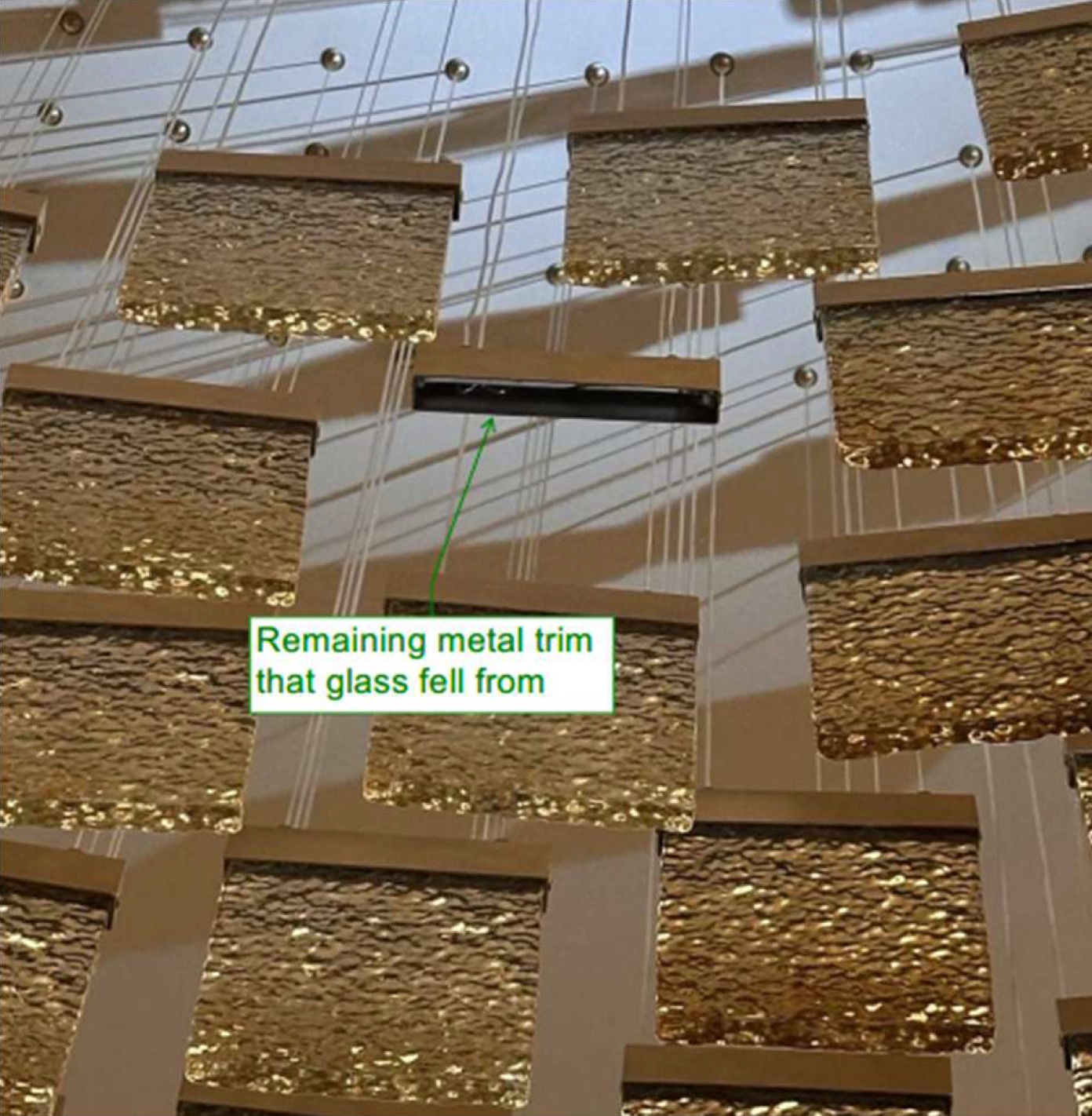
Above: Complaint alleges glass fell from a section of the custom fixture, creating a safety hazard
The complaint alleges Byzantivm knew the LT-08 glass attachment had a "known fail point" before shipment. For LT-09, LT-10, and LT-12, it alleges Byzantivm's own personnel directed installers on clip use, the clips broke the glass, and Byzantivm subsequently abandoned its remediation commitments. The specification sheets attached to the purchase order explicitly required proper packaging, installation hardware, installation instructions, and products "suitable for commercial use." HILR alleges none of those obligations were met.
Inside Lighting reached out to both Hawaii Lighting Representatives and Byzantivm for comment. Neither had responded before press time. We will update this article if that changes.
The Broader Signal
Manufacturers make things. Agents sell them. That division of labor has held together the lighting channel for decades, and the rep agreement sitting at the center of this dispute looks, on paper, like a hundred others signed every year. A buy/sell arrangement shifts the profit profile, giving the rep more upside on a successful project and considerably more exposure when one goes wrong. But the underlying partnership dynamic does not change much: both parties still need the fixtures to arrive, install, and perform.
What erodes that partnership is not a bad outcome by itself. It is what happens after. The complaint describes a manufacturer that initially acknowledged responsibility, promised remediation efforts that, according to the complaint, ultimately broke down. Whether that account holds up in court remains to be seen. What is clear is that somewhere between Honolulu and Miami Beach, the collaboration required to fix an expensive problem came apart — and a contract that was written for exactly this moment is now the only thing left holding the pieces together.