


January 21, 2026
Signify Keeps Heat on Deco in Bankruptcy Saga
For Signify, the money matters, but enforcing royalties may matter more
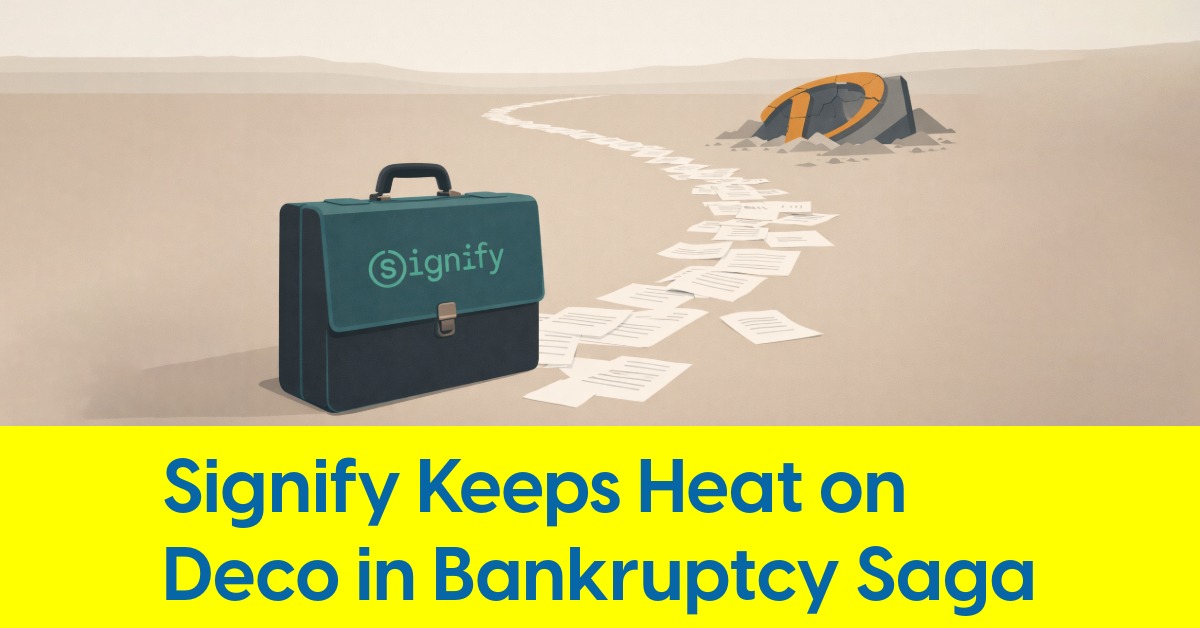
Nearly six years and 600 court filings after Deco Enterprises entered bankruptcy court, Signify is still in the case — seeking payment on a claim that has yet to be resolved.
Deco Enterprises is the corporate entity behind the brand long known to the lighting industry as Deco Lighting, a company that once positioned itself as an edgy, technology-driven challenger in the commercial lighting market. The company filed for bankruptcy protection in February 2020. What followed has been an unusually long and unresolved wind-down.
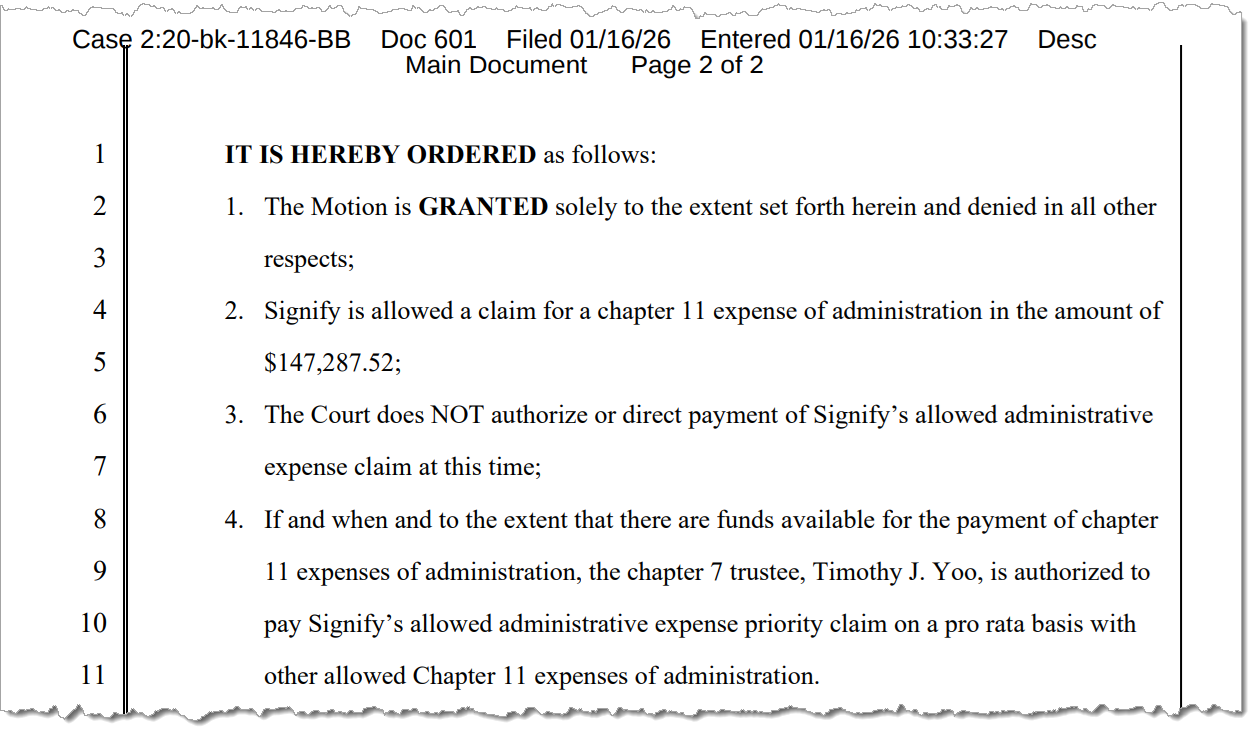
On January 16, 2026, the U.S. Bankruptcy Court in Los Angeles entered an order granting Signify an allowed administrative expense priority claim of $147,287 in the Deco bankruptcy case. Payment, however, was not authorized at this time. The court ruled that Signify may be paid only if and when funds become available and only on a pro-rata basis alongside other creditors. The bankruptcy estate remains open.
The order is the latest turn in a dispute that began with a 2017 patent infringement lawsuit, which ended in a confidential settlement and a royalty obligation under Signify’s EnabLED program; terms Deco later ceased to honor. Over the years, Signify’s efforts to recover what is owed have persisted through plan confirmations, case conversions, and repeated procedural setbacks — an unusually long arc for a mid-market lighting bankruptcy.

For Signify, the dollar figure is almost beside the point. EnabLED is a licensing program built on compliance, and selective enforcement would weaken it. In that context, walking away from a six-figure claim could prove far more costly than pursuing it.
Framing Signify: Competing Narratives, Unequal Scrutiny
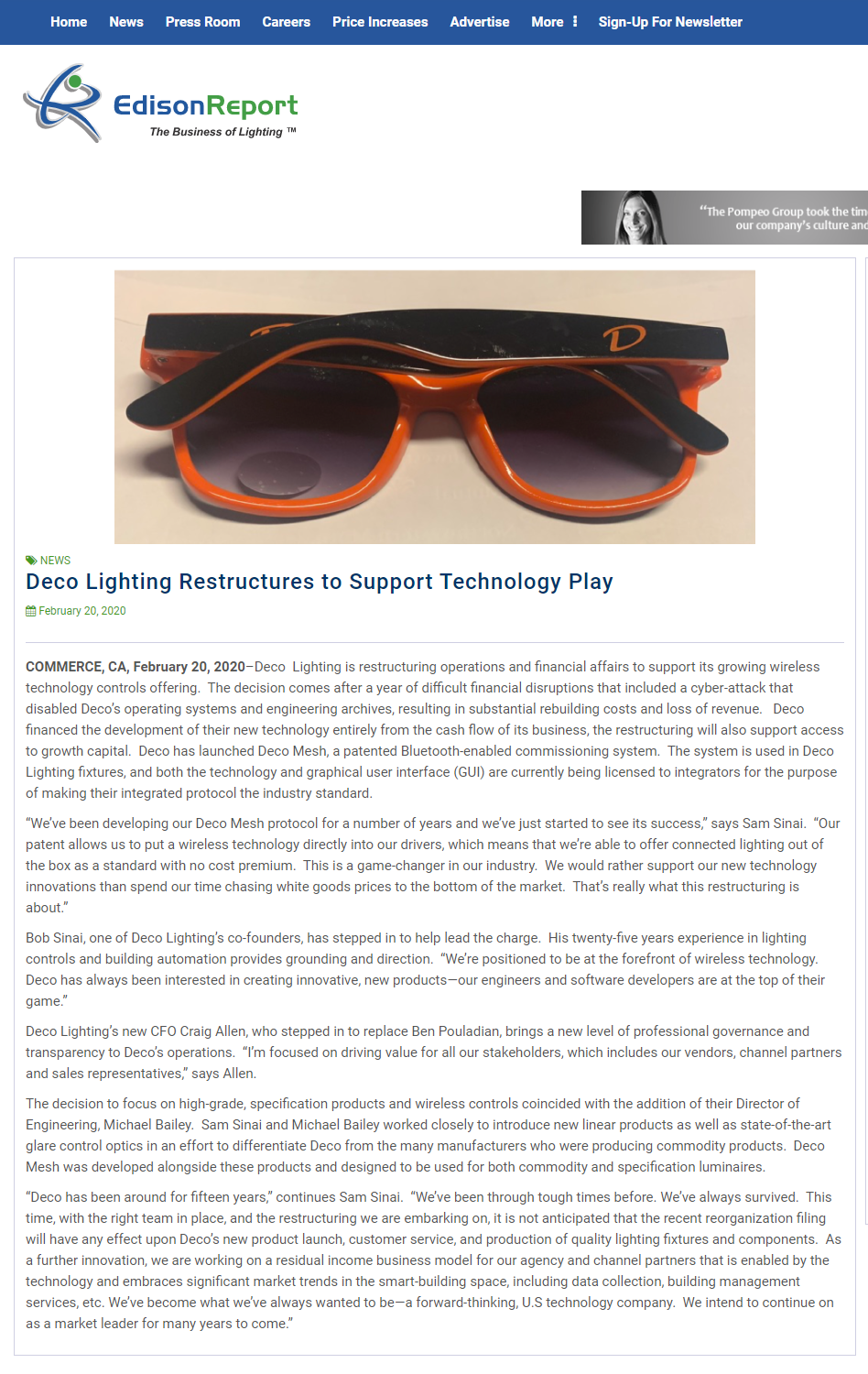
Above: EdisonReport headline news article that was eventually deleted from the website without explanation
During the bankruptcy period, Deco’s public-facing talking points were amplified through EdisonReport, which regularly published Deco-friendly narratives that largely reflected Deco’s framing without scrutiny. When Deco’s bankruptcy first became known to the industry, an EdisonReport headline news article announced it with the lead sentence: “Deco Lighting is restructuring operations and financial affairs to support its growing wireless technology offering.” The article made no reference to bankruptcy and later disappeared from the site without explanation.
An EdisonReport news item published two weeks later, "Deco Lighting’s Chapter 11 Restructuring Plan" avoided the "Bankruptcy" headline and also disappeared from the website without explanation.
In a subsequent, and very friendly EdisonReport interview with Deco leadership months later, the term “bankruptcy” again went unmentioned, replaced instead with only one brief mention of “restructuring,” alternate language that Deco co-founder Sam Sinai consistently insisted upon.
In a December 2020 phone conversation with Inside Lighting, Sinai explained why he declined an on-the-record interview and opted for EdisonReport, saying we were “digging a little too much,” trying to “get down to the truth.” “I respect that,” he added, but drew a sharp contrast, noting Inside Lighting was “a lot more detailed than Randy” Reid — the editor of EdisonReport — and acknowledged, “Some of the information that could have been in that interview, if we didn’t control it, could be used against us.”
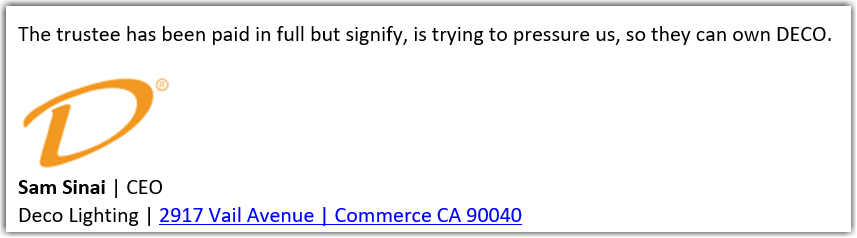
Above: Sam Sinai email to Inside Lighting pushing back on liquidation coverage as Signify pressure escalated
In February 2023, a less-pliable Inside Lighting stood alone in reporting that Deco’s bankruptcy proceedings had reached a critical stage. The report detailed mounting pressure from Signify, the world’s largest lighting company, alongside a pending U.S. Trustee motion seeking conversion of the case — developments that together left Deco potentially weeks away from a Chapter 7 liquidation. In response, Sam Sinai claimed that Signify was trying to pressure Deco because it ultimately wanted to own the company — a puzzling assertion, given that court-ordered liquidation is not how acquisitions typically occur.
Shortly afterward, when asked by EdisonReport why Signify would want Deco, Sinai replied, “Are you kidding? We have patents. We have strong patents that they want in their portfolio, and they want our designs.” EdisonReport later published Signify’s response, which rejected that narrative and described the dispute as a narrow effort to recover past-due royalties. Other assertions made by Sinai, including claims that lighting agents were paid “like clockwork,” were published without any scrutiny, even as court records sometimes told a different story.
Deco 2.0
Following Deco’s entry into Chapter 7 liquidation months later, substantially all operating assets of Deco Enterprises were transferred through a court-approved sale to an entity controlled by one of Deco’s original co-founders, Babak “Bob” Sinai. From those assets emerged a revived Deco Lighting.
However, the brand’s presence has been difficult to detect within traditional U.S. and Canadian commercial and industrial lighting channels. Deco’s own website currently lists 13 agent partners, with representation in markets such as Los Angeles, New York City and Dallas, while notable gaps remain in major regions including Chicago, Boston and Atlanta. While the brand has secured reps in key cities, most appear to be smaller firms — so in many cases, Deco won’t be competing for agent mind share alongside major lines like Acuity, Cooper, Current or Genlyte.
Signify, meanwhile, has not disengaged. The court has now recognized a six-figure administrative claim. Whether it will ever be paid remains uncertain. What is clear is that a bankruptcy filed nearly six years ago continues to generate new rulings — and unresolved obligations.