


January 14, 2026
GUV Isn't the Whole Answer, But It's Still an Answer
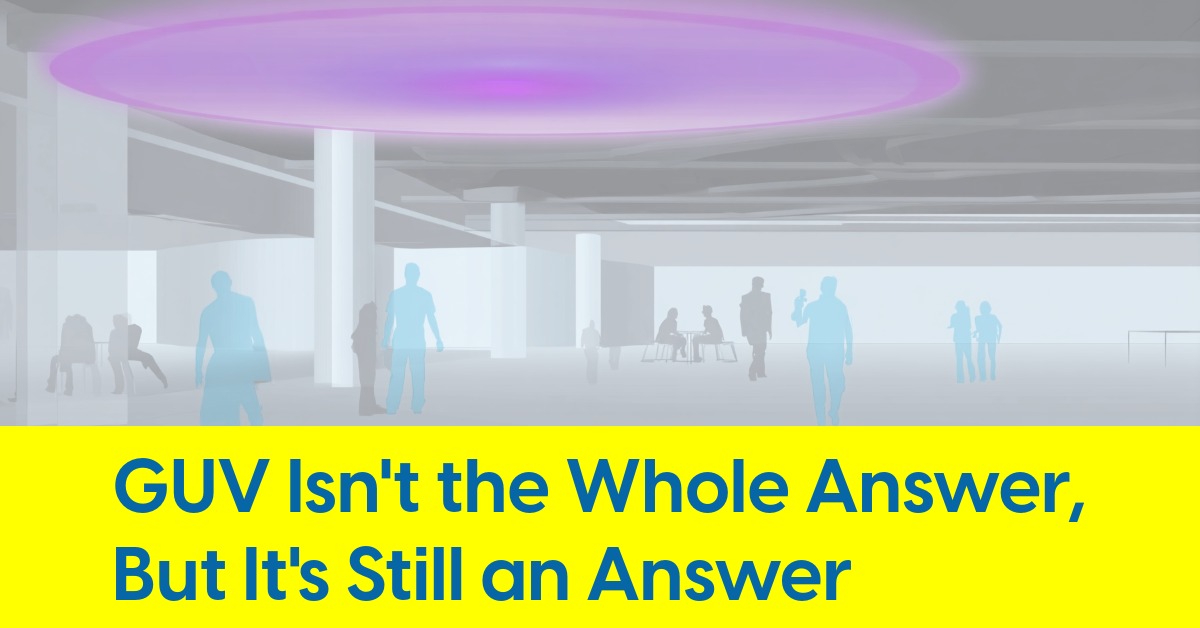
Despite modest market adoption, the technology can deliver where it matters
During the pandemic’s peak, germicidal ultraviolet (GUV) lighting found itself briefly in the spotlight; touted as a fast, technical answer to airborne pathogens.
Airports, schools, and hospitals flirted with futuristic UV installs. But as Inside Lighting reported in 2021 and 2022, the boom never quite boomed. GUV's commercial trajectory was more fragmented than explosive — gaining traction only where it was credible, correctly applied, and integrated into broader strategies.
Now, a new simulation study from the U.S. Department of Energy offers fresh validation for that more measured, but enduring, role.
ASHRAE 241: New Targets, Old Constraints
Published in late 2023, ASHRAE Standard 241 sets aggressive clean air targets for buildings, measured in liters per second per person of “equivalent clean air” (ECA). These targets are designed to reduce infectious aerosol transmission — effectively translating pandemic-era learnings into codified building standards.

Researchers at Pacific Northwest and Lawrence Berkeley national labs tested how typical buildings might comply. Using EnergyPlus™, a DOE-developed open-source simulation tool, they modeled offices, classrooms, dining areas, and healthcare waiting rooms across seven climate zones. They tested combinations of outdoor air, filtration, in-duct UV, portable air cleaners — and upper-room GUV.
Among the study’s lead authors was Gabe Arnold, a familiar name in lighting research circles, particularly for his longstanding work on UV technologies and energy modeling.
The results were sobering. Offices and classrooms could often meet the standard with layered strategies. But restaurants and healthcare waiting rooms — where occupancy is dense and risk is high — fell short, even with multiple interventions stacked.
And yet, one technology consistently moved the needle: upper-room GUV.
A Lighting Solution That Still Works, Quietly
Unlike ductwork retrofits or full ventilation overhauls, upper-room GUV performed well in simulations, delivering meaningful ECA gains without excessive energy penalties. In fact, it routinely outperformed added outdoor air in energy efficiency — especially in extreme climates.
But here’s the nuance: even the best GUV systems didn’t always “pass.” Why? ASHRAE 241’s performance criteria are based on MS2 bacteriophage, a virus surrogate that’s notoriously UV-resistant. As the authors point out, actual viruses like SARS-CoV-2 are far more susceptible to UV light. Change the test organism, and suddenly upper-room GUV clears the bar in more scenarios.
The implication? Lighting professionals may be sitting on a technology that works better than the current standard gives it credit for.
GUV’s Reframed Value Proposition
As the study confirms the technical strengths of GUV, the lighting industry’s challenge remains commercial, not scientific. During COVID, upper-room GUV systems found real-world traction in schools, correctional facilities, and healthcare waiting areas — driven by public funding and regulatory urgency. Manufacturers with deep UV experience — not pandemic opportunists — delivered most of the credible projects.
Today, the sales pitch has shifted. GUV is no longer about “COVID mitigation” — it’s part of the healthy buildings narrative, aligned with standards like ASHRAE 241 and expectations for resilient infrastructure.
But three headwinds persist: confusion between GUV types, competitive cost pressure from simpler HVAC upgrades, and growing demands for commissioning, proof, and ROI. Performance claims are no longer enough. GUV must now perform on paper and in the field.
Lighting's Role in the Airborne Age
While ASHRAE 241 does not explicitly reference GUV, its performance targets effectively favor disinfection technologies that operate without compromising energy use or comfort, a category that includes lighting.
The takeaway for specifiers and manufacturers? GUV may never be a universal solution — but in the buildings that matter most, it’s still part of the answer. Quietly, credibly, and above our heads.