


July 22, 2026
When "Fully Shielded" Means Something Different
Kentucky rewrites a familiar lighting term to protect farmland instead of skies
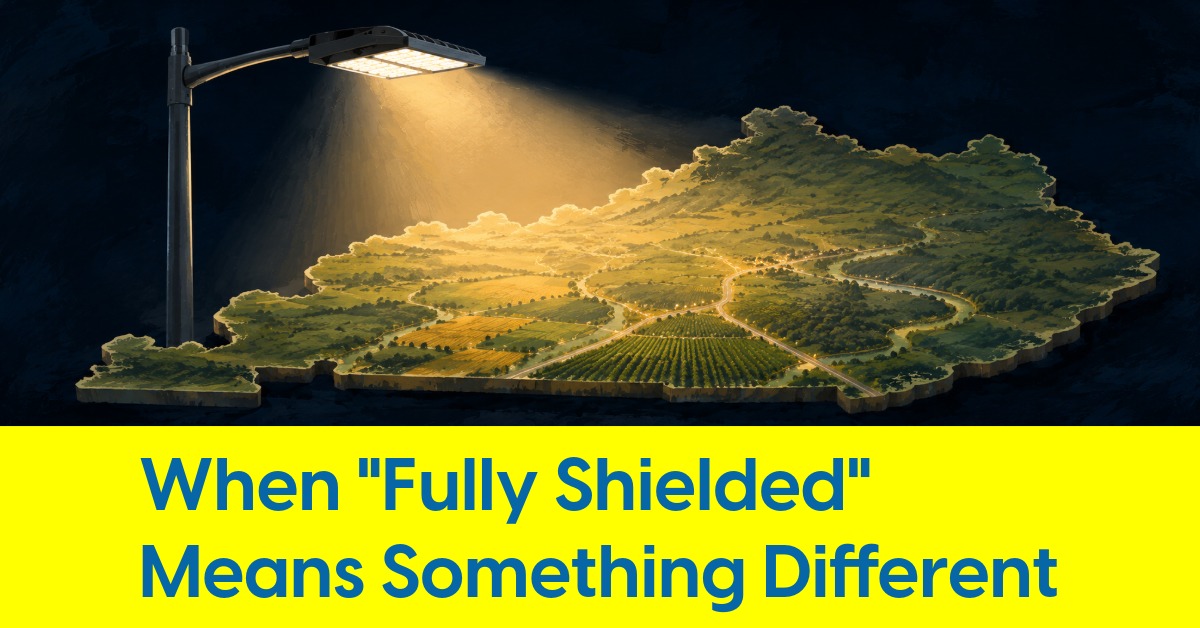
A new Kentucky law effective July 15, House Bill 571 protects the commonwealth's farmland from stray highway light. It does not, whatever DarkSky Kentucky posted this week, protect the stars.
The bill that became Acts Chapter 130 requires the Kentucky Transportation Cabinet, the state's equivalent of a DOT, to shield state highway fixtures that spill light onto agricultural land, defined as tracts of at least ten contiguous acres used for crops, livestock or timber. The final law passed the House 98 to 0 and the Senate 37 to 0.
New highway fixtures installed after the law's effective date and found to encroach on farmland must be shielded at installation. Existing fixtures get fixed only after a landowner files a written complaint, and the Cabinet then has thirty days to comply. Construction lighting is exempt for up to 180 days, provided it goes dark when not in active use.

What the law does not do is tell anyone how shielding gets done, and its central term is doing less work than it sounds like. In the lighting industry, "fully shielded" generally means zero upward light output: nothing escapes above the fixture's horizontal plane, regardless of what happens below it.
"Fully shielded" means an outdoor light fixture that is shaded so that light rays emitted by the fixture, either directly from the lamp or indirectly from the fixture, are no longer encroaching on agricultural land;
Commonwealth of Kentucky, Chapter 130, HB 571 (1) (b)
Kentucky defines the phrase by destination instead of geometry, a fixture is "fully shielded" if light no longer reaches agricultural land. Theorertically, a fixture could keep forward throw uplight and still qualify, as long as the shielded backside faces the farm. There's no cutoff classification, no BUG rating, no reference to IES standards anywhere in the text. The Cabinet gets a result to achieve on the "farm-facing sides" of a fixture, not a specification for the whole thing.
DarkSky Kentucky celebrated the law's effective date anyway, calling it a step toward darker skies and hoping for more to follow.
What the Committee Took Away
As introduced, the bill defined "outdoor light fixture" broadly enough to cover anything under the Cabinet's authority. The House Committee Substitute narrowed that to fixtures the Cabinet actually owns or maintains, and gave the Cabinet more room to work with: the complaint window for existing lights went from ten days to thirty, and the construction exemption grew from thirty days to 180.
A floor amendment from Rep. Suzanne Rudy then struck language that would have granted the Cabinet civil immunity for timely compliance. What started as a fairly aggressive mandate left Frankfort as something closer to a farmland-specific customer service standard, with less legal cover for the Cabinet than the original draft offered.
A Pattern With a Different Justification
Kentucky joins a small cluster of states regulating government-owned lighting before touching private fixtures:
- Illinois' SB 3037, the Dark Sky Act, imposes mandatory standards on state-funded and state-owned lighting starting in December while leaving private lighting largely untouched for now.
- New York's S5007, the Dark Skies Protection Act, aims higher: a statewide standard covering residential, commercial, industrial and municipal fixtures alike. It remains stuck in committee, part of a lineage of similar bills stretching back to 2021.
- Maine's LD 1934, the Responsible Outdoor Lighting Act, the strictest of the bunch, caps public lighting at 3,000K and fully shielded, with a dusk-to-dawn shutoff for nonessential fixtures, though DOT roads, construction lighting, historic fixtures and ski resorts are exempted.
Most state legislation leans on sky-glow and circadian science. Kentucky's law is built on crop yield and property rights, language that reads more like an agricultural bulletin than a dark-sky manifesto.
For lighting people watching the statehouse, that gap between stated purpose and adopted meaning is worth tracking. Kentucky farmers now have a specific number to call if a light bothers their soybeans. Stargazers do not yet have one of their own.