


July 13, 2026
Real-World Data Backs Circadian Lighting Guidance
A wearable study finds daily-life evidence for melanopic light recommendations
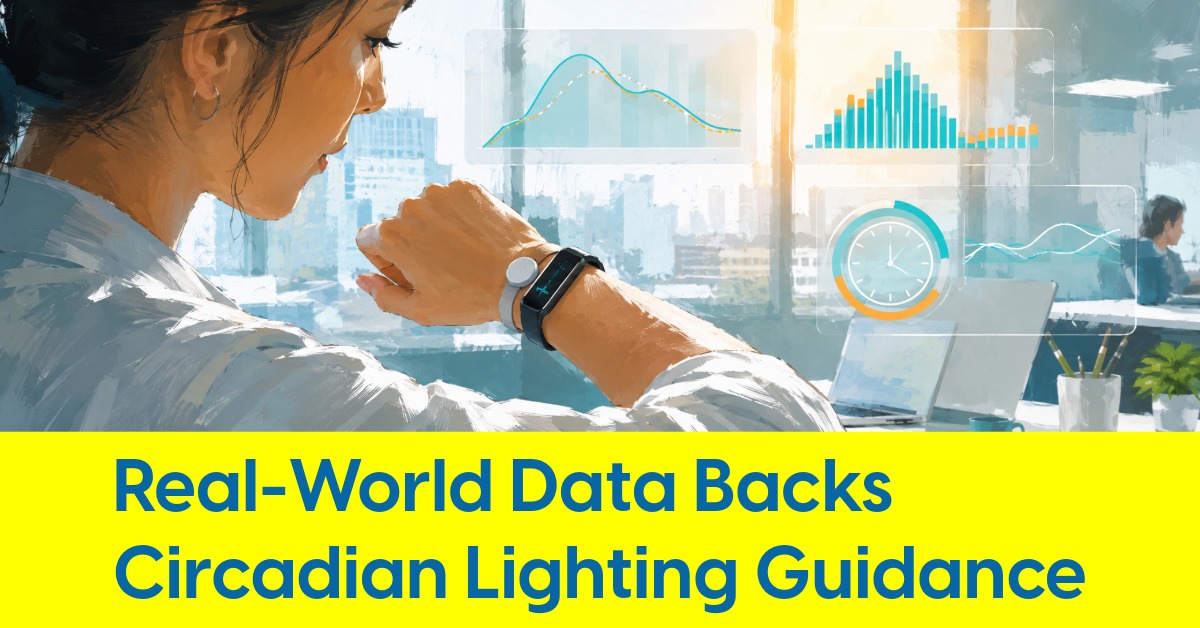
Manchester U.K. researchers strapped light sensors and Fitbit trackers onto 89 volunteers for a week each, then let them live their lives: work, commute, insomnia and all. No lab. No blackout curtains. Just people doing what people do, monitored around the clock. The result, published in npj Biological Timing and Sleep, is one of the more useful real-world tests yet of guidance the lighting industry has been citing for years.
In 2022, a group of sleep scientists set benchmarks for healthy light exposure: strong melanopic light (a measure of how light affects your body clock, not just how bright it looks to the eye) above 250 lux by day, less than 10 lux in the three hours before bed, and near-total darkness during sleep. Those numbers came largely from controlled lab studies. This one asked whether they hold up in real life. They mostly do.

Across more than 500 participant-days, people who got more daytime bright light fell asleep and woke earlier. Those who kept their light exposure more stable and less fragmented across the week showed a higher proportion of deep sleep in the first third of the night, the period when slow-wave sleep does its heaviest lifting. Participants averaged 207.6 minutes above the 250-lux threshold daily, with wide day-to-day swings.
Consistency, Not Just Brightness
The finding likely to interest specifiers more than the headline number is regularity. Interdaily stability and low intradaily variability, meaning light exposure that follows a predictable rhythm rather than an erratic one, were tied to better sleep architecture independent of raw brightness. A bright but chaotic light diet did not perform as well as a dimmer but consistent one.
That is a subtler message than "more light is better," and it complicates how the industry talks about circadian design. A single bright conference room does not fix a lighting schedule if the rest of someone's day and evening remain unpredictable.
Wearables as Infrastructure
The study's other contribution relates to research methods. The researchers paired consumer Fitbits with wrist-worn melanopic light loggers (Spectrawear and ActLumus) and found the devices correlated well with calibrated light sources and, in a smaller comparison, with EEG-based sleep staging. That is a quiet but important validation. It suggests the field no longer needs a sleep lab to generate credible circadian data, which lowers the cost of future research and, eventually, of workplace or product testing.
What Lighting People Should Take From It
The study did not examine offices, schools, or care facilities directly. Its 89 participants were a small sample size of healthy UK adults tracked in ordinary domestic and work settings, not a controlled deployment of any lighting system. Anyone citing this for a product claim should say so plainly.
What it does offer is corroboration, from outside the lab, that the melanopic EDI framework specifiers have been asked to design around is not merely theoretical. It also hands controls providers a more precise design target: predictable daily light schedules may matter as much as peak brightness.
For lighting people, the open question is not whether daylight matters. That case was made years ago. It is whether the industry's circadian products are built to deliver rhythm, not just lumens, and whether anyone is measuring that yet.