


July 22, 2026
Cloudless A.I. Lighting Control Runs on a $200 Controller
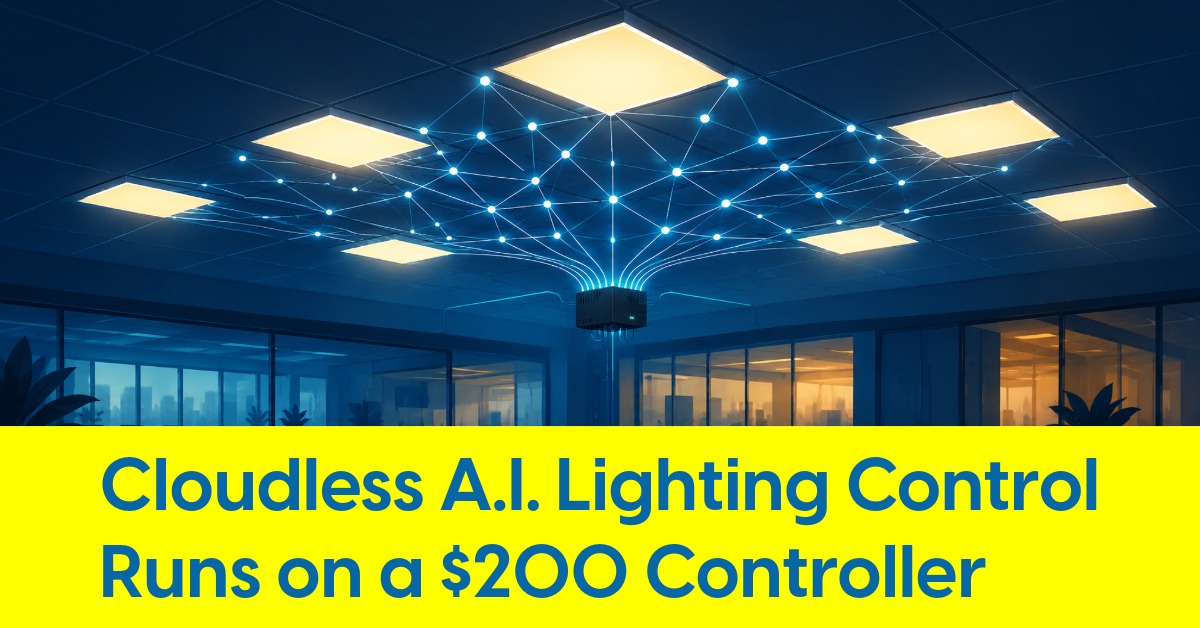
Offline networks delivered adaptive DALI-2 control without GPUs or internet connectivity
An academic research team at the University of Žilina spent four months running a neural network on a $200 automation controller, and a common assumption about AI-adaptive dimming just got a reality check.
The assumption: that AI-adaptive dimming, a direction several DALI-2 controls vendors have signaled interest in, requires cloud computing or specialized hardware to work. It doesn't. The research team trained a feedforward neural network offline in MATLAB, then hard-coded the resulting weights into a standard Loxone brand Miniserver already deployed in an office building. No GPU. No internet connection. Just a controller talking to DALI-2 luminaires it was already talking to anyway.

The results, published in Scientific Reports as an accepted-but-not-yet-final "article in press," are useful precisely because they're unglamorous. In an artificial around-the-clock stress test, the system cut lighting energy 7.4 to 12.5 percent. Under a more realistic occupancy-driven schedule, the figure settled at 8.5 percent against a manually operated legacy system.
Those numbers sit well below the 40 to 50 percent savings that simulation studies routinely cite, and the authors are explicit that their 24/7 test "does not represent typical usage." For lighting people accustomed to procurement conversations built on lab-scale projections, this is a corrective, not a triumph.
Where The Data Gets Useful, And Where It Might Fall Short
The more consequential finding may be for specifiers. The building's existing three-step DALI control, the industry's default daylight-linked scheme, left work areas below the EN 12464-1 minimum of 500 lux nearly 28 percent of occupied time. The ANN controller cut that to under 13 percent. Threshold-based dimming has always had a blind spot between its switching points, and this study puts a number on how often that blind spot matters.
A few qualifiers are worth carrying into any pitch built on this paper. It's one building, one room, one façade orientation, one climate zone, and the authors say so themselves. The comparison baseline is the site's own legacy three-step control, not a more sophisticated existing alternative like fuzzy logic or model-predictive control.
Part of the headline savings also traces to a drop in standby draw, from 30 watts to 22, that has more to do with hardware substitution than with the neural network's daylight predictions. None of that undercuts the core demonstration, though: a lighting-specific AI model can run in real time on the same cheap embedded gear.
For a lighting controls market that has spent recent years hearing "AI" pitched as the future, that's a narrower and more credible story than the one usually told.