November 23, 2026
Tariffs Reshape Sourcing at Canada Light Expo

Guest author: Lance Hollner
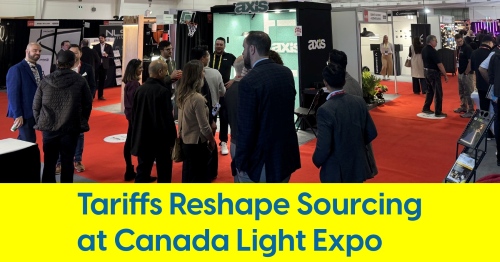
Greater Toronto specifiers, reps and distributors filled a growing show that still left room for longer conversations.
MISSISSAUGA, Ontario — Tariffs were reshaping the buying decisions behind the displays at Canada Light Expo. With 50% duties affecting selected lighting products crossing the U.S.–Canada border, buyers were weighing substitutions while suppliers considered how to finance the added cost before customers paid.
Organized by MEX International, the November 18–19 event at the International Centre drew lighting professionals from across the Greater Toronto Area (GTA). Booths were well spaced and the education program was full. Attendees could survey new lighting and controls technology on the floor. Those who wanted more depth could dig into tariff and sourcing questions, software updates, adjustable optics and hands-on training.
Country of origin determines tariff exposure
Canada’s current counter-tariff list applies a 50% surtax to specified categories of U.S.-origin luminaires and lighting parts. A U.S. brand name or shipping address alone does not establish a product’s origin under customs rules.
A fixture made in Mexico or another country does not acquire U.S. origin merely by being cross-docked through a U.S. warehouse. Under Canada’s origin rules for the counter-tariff, documented non-U.S.-origin goods can avoid that surtax, although other duties or measures may still apply.
Reports from the show floor described manufacturers issuing separate tariff and non-tariff price lists to clarify the difference. Heavily tariffed lines were facing substitution as buyers sought alternatives with a lower delivered cost. Tariff status had become another item for reps and specifiers to resolve before committing to a product.
Maple-leaf signs around the hall emphasized different connections to Canada. Current highlighted its Canadian history; Lutron pointed to an established Canadian presence. Those messages mattered, but buyers still needed product-specific answers about manufacturing origin and landed cost.
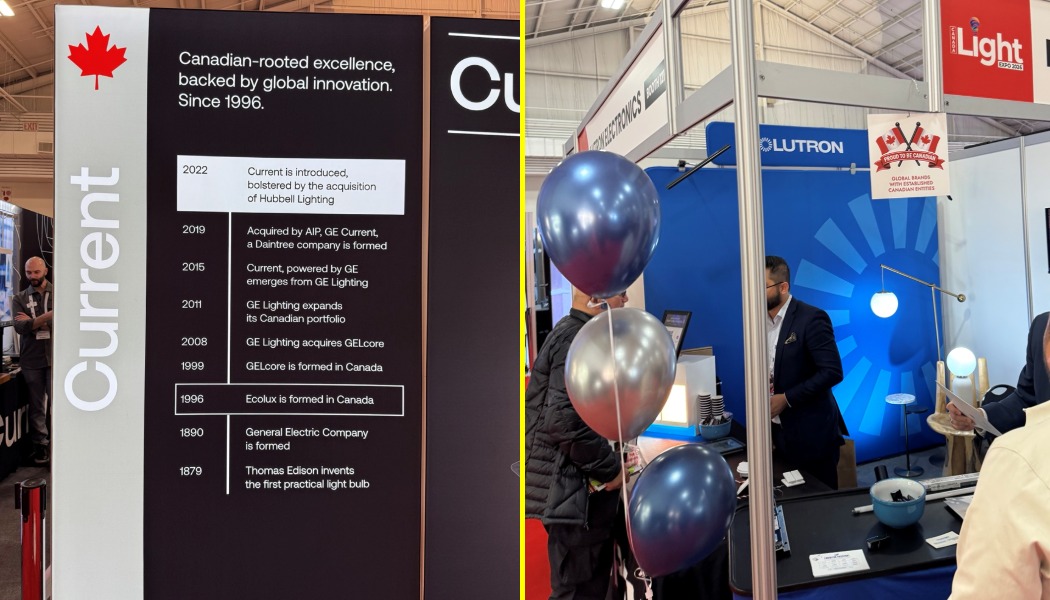
Current emphasized Canadian history, while Lutron highlighted an established Canadian presence.
Photo credit: Lance Hollner
Tariffs also consume working capital
A 50% surtax adds $50,000 CAD to a shipment with a $100,000 CAD value for duty, before other applicable taxes. Financing that obligation before collecting from a customer can tie up credit capacity. As Inside Lighting previously reported, affected lighting products face tariff barriers in both directions, straining companies that depend on cross-border sales.
Qualifying healthcare projects, including those in Ontario, can face a different calculation. Federal remission provisions provide relief for eligible imports used in medically necessary healthcare, potentially allowing an affected product to remain specified. Eligibility depends on the import and its intended use.
Finance Canada’s guidance for importers allows qualifying surtaxes to be waived at importation or refunded after payment. A properly supported claim filed through a customs broker can avoid advancing the surtax. A later refund leaves the importer financing the interval.

Western Canadian projects support optimism
A Western Canadian distributor offered a more upbeat view of demand, citing project activity in Calgary, Edmonton and Vancouver. The opportunities extended across the broader electrical business, including switchgear and transformers.
Data-center development and oil production were part of that optimism, particularly in Alberta. KPMG’s fall economic outlook cites commodity strength, major projects and data centers as supports for Prairie growth. Alberta’s outlook similarly points to energy activity and major projects supporting investment and construction.
Those projects offer opportunities for lighting suppliers alongside the wider electrical channel, although stronger demand for electrical infrastructure does not predict equivalent growth in luminaires.
Software works on the handoffs
OASIS and Sourcery focused their shared show presence on connecting designers' fixture schedules with the agencies representing the products on them. RepConnect, a Sourcery feature powered by OASIS, was presented as available, identifying agencies and sales contacts by a project's territory.
The partnership was announced at ArchLIGHT Summit in September. RepConnect is an early result; broader pricing and project exchanges remain in development.
A separate November 18 announcement paired Ingen Software’s OASIS with IDEA’s ProjectNexus. The planned integration would bring order and shipment updates into OASIS, reducing portal checks and tracking emails. Technical work is underway, with workflows, permissions and timing still being defined.
Both initiatives target persistent gaps between companies working on the same lighting project: identifying the right agency during specification and getting reliable order information after the sale.
LensVector optics return under new ownership
A representative carrying a sample case around the show offered an informal look at liquid-crystal beam-shaping optics formerly marketed by LensVector. Québec-based Patqer Photonique acquired the technology and lighting patent portfolio, according to LensVector’s notice.
Université Laval identifies Tigran Galstian as a co-founder of both companies. Patqer’s product information describes electronically adjustable optics that broaden beams symmetrically or independently in horizontal and vertical directions without mechanical movement. For designers, the attraction is adjusting distribution after installation.
A growing Canadian alternative to crowded LEDucation
Show management printed 1,937 badges this year, up 49% from about 1,300 last year. The exhibitor count rose to 145 from 90.
Tariff-driven sourcing questions added to the appeal of a Canada-focused show where buyers could compare products and clarify their origin and delivered cost. Attendees also described the event as a suitable alternative to LEDucation for those finding the New York show increasingly crowded and hectic. The more relaxed setting allowed longer product discussions without the pressure of crowded aisles.
Show management wants to preserve that atmosphere as the event grows. Organizers are seeking a larger hall for next year rather than narrowing the aisles to fit another row of booths. The space and dates remain to be secured.
Practical education puts controls to the test
The Lighting Controls Escape Room put attendees in front of familiar faults: a sensor that activates lights only for them to time out immediately, or a button that calls the wrong scene.
Led by Webster Marsh of Penumbra Controls and Will Norris of VxV Solutions, the workshop used live training boards and a Casambi-based setup. Instruction and app setup preceded troubleshooting exercises with planted faults.
The exercises connected programming and device settings to visible behavior, giving attendees practice diagnosing why a system was doing something different from its intended sequence.
Other sessions covered circadian lighting, wellness design and applying WELL standards.
The industry makes time for a game show
The first evening’s Lovers of Light Canada brought costumes and a lighting-themed game show to the seminar area. Questions included what can ruin a great lighting design and which terms confuse outsiders. Contractors, architects, color temperature and too much light all appeared on one answer board.
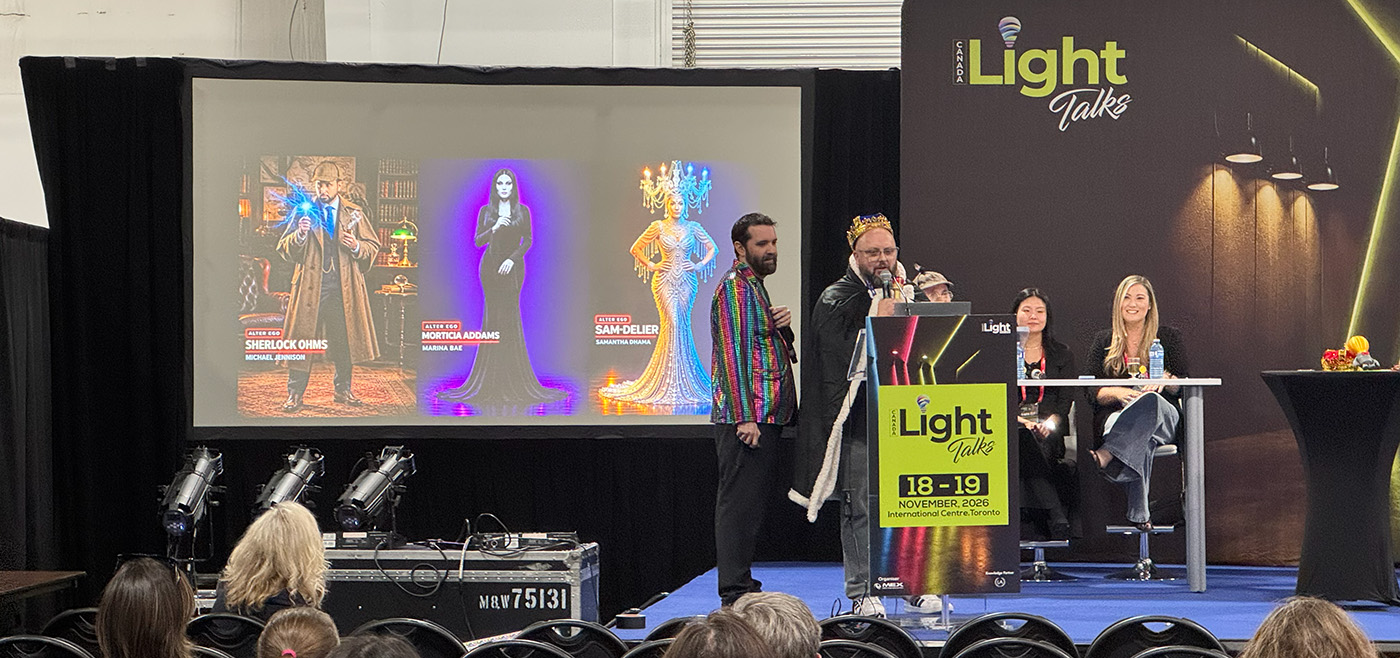
Costumes and lighting-themed questions turned Lovers of Light Canada into an entertaining evening gathering for the GTA lighting community. Photo credit: Lance Hollner
The jokes drew on shared frustrations and gave people from different sides of a specification or sales transaction a reason to stay after the day’s business ended.
Growth will test whether the show can retain the atmosphere attendees valued. For an industry working through tariff questions and substitutions, time to compare products and get clear answers is part of the event’s appeal.

Lance Hollner
Lance Hollner is a lighting and controls industry executive with leadership experience at manufacturers, sales agencies, field services companies, and design/build construction firms. He previously served as CEO of MaxLite, Executive Vice President and Principal at Diversified Group (PA/NJ/NYC Agency), and held leadership roles at Acuity Brands.
As founder of Apex Insight Group, he advises businesses on growth strategy, operational improvement, succession and exit strategy, and AI & Technology adoption, drawing on experience leading organizations and strengthening connections across the industry.
Disclosure: Hollner advises Ingen Software (OASIS) and Sourcery through Apex Insight Group and serves on Pull Logic’s advisory board.