November 16, 2026
Outdoor Lighting's Ecological Impact Goes Beyond Spectrum
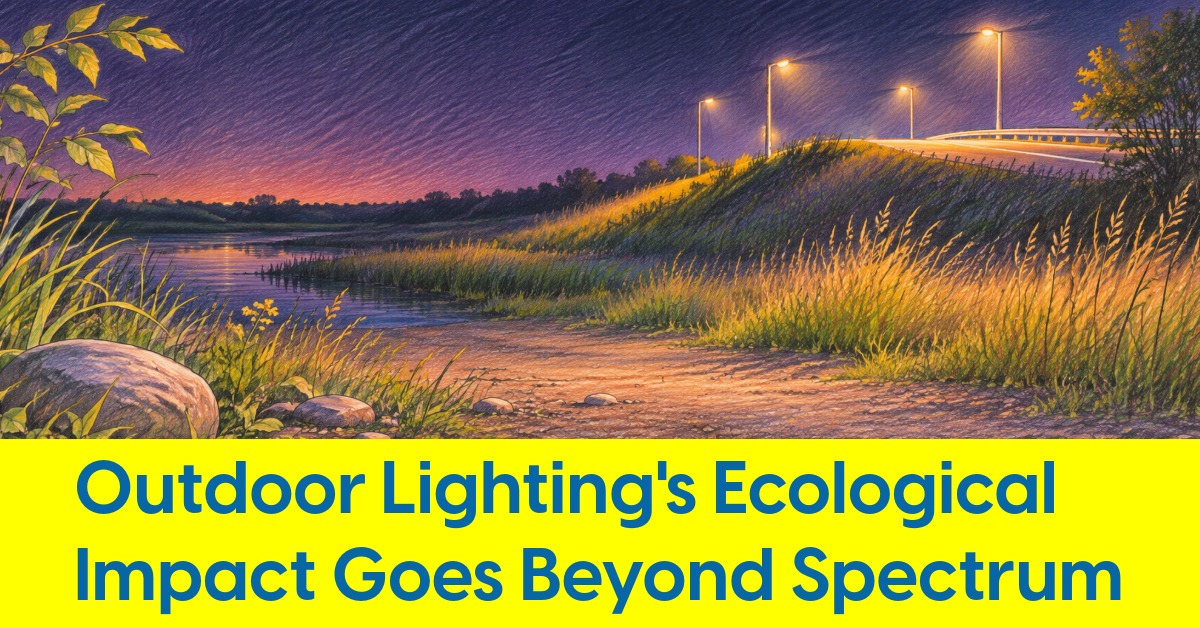
A scientific review challenges the color-first approach to reducing ecological light pollution
Ask what makes an outdoor fixture wildlife-friendly, and the answer often leads with color temperature. A new review in Nature Reviews Biodiversity puts that answer last among four strategies for reducing ecological light pollution.
The paper is by six researchers led by Ashton Dickerson of the Leibniz Institute of Freshwater Ecology and Inland Fisheries in Berlin. Travis Longcore of UCLA is one of them. It reviews existing studies and reports no new field research.
Its main contribution is a proposed four-tier hierarchy of measures, which the authors order by effectiveness. First, remove lights that serve no real need. Second, confine and reduce light through shielding, tailored optics and dimming. Third, limit operating hours with time switches, motion sensing and smart controls. Fourth, tune the spectrum. The authors caution that the hierarchy still needs testing across a broader range of species and settings.

They call spectral tuning a “supplementary measure.” They say it helps species that are sensitive to blue and ultraviolet light but falls short as a stand-alone strategy. Their reasoning is that there is “no universally ‘safe’ spectrum.” A warm source may miss one animal’s peak sensitivity and still trigger a response in another.
That’s an awkward finding for product lines whose wildlife claims rest on amber and warm-white LEDs. Warm light keeps a place in the framework, but it sits behind hardware decisions that spec sheets rarely lead with.
Where the Numbers Point
Removing unneeded lights produced the biggest gains. The authors cite reductions of more than 90% in harm to insects and other arthropods. The shielding figure is more useful to manufacturers: at identical illuminance, shielding reduced insect attraction by about 50%. That evidence comes from German towns and cities near nature reserves that installed shielded luminaires.
The authors also argue that shielding, optics and dimming “should be designed together.” Optical distribution, output, mounting geometry and luminaire spacing together determine how much light reaches the target area and how much spills into nearby habitat. That sentence could have come from a photometric layout review. Most of the levers belong to optical engineers, controls providers and whoever decides where the poles go.
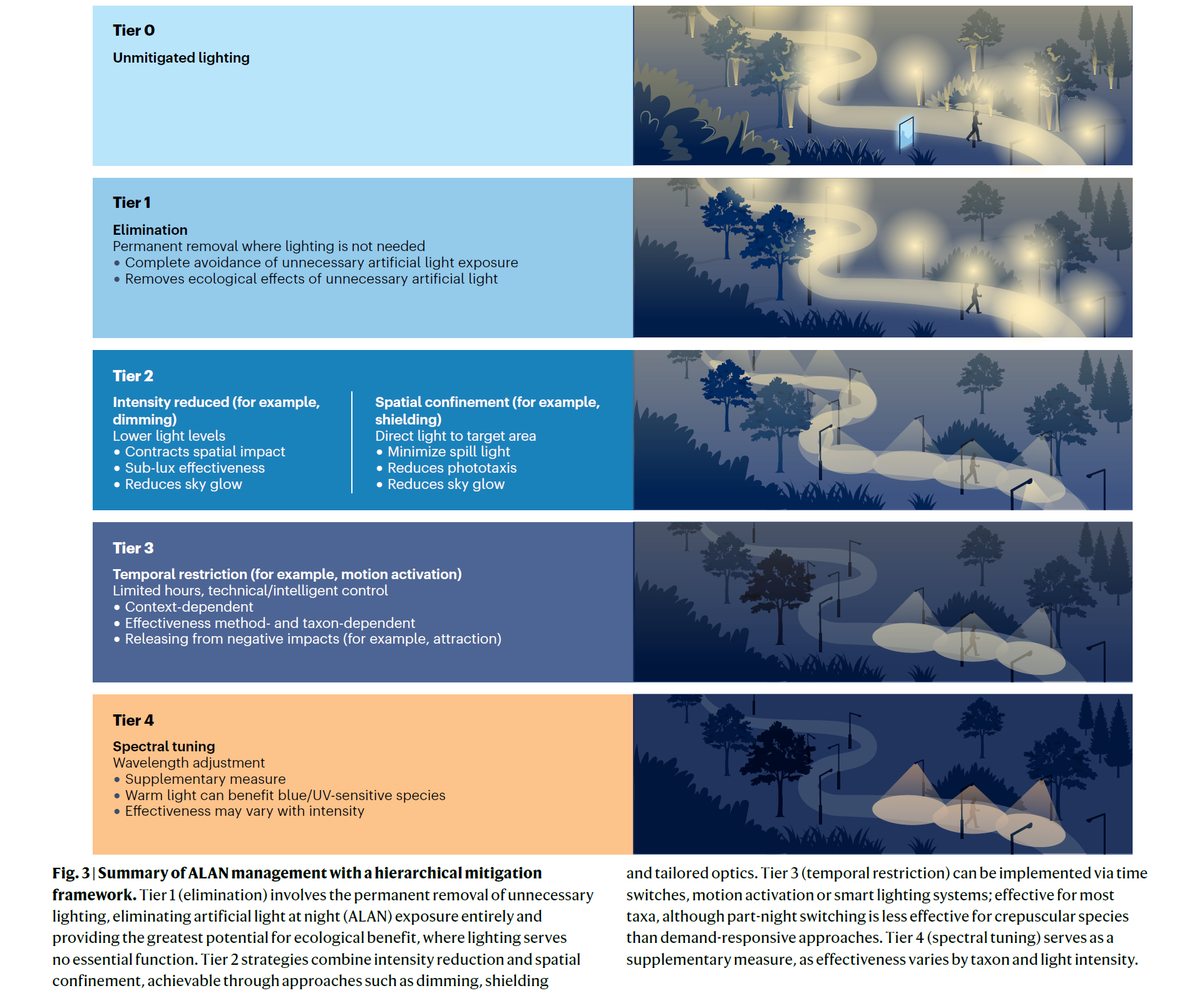
Above: The proposed hierarchy, from the most to the least effective measure: remove unneeded lights, dim and shield, limit operating hours, then tune the spectrum. The authors call spectral tuning supplementary because its effectiveness varies by species and light intensity. Source: Dickerson et al., Nature Reviews Biodiversity (2026).
The Sub-Lux Problem
The thresholds are the uncomfortable part. Studies that measure response against light level find animals most sensitive below 1 lux, with responses leveling off at higher intensities. Sky-glow levels of 0.06 to 0.1 lux have disrupted processes ranging from nutrient cycling in lakes to butterfly diapause, a seasonal dormancy. For comparison, the paper says international (CIE) streetlight guidelines run from about 2 to 30 lux, depending on road type.
What follows is our reading, not a claim the authors make. If the biological response levels off well below roadway design levels, cutting a road from 10 lux to 7 could save energy and do little for nearby wildlife. The light reaching the hedgerow or riverbank matters more, so spill control may be the bigger lever. Dimming still counts when it pushes light at the edge of the lit area below those thresholds, and the authors credit it with shrinking the area affected around each source.
Standards, Laws and a Spec Sheet
The review says voluntary standards and legislation often work at cross purposes, because standards aim at “sufficient” lighting for human vision. The authors cite CIE, not the Illuminating Engineering Society, but North American roadway designers will recognize the tension. The authors also cite EU Regulation 2019/2020, the ecodesign rule for light sources, as an example of law that puts energy efficiency ahead of biodiversity.
Upper Austria shows how a technical standard can become law. Section 41b of the state’s 2024 Environmental Protection Act adopts the ÖNORM O 1052 light emission limits by reference, which gives them legal force without a separate light pollution statute. Other precedents in the paper include Germany’s 2021 Insect Protection Act, Australia’s 2023 National Light Pollution Guidelines for Wildlife, and guidelines adopted under the Convention on Migratory Species in 2024.
The recommendation with the most commercial weight is in a sidebar. The authors propose fixed emission limits for each lighting type that “producers, vendors and lighting planners” could apply before anything is installed. Today, regulators often have to prove after installation that a particular light caused harm. Under fixed limits, compliance would come down to a number that manufacturers and designers can calculate before installation. The work is part of a German Federal Agency for Nature Conservation project examining regulatory approaches to light pollution, giving the recommendations a potential audience beyond academia.
What the Review Doesn’t Settle
Beyond the untested hierarchy, the authors say the research base leans toward the Northern Hemisphere and toward land vertebrates. Their one U.S. example, a comparison of paired cities, found weaker shifts in plant timing where mitigation policies existed. They call it a proof of concept.
For manufacturers, the open question is what “wildlife-friendly” will mean: a color temperature option, or a cutoff, a control schedule and an emission number someone can audit. If more regulators follow Upper Austria, that definition could end up in the spec before marketing has a say.