November 17, 2026
Incandescent Repeal Bill Faces Lame-Duck Deadline
The bill remains stuck after a divided Senate committee vote, with broader lamp standards at stake
The Liberating Incandescent Technology (LIT) Act left the Senate Energy and Natural Resources Committee on September 30 on an 11 to 9 party-line vote, a tally that had not been posted when we first reported the committee action. Since then, the bill has not moved. Nearly everything around it has.
The midterms have come and gone, and the lame-duck session is now the last realistic opening for S.1568. Any bill not enacted before the 119th Congress adjourns dies with it, and the same clock applies to Sen. Mike Lee’s broader Energy Efficiency Reform Act, introduced in August.

Sen. Mike Lee (R-UT) wrote the bill and chairs the committee that advanced it, but committee chairs are chosen anew when the 120th Congress organizes in January. The House companion, H.R. 3341 from Rep. Craig Goldman (R-TX), has not moved since it was referred to Energy and Commerce in May 2025.
With no Democratic support, the Senate bill would generally need 60 votes to overcome a filibuster, so its realistic route has always been a rider. Congress used that approach in 2011 to defund enforcement of the original bulb standards. It works only if a must-pass bill moves and someone fights to attach the rider.
NEMA’s Eric Bursch told Facilities Dive in October that the split committee vote made end-of-year package action less likely, because senators prefer to move bills by unanimous consent. He also noted the gap between the bill’s premise and the factory floor. “Our members no longer make incandescent bulbs,” he said. “That hasn’t been the standard for a few years.” We have found no lame-duck vehicle carrying the bill.
Lighting Associations Signal Statements
The professional societies may soon weigh in. A slide shown at last week’s IES Street and Area Lighting Conference (SALC) summarized the bill. It said the International Association of Lighting Designers (IALD) and the Illuminating Engineering Society (IES) are both likely to release public statements.
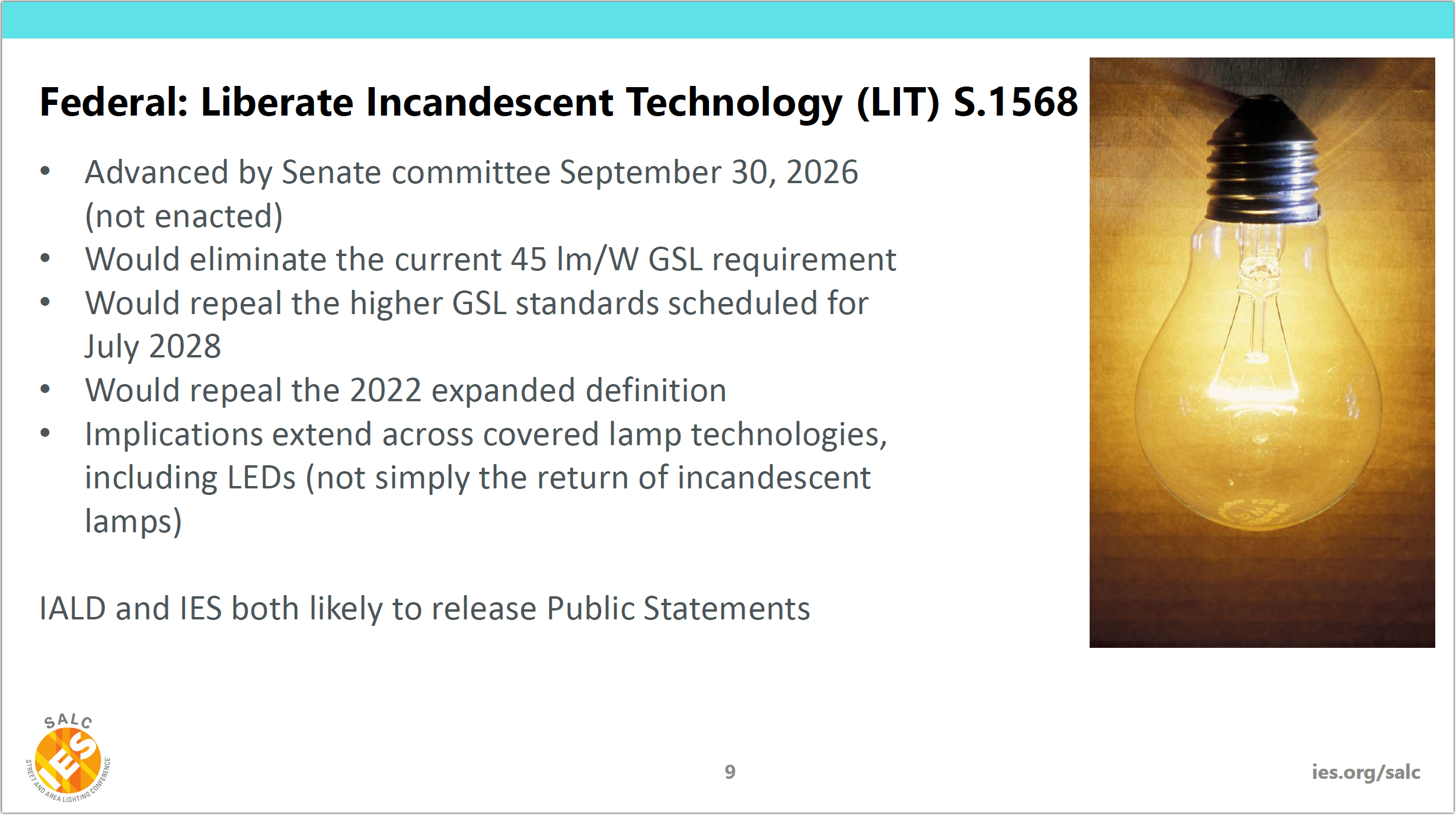
Above: A slide presented at last week’s IES Street and Area Lighting Conference summarized S.1568 and said IALD and IES are both likely to release public statements. (Source: IES)
The slide also made a point the sponsors rarely mention. Repeal would eliminate the 45 lm/W general service lamp floor, cancel the higher 120 lm/W standards due in July 2028 and undo DOE’s 2022 expanded definition. The implications reach across covered lamp technologies, LEDs included. Read that way, the fight is over whether any federal efficacy floor survives for the lamps lighting people actually sell, and the 60-watt bulb is mostly the mascot.
The Fine Print Still Reaches Commercial Lamps
As we reported in October, the bill strikes Section 325(i) of the Energy Policy and Conservation Act in its entirety. That subsection also holds the 1992 efficacy minimums for general service fluorescent lamps and incandescent reflector lamps, the rules behind 4-foot T8s and halogen PARs. Neither sponsor has said whether erasing those floors was intended.
In a September 15 letter, NEMA and the American Lighting Association warned that foreign factories would be the main beneficiaries of repeal. They also warned that fixtures redesigned for LED heat loads are not rated for incandescent lamps. That liability question would land on fixture makers and contractors as much as on retailers.
What Repeal Would Mean for Commercial Work
By our reading, the commercial exposure is real but very narrow. The bill does not touch spec-grade luminaires, controls or energy codes, so the lighting power density limits in ASHRAE 90.1, the IECC and Title 24 would still govern new construction.
Relamping is where repeal could show up. Without the reflector lamp floors or the 2022 definitions rule, low-efficacy halogen PAR and BR imports could return to retail and hospitality maintenance shelves. Linear fluorescents are a weaker bet, since about ten states, including California, Colorado and Vermont, have banned mercury-containing lamps.
Then there is the question of who would actually make the bulbs. Domestic incandescent lines were shut down and largely scrapped years ago. Restarting one would mean buying new capital equipment for a low-margin product whose legal status could flip with the next Congress, the next DOE rulemaking or a single state legislature. Sen. Catherine Cortez Masto said at the hearing that restarting production would not make economic sense, and we found no lamp maker saying publicly that it would try. The likelier suppliers are foreign factories positioned to fill the gap, the outcome NEMA and ALA predicted. They would be selling into a state-by-state patchwork, because the bill loosens federal preemption.
What to Watch
Any stopgap or omnibus spending bill that moves before adjournment is the last practical vehicle in this Congress. Failing that, the sponsors would start over in January with reintroduction, a new hearing and a new markup.
Meanwhile, DOE supports the bill but has not, as far as we can find, formally delayed July 25, 2028, when the 120-plus lm/W standards take effect.
The Senate is scheduled to adjourn December 18, and the 119th Congress expires January 3; a government funding deadline on December 11 is the likeliest ride for a rider.