November 11, 2026
At SALC, the Buyers Talked. Here’s What They Said.
Cities, DOTs and utilities spent three days in Phoenix comparing notes on failures, theft and payback
Cities, DOTs and utilities buy millions of streetlights. Most of the people selling them find out what those buyers want from an RFP and a rep’s best guess at what the customer really meant. At the IES Street and Area Lighting Conference in Phoenix this week, more than 900 attendees got it firsthand. The buyers were in the room, and they spent three days telling each other what’s broken, what they’ll pay for and what they wish they had done differently.
We can’t think of another lighting show that puts this many end users in one place. We sat in on the sessions, worked the hallways and listened in on the sidebar conversations with one question in mind: what are the people who buy streetlights telling the people who sell them?
Four messages came through clearly:
1. The First LED Installations Are Coming Back to Market
NYC DOT converted nearly 400,000 streetlights, mostly between 2012 and 2019. The oldest of those assets are now about 14 years old, and Akmal Mikhail, who directs streetlighting engineering for the department, told attendees it projects annual driver failures rising from 0.5% to between 3% and 5% as units hit that mark. The early fixtures deliver about 60 lumens per watt; current product exceeds 200. The city is moving from run-to-fail to planned replacement. He also named a regret: controls should have gone in during the conversion, because adding them afterward is “significantly more costly and complex.”
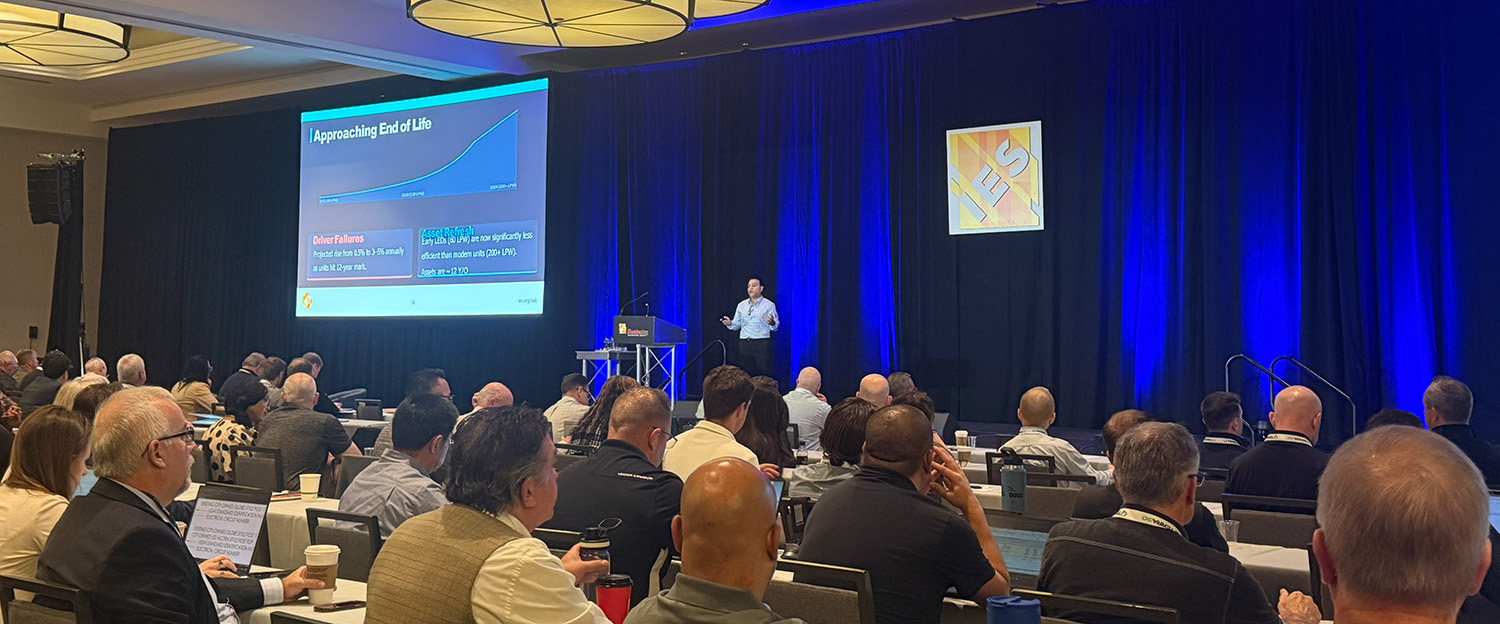
Above: Akmal Mikhail of the New York City Department of Transportation speaks at SALC 2026 in Phoenix
Georgia Power and Southern Linc described the same problem from the network and controls side. Georgia Power is moving its networked lighting controls off ultra-narrow-band radio and onto NB-IoT running over Southern Linc’s private LTE network, replacing every mapped base station across Georgia and Alabama. Southern Linc says it is planning for more than 1 million lighting control nodes, a scale its network “has never seen before.” The motive is plain: utilities have been “burned before” by carrier network sunsets. One slide, titled “The Ghost of NLC Future,” warned that hardware, software and CMS all reach end of life.
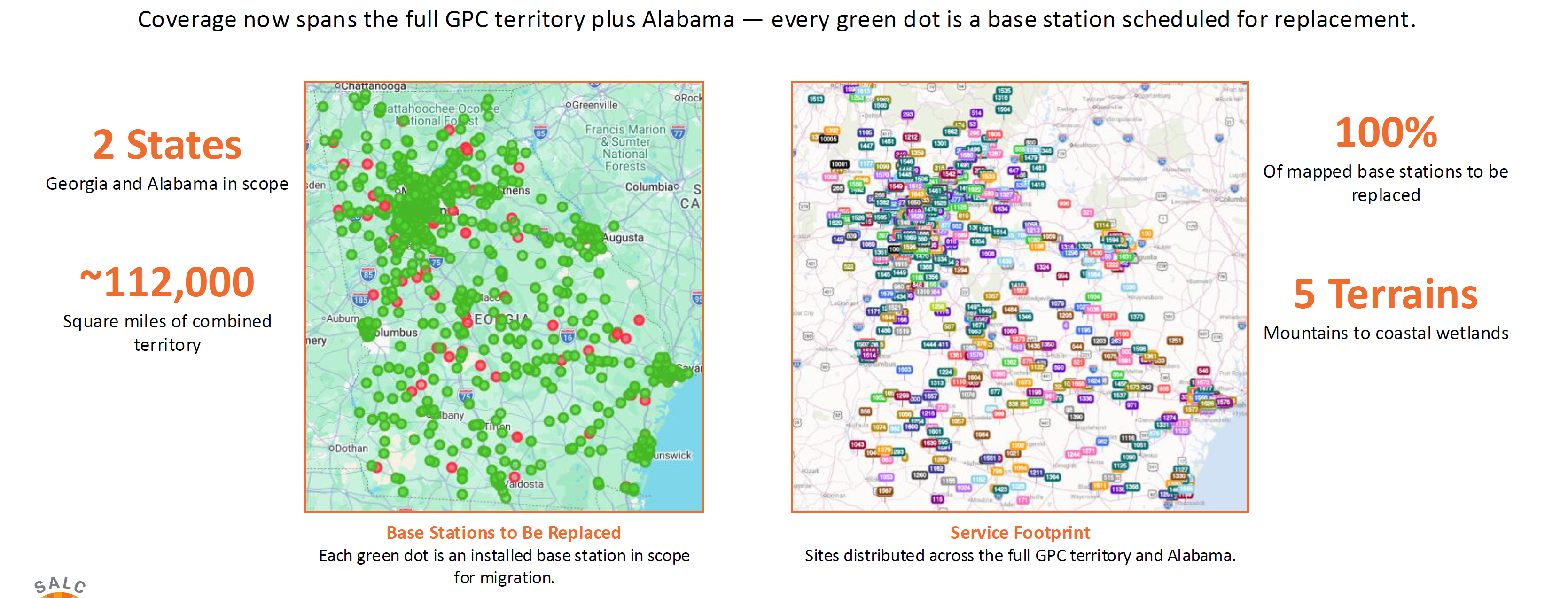
Georgia Power plans to replace 100% of the mapped base stations behind its streetlight controls across roughly 112,000 square miles of Georgia and Alabama. (Slide: Georgia Power/Southern Linc, SALC 2026)
For manufacturers and reps, that adds up to a large installed base returning to market, owned by buyers who have learned a few things. They’ll weigh NEMA 7-pin sockets, DALI drivers, open interfaces such as TALQ and D4i, and connectivity a carrier can’t switch off. Georgia Power’s evaluation framework for control nodes even asks where the device and its modem are designed and manufactured, a supply-chain question worth having an answer for before the RFP arrives.
2. Controls Aren’t the Option Package Anymore. They’re Infrastructure.
Copper theft is a lighting problem, and the Arizona Department of Transportation (ADOT) offered the clearest case for treating controls as security equipment. ADOT installed 12 smart photocells that send a “last-gasp” signal when power is cut. On the second night, an alert went out, state police were dispatched, and an arrest followed at a location that had been hit weekly. At I-17 and Happy Valley Road, about 50 nodes produced one arrest and then a second a week later. Mesa reported a similar arrest from last-gasp alerts, and its switching logs have helped the city fend off legal claims.
A connected streetlight’s power-loss alert led to this 2025 copper theft arrest near I-17 in Phoenix. (Video: KPHO)
Manufacturers should notice how ADOT arrived there. The idea came from a conference booth where a vendor was selling plug-in cameras for connected lighting nodes. The camera was “a useful feature, but not what caught my attention.” The power-loss notification was. Call it a small reckoning for cameras: the feature that sold a state DOT on networked controls was an alarm.
ADOT’s other lesson matters just as much to vendors. IT software review and homeland-security concerns delayed the rollout by more than eight months. The deck closes with “The Technology Detects. People Deliver.” and calls for a full-time system owner. The sale, in other words, does not end when the nodes ship.

3. L.A. Bets on Solar, Then Grades It Hard
We asked numerous municipal, DOT and consulting-engineering attendees whether solar streetlighting is ready for prime time. We skipped the manufacturers, since solar makers can give you 17 reasons it is great and everyone else can give you 17 reasons it isn’t. The people who specify and buy streetlights gave us mixed reviews.
Los Angeles made the strongest case for solar and, read closely, the most candid. The Bureau of Street Lighting has installed about 2,000 roadway solar units since 2023, driven partly by copper theft, and floated a conceptual $19 million a year in lease revenue from conduit the conversion would free up. It has also lab-tested 39 solar units and approved eight. Approved units may not use dimming or motion sensors, and UL certification appears on the roadmap for 2027. The headline result, a 31W solar fixture beating a 70W LED by nearly 42% in field readings, pitted new solar against an LED installed in 2018 at 4300K; the deck’s own footnote notes that fixture has drifted since.
The fair conclusion is that one of the largest and most committed solar buyers in the country has approved only a fraction of what it tests. That’s useful to both camps, and probably more useful than another 17 reasons.
4. The Studies Favor Dimming. The Payback Doesn’t.
The safety evidence presented pointed in one direction. Suffolk County Council in England reported average savings of 51% over 12 months at its trial sites with no statistical difference in crash rates. Consultant Don McLean cited a 2025 Department of Energy study covering 7,000 lights and a Virginia Tech Transportation Institute project, both finding no significant effect on crashes or crime at the sites studied.

In the exhibit hall, 83 exhibitors put product within arm’s reach. Inside Lighting’s Al Uszynski sizes up a 30,000-lumen Streetworks Archeon controlled by Trellix, in the Cooper Lighting booth.
Those results are encouraging, but they don’t clear dimming everywhere. McLean’s own deck lists places not to dim, including signalized intersections, midblock crosswalks, roundabouts and rail crossings.
The economics are a bigger obstacle. McLean’s sample math (1,000 cobra heads, 40% dimming, $200 per node installed plus an $8 annual CMS fee) produced an energy-only payback of roughly 11 years. Cities on flat-rate utility tariffs may never see the savings at all. Riverside, Calif., which converted more than 33,000 luminaires, evaluated a full CMS and turned it down for cost and operational complexity, choosing programmable smart photocells with scheduled dimming instead.
Who Signs Off on the Next Sale
Read across the sessions, and the business case for controls has quietly changed. Nodes were once sold on kilowatt-hours. In Phoenix, cities and utilities justified them on theft response, liability defense and maintenance, with energy savings a welcome bonus. McLean’s 11-year payback shows why energy alone can be a hard sell, while an arrest at a site hit every week, or a switching log that helps settle a claim, is easy for a city council to understand.
That shift also changes who sits at the table. ADOT’s system had to clear IT and homeland-security reviewers before it saved a foot of wire, and it works only because state police agreed to respond and operators read every alert. Mesa’s switching logs ended up with the city’s lawyers. Georgia Power’s node checklist runs through cyber risk assessments and carrier certification alongside country of origin. Reps who pitch only the streetlighting supervisor may be missing the people who now decide, and buyers who approved eight of 39 solar units and walked away from a full CMS are reading well past the spec sheet.
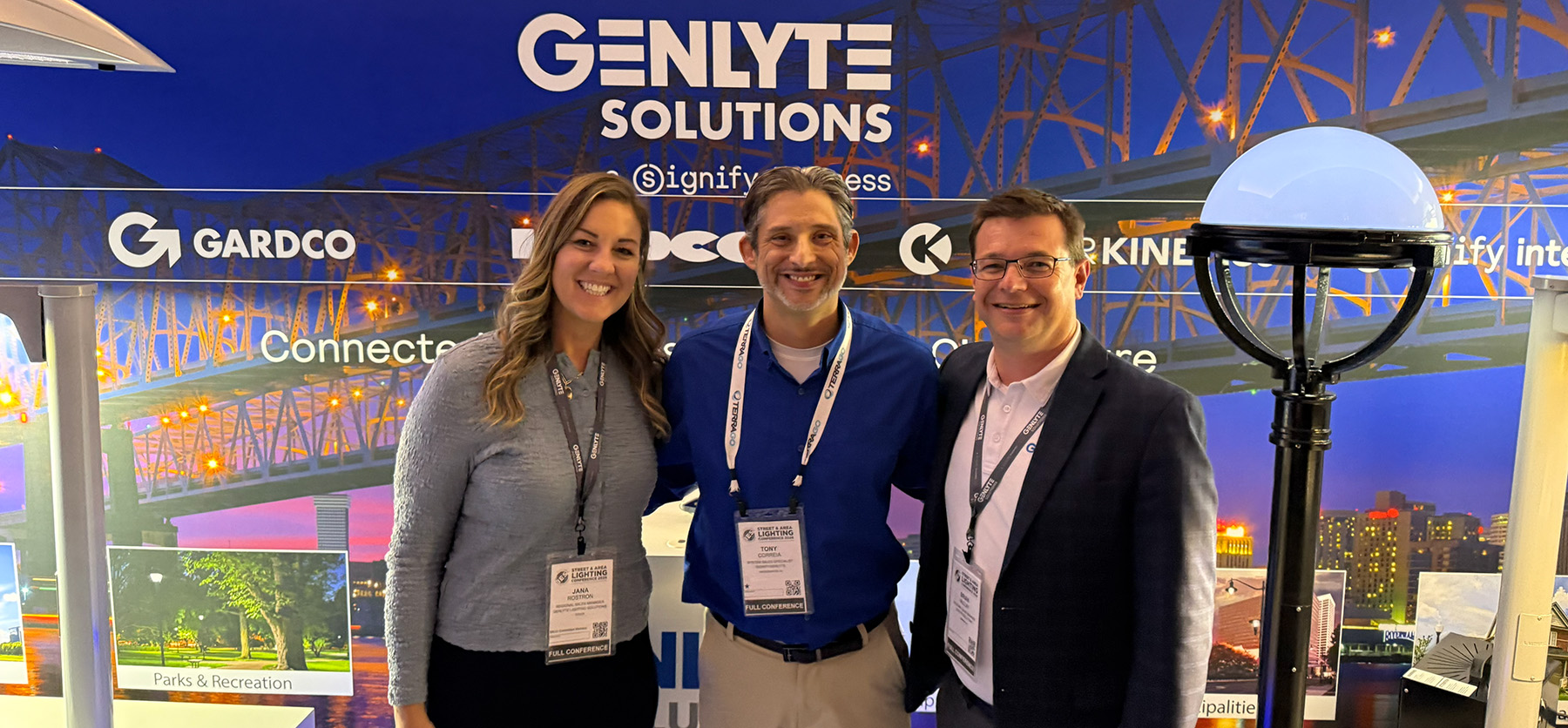
Above: Jana Rostron (left) of Genlyte Solutions will chair the SALC Executive Subcommittee for 2027, when the conference moves to Orlando. She’s joined by Genlyte Solutions colleagues Tony Correia (center) and Brian Mullay (right).
SALC 2027 moves to the Renaissance Orlando at SeaWorld, Sept. 27 through 30, with education shifting to Monday instead of Sunday, which hands attendees their weekend back. The conference heads to San Antonio in 2028.