November 10, 2026
Dialight Turns Pricing Discipline Into Bigger Lighting Profits

Tighter bid approvals and fewer SKUs help nearly triple segment operating profit
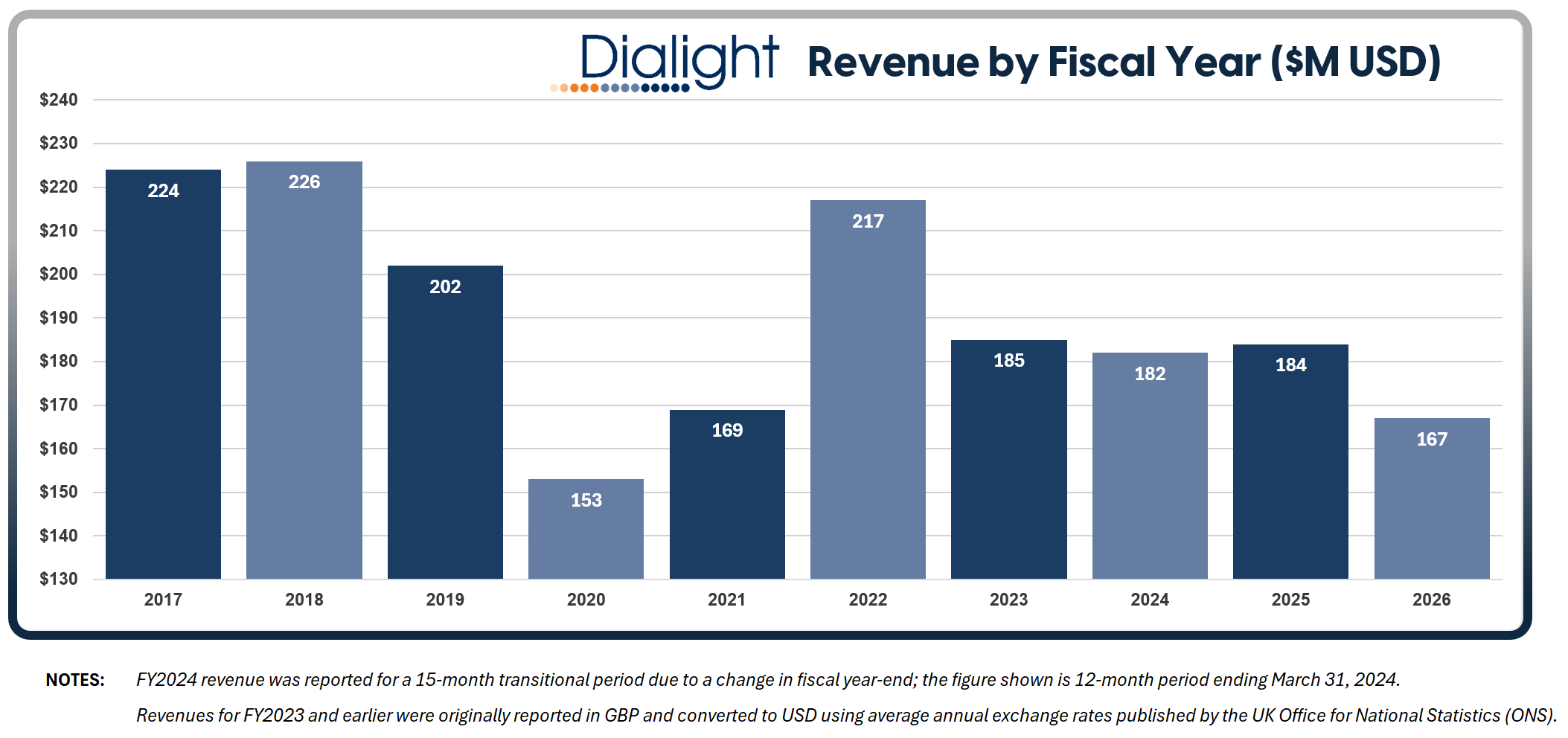
In June, we described Dialight’s annual report as two companies in one filing: one that ran itself well, and one that kept selling less. This half, the second company finally grew. The more interesting question is how.
The interim results Dialight released today point mostly to pricing. The industrial and hazardous-location specialist raised prices while industrial capital spending was soft and still grew. Data centers did much of the rest.
For the six months ended September 30, Lighting revenue rose 14.4% to $69.1 million. The segment, which accounts for about 70% of group revenue, lifted its gross margin from 36.9% to 48.3%. Management credits “improved pricing discipline,” price increases, “tollgate” pricing approvals and a push toward fewer, higher-margin SKUs.
The telling figure is in the segment notes. Lighting’s cost of inventories expensed, the product cost of what it sold, fell 16% from $19.8 million to $16.6 million while revenue climbed 14%. That cost dropped from about 33% of Lighting revenue to 24%. The line can include manufacturing and conversion costs as well as raw materials, so it doesn’t measure how many fixtures shipped. It is still strong evidence that pricing, product mix and cheaper production are doing more of the work than volume.
Dialight gives no price/volume split. And unlike in June, when it highlighted a backlog up more than 25%, it reports no Lighting backlog figure, so readers can’t tell whether new orders are replacing the ones that shipped.

The Sales Team Learns to Say No
The annual report explains the mechanics. Any bid below margin targets now needs approval from CEO Steve Blair or CFO Mark Fryer. Underperforming salespeople were let go, lighting agent commissions now reward margin as well as growth, and finished-goods SKUs were cut by roughly a third.
The results show up in the segment’s own numbers. Lighting’s operating profit before central costs rose from $5.6 million to $14.9 million, while segment overheads rose only $1.8 million, mostly from higher commissions. Of the $11.1 million in added gross profit, $9.3 million reached the segment’s operating line.
The filing doesn’t say how distributors and contractors have taken the increases, but the arithmetic suggests someone in the chain is paying more per fixture. In our view, the niche explains why it worked. A maintenance manager replacing a certified fixture at a refinery has fewer choices than a warehouse buyer comparing catalogs.
Tailwinds and Fine Print
Part of the rebound comes from an easy comparison. Last November we reported that Lighting sales had fallen 9% in the prior-year half, which puts this half only about 4% above the level of two years ago. Group revenue rose 9.3% to $94.4 million, or 19.8% excluding the exited Traffic business. Components grew 37.5% on that basis, and order intake for its opto-electronic parts doubled on data center demand. The company says that growth depends on data center investment continuing “to increase globally.”
Group operating profit rose to $14.9 million from $5.9 million, and Dialight now holds $4.5 million in net cash after carrying $10.2 million in bank debt a year ago. However, inventory rose $6.1 million, and Dialight says the overheads capitalized into that inventory produced a $3.6 million benefit to first-half operating profit, about a quarter of the total. That benefit reverses if stock comes down, and management expects inventory to rise a little further.
The company also says its Mexican plants are running at less than half of theoretical capacity and remain tariff-free under USMCA, a status it keeps “under review.” Management calls the spare capacity headroom. It also shows how far Lighting volume sits below what those plants were built to produce.
What Lighting People Should Watch
Analysts at Investec and Singer Capital Markets had forecast full-year pre-tax profit of about $17.3 million to $17.6 million. Dialight earned $14.2 million in the first half alone and now says it could “significantly exceed” net income expectations.
That leaves one question the filing doesn’t answer. Dialight has shown its customers will pay more. It has not yet shown they will buy more.