


September 14, 2026
Specification Integrity Meets a More Complex Industry
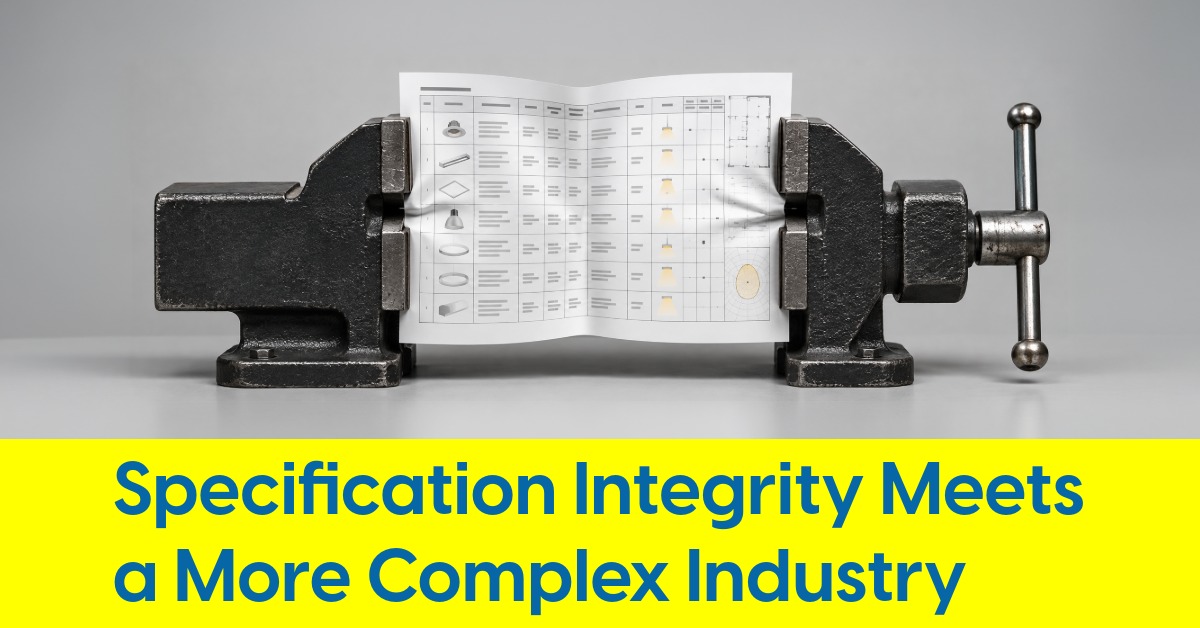
What IALD's 2017 guidelines for spec integrity got right, and where the ground has shifted
The Guidelines for Specification Integrity, published by the International Association of Lighting Designers (IALD) in 2017, called itself a "Pilot Edition." That framing was accurate. The project set out to give lighting designers of any experience level a working vocabulary for defending a specification through budget cuts, substitutions, and construction, and by that measure it succeeded: nine years on, it's still the closest thing the architectural lighting design profession has to a shared playbook for the subject.
No document this ambitious could cover every nuance of lighting design permanently, and this one never claimed to. So rather than treat the guide as finished business, Inside Lighting went back through it to see which parts have held, and which have simply had more industry built on top of them since 2017.
What Aged Well
The foundational advice reads less like a product of 2017 and more like something written to survive any year.
- The three core rules are basically timeless. Write specifications clearly, coordinate with the full design team, and stay engaged from concept through completion. Nothing about LED evolution, controls proliferation, or channel consolidation has touched these.
- "Photometry trumps wattage" nailed the trajectory. The guide warned designers against treating wattage as a defining spec characteristic, on the logic that efficacy would keep improving. It did, and the advice reads even better now than it did in 2017.
- The value-engineering warnings haven't dated at all. Establish substitution rules before bidding, document VE compromises in writing, and don't let first cost drive design decisions. If anything, this fight has gotten harder given aggressive VE and channel consolidation.
- Product evaluation already looked past the cut sheet. The guide told designers to weigh warranty, long-term availability, and field service alongside photometrics, well before availability and support became major differentiators in their own right.
- They were forward-looking on maintainability. The guide recommended modular luminaires that would allow internal components to be replaced as technology improved, and urged designers to consider future product generations and long-term manufacturer availability.
- "Get out of the office" is more relevant now, not less. Visit factories, get working samples in the room, and build a product-performance database. In an era when a website can make a mediocre product look flawless, this instruction has only gained urgency.

Where the Industry Has Kept Moving
None of the above is where the guide shows its age. The more interesting territory is where the profession has simply generated new practice since 2017, on ground the original document didn't need to cover yet.
Buy/sell has reshaped what specification integrity is defending against: The 2017 document assumes a clean separation: the lighting consultant designs, the manufacturer and distributor supply, and the framework exists to help the designer hold the line against that supply chain's commercial pressure. In 2024, IALD adopted a revised Code of Ethics that removed prior restrictions governing certain financial relationships, shifting the ethical emphasis toward disclosure of conflicts of interest. Only a small minority of architectural lighting designers actually procure or supply product themselves, and for that group, disclosure and transparency have become the operating principle for upholding the same ethical standards in this expanded context.
Several other areas have simply matured alongside the core document:
- Controls have grown from equipment into ecosystems. The guide covers 0-10V, DALI, BACnet, and wireless protocols competently. The conversation has since extended into firmware support, cloud dependence, data ownership, privacy and continuity when a building changes hands, all of which now show up in serious controls specifications as a matter of course.
- Cybersecurity has become its own line item. A networked lighting system increasingly touches occupancy data, administrator credentials, and the building's broader network, and specifiers are paying closer attention to who owns that data and who holds access once a project is commissioned. It's become a materially larger consideration in controls specification work.
- Light & Health was already on the radar; the science has deepened considerably. The 2017 guide flagged flicker as something to test for and coordinate against occupant needs, and that instinct holds up well. Research into circadian lighting and the broader effects of spectral output, including work outside the visible range, has since given specifiers a far more clinical basis for decisions that used to rest mostly on comfort.
- Maintainability and repairability: the products haven't always followed the guide's vision. Most architectural LED fixtures today are integrated rather than modular or easily repairable, limiting designers' ability to execute the maintainability strategy the original guide encouraged.
- The 2017 lead-time estimates still hold, but COVID showed how fragile that assumption can get. Four to six weeks for standard products, eight to sixteen for custom, remains a reasonable planning baseline. But when products can't ship on schedule, the risk isn't just delay. It's a substitution made under time pressure that ends up out of step with the original design intent, which is exactly the kind of drift specification integrity was built to prevent.
- Tariff policy has turned country of origin into a live variable designers now solve for in real time. Erratic tariff changes can shift a product's cost or availability with little warning, and increasingly it falls to the lighting designer to work through those implications on the fly rather than treat sourcing as a settled fact once a specification is written.
A Harder Job, for Good Reason
Lighting design sits at the intersection of photometric science and creative judgment, and it answers to numerous parties on a project: the architect's vision, the owner's budget, the contractor's schedule, the occupants’ actual needs. Those interests don't always align.
IALD's original initiative understood that tension. Specification integrity was never really about fixture schedules. It was about giving a designer with real creative and technical authority a way to hold that authority against pressure from everyone else at the table. Most of that framework still works exactly as intended.
But the ground continues to shift. Buy/sell models, networked controls, cybersecurity, tariff-driven sourcing, firmware lifespans; those things look a lot different today than they did in 2017. It doesn't make the original rules less true. It makes them more complex to execute.
Is that good? Depends where you sit. It's more to track and more that can go wrong between concept and occupancy. But it's also a profession growing into its own complexity rather than shrinking out of relevance, which is the better problem to have. Specification integrity was always the discipline that let good design survive contact with a construction budget. It just has more to survive now.