



August 31, 2026
Uncontested Election Points to Likely Future IES President
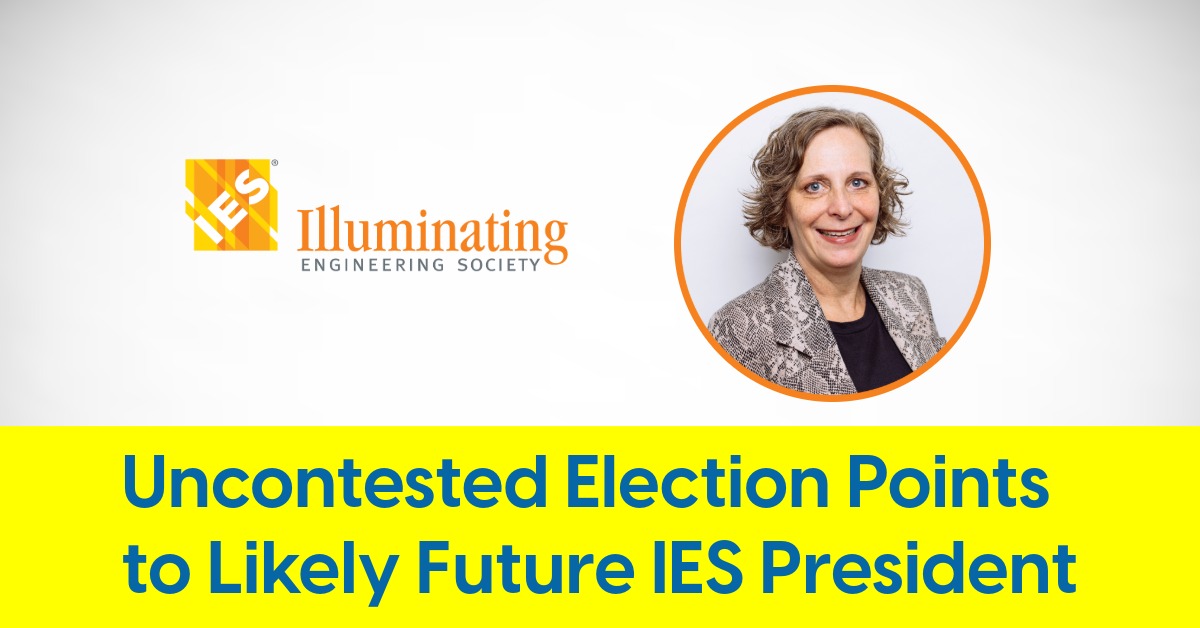
Carla Bukalski’s likely ascent comes alongside other nominations and a consequential bylaw change
Every year, Illuminating Engineering Society (IES) members open an email carrying the shape of the Society's leadership for years to come, and every time the shape looks similar: one name per open seat, the product of months of work by a nominating committee.
This year's ballot, open now with member votes due to IES by October 15, follows that pattern exactly. Carla Bukalski stands alone for Vice President (President-Elect). Michael Myer is unopposed for Treasurer. Three candidates, Ken Bruns, Matthew Hartley and Cristian Suvagau, fill three open At-Large Director seats. Jackie Eury and Kurt Nielsen are nominated for the South and West Regional Director posts.
This year's ballot also carries something the last few didn't: a bylaw amendment that would strike the write-in line from every office on future ballots, closing the one channel that actually produced the only contested race in recent Society memory.

The Succession Line Holds
If Bukalski's nomination is ratified, she becomes Vice President in 2027 and President in 2028, continuing an unbroken chain of one-year handoffs. Jared Smith is serving as President in 2026, Scotty Hutto is set to succeed him in 2027, and Bukalski stands next after that. The design is deliberate: IES bylaws cap the presidency at a single one-year term and route the Vice President automatically into the top job the following year, which means the Society's most consequential leadership decision typically happens a full cycle before a president actually takes office, at the moment the nominating committee settles on a single VP nominee.

Carla Bukalski
In her candidate statement, Bukalski points to nearly 30 years with the Society, spanning section leadership, committee work, conference planning and prior Board service. She credits recent progress on the Society's financial stability but argues that stability alone won't carry IES through a changing professional landscape, one where member engagement looks different and where standards work, education and knowledge-sharing remain the Society's core claim to authority in the field.
Her professional background spans engineering, lighting design and roles across some well-known manufacturers, backed by an MBA. She is currently a principal with Reed Burkett Lighting Design.
The Line the Bylaws Would Remove
Under current bylaws, every ballot must include, for every office, a blank line where a member can write in someone the nominating committee didn't choose. The proposed amendment deletes that requirement. IES's stated rationale isn't that the write-in option has been abused; it's that it doesn't functionally work.
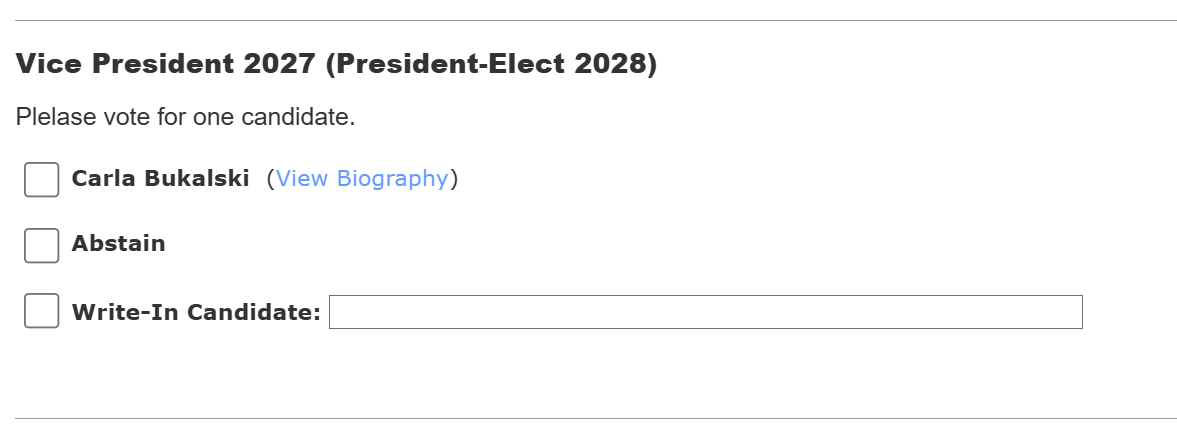
The IES Candidate's Handbook bars mass mailings and access to Society membership lists, and Campaign Conduct rules require prior approval for any communication to Sections, Regions or Society-wide lists. IES's printed rationale for the amendment centers on that restriction: because a write-in candidate cannot lawfully reach the membership through mail or list access, the Society reasons, the option should be removed. What the narrow, mailing-focused rationale doesn't address is that a write-in campaign can still reach members through other, rule-abiding means, social media chief among them.
The Society already offers an alternative: nomination by petition, which places a qualifying candidate on the printed ballot in the same format as a committee nominee, name and all, rather than on a blank line a voter has to fill in correctly.
A Proposed Amendment That Follows an Anomaly
For years, the write-in line sat untouched. Then, in 2025, Ira Rothman, a 38-year Society veteran, mounted a write-in bid against Hutto's VP nomination. It was, by the account of longtime members at the time, the first contested race anyone could recall in the modern Society. Rothman's name appeared nowhere on the printed ballot; voters had to spell it correctly on a blank line, and turnout hovered near 14 percent, a figure the Society's executive director confirmed was already an improvement over prior cycles. Hutto's nomination held.
The amendment to eliminate that same line arrives on the very next ballot cycle. IES hasn't framed the timing as a response to Rothman's campaign, and the stated rationale, that write-ins can't lawfully be publicized, predates his run. Still, the sequence is hard to ignore: the one write-in bid in recent memory is followed, one year later, by a proposal to remove the mechanism that made it possible.
Smith's Framing, and Its Limits
In a Monday conversation with Inside Lighting, IES President Jared Smith framed the change as a redirection, not a restriction: candidates can still make the ballot by following the petition process.
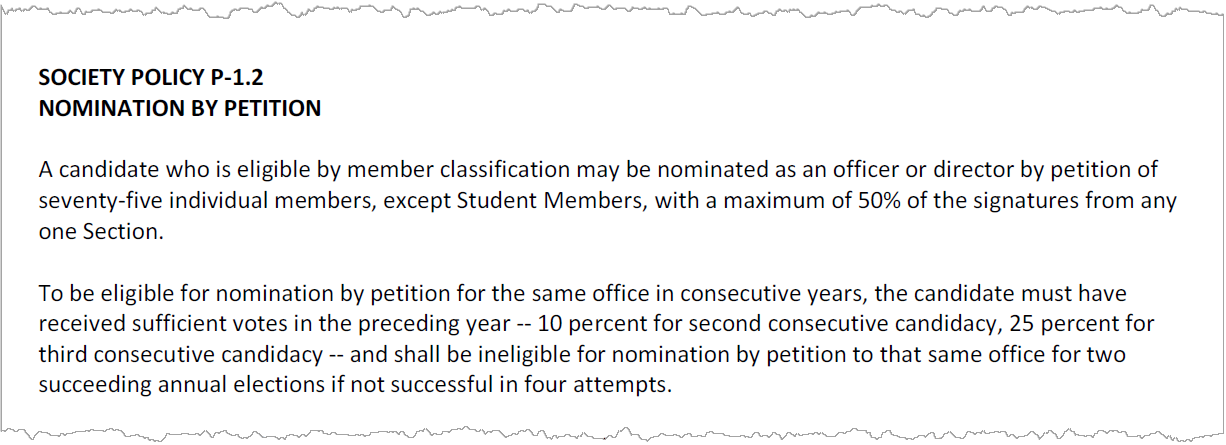
A petition, unlike a write-in, does put a name on the printed ballot. That path runs through a fixed threshold: 75 individual member signatures, with no more than half coming from any single Section. It's a defined bar rather than a discretionary one, though it still requires a candidate to organize support across multiple Sections before ever reaching the ballot.
Ballots are due October 15; the amendment needs two-thirds of votes cast at the October 21 Annual Membership Meeting to pass. If it does, this is the last cycle where write-in spaces appear on an IES ballot at all.