


August 24, 2026
Inside the Courtroom: Mlazgar v. Hubbell Lighting
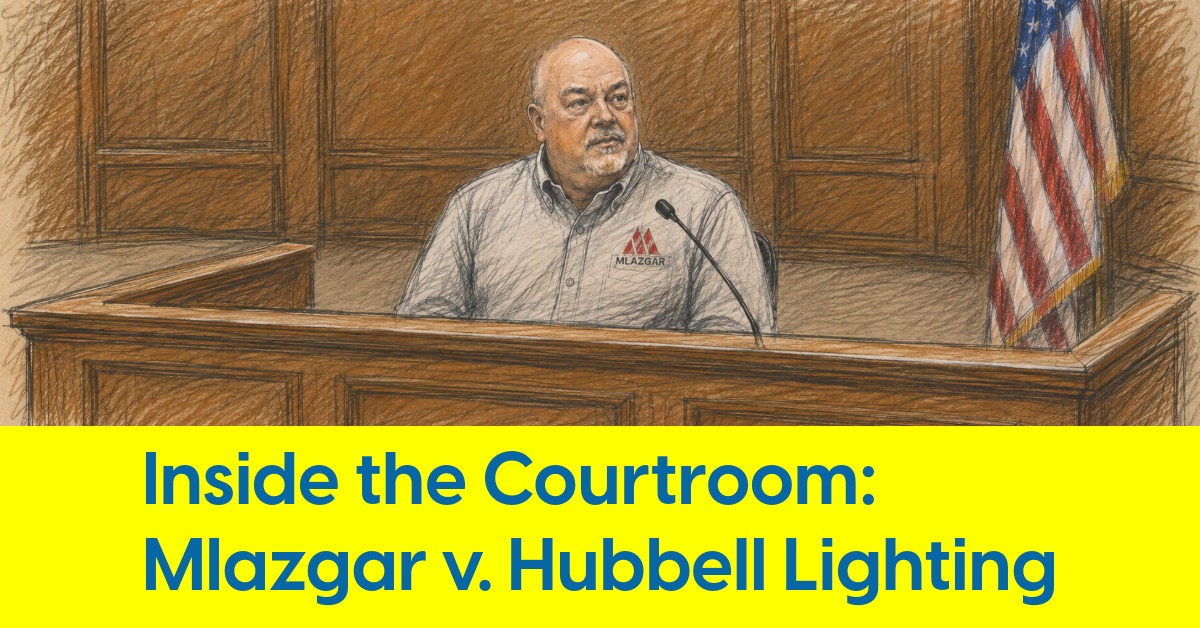
Illustration: Scott St. Marie, president of Mlazgar Associates, testifies on Thursday, August 20, during the company’s federal trial in Greenville, South Carolina. (A.I. generated courtroom sketch)
Competing contracts, former employees and $11.7 million drive the dispute
Trial testimony is entering its second week today in Greenville, South Carolina, in a nearly four-year-old commercial dispute between a Minnesota lighting sales agency and one of the industry's most recognizable manufacturers. Inside Lighting had correspondents in the courtroom Wednesday, Thursday, and Friday of the opening week.
The case is R.L. Mlazgar Associates, Inc. v. HLI Solutions, Inc., et al., and it opened Monday, August 17, before Judge Jacquelyn D. Austin in the Greenville Division of the U.S. District Court for the District of South Carolina. HLI Solutions, Inc. is the official defendant of record, a name some lighting people might not recognize. The company is better known by its former identity, Hubbell Lighting, or its current one, Current HLI Brands, following Hubbell Lighting's divestiture and rebrand under Current.
Three current and former Hubbell executives took the stand and were cross examined last week: James Farrell, President during the late 2020 and early 2021 period at the heart of the dispute; Tom Benton, the company's former number two and general manager at the time of the events in question; and Paul Lewis, a vice president still with the company today.
Ten jurors, pulled from the Greenville federal district, will decide the fate of the case.
How the Relationship Got Here
The numbers that preceded the falling out are worth noting. In 2019, Mlazgar sold $26 million worth of Hubbell Lighting product across Minnesota and the Dakotas, plus another $7.2 million in Wisconsin, a substantial book of business built over years.
Then, in the summer of 2020, Mlazgar struck two deals in principle: the acquisition of Elan Lighting, a Cooper Lighting Solutions representative based in the Milwaukee area, and a direct agreement to represent Cooper Lighting across the same Minnesota, Dakotas, and Wisconsin territory Mlazgar already covered for Hubbell. Both agreements were finalized in September and October of 2020. That is, by every account in this case, the moment the Mlazgar-Hubbell relationship began to unravel.
Hubbell’s move to rival agent JTH Lighting Alliance's startup agency in Wisconsin sits at the heart of Mlazgar’s claims.
A Courtroom That Runs on Patience
Judge Austin has presided over this case for more than three years, and if her directives on the bench last week are any indication, patience is running thin, though not with the case itself so much as with how it is being tried.
On more than one occasion, her soft-spoken, articulate comments to counsel carried an edge that read as frustration directed at Mlazgar's legal team specifically. She has told them with the jury out of the room, to tighten their cross examinations. She has told them to cut down the runtime of video depositions scheduled for the jury, some clips stretching past the hour and a half mark.

What was visible from the gallery last week was something more mundane and, in its way, more telling. When spreadsheets and contract clauses are projected onto the individual monitors mounted in front of each juror, there is not much to suggest anyone is leaning in. Just the quiet, unreadable stillness of ten people being asked to absorb contracts that took the industry itself decades to standardize.
That stillness deserves context. The commercial lighting trade runs on a go-to-market logic that takes lighting veterans years to fully internalize: the layered relationships between manufacturers, independent sales agencies, specifiers and distributors; the customs that govern who represents whom in a given territory, and why.
This jury has been handed that entire architecture in the span of a week, then will be asked to adjudicate a dispute that partially hinges on it.
At one point, testimony veered into why a distributor like Viking Electric can sell both Hubbell Lighting and Cooper Lighting lines simultaneously, while Mlazgar, an agency, allegedly cannot represent both. It's a study in contrasts for a jury asked to untangle the differing roles of the commercial lighting go-to-market food chain.
Two Claims, One Trial
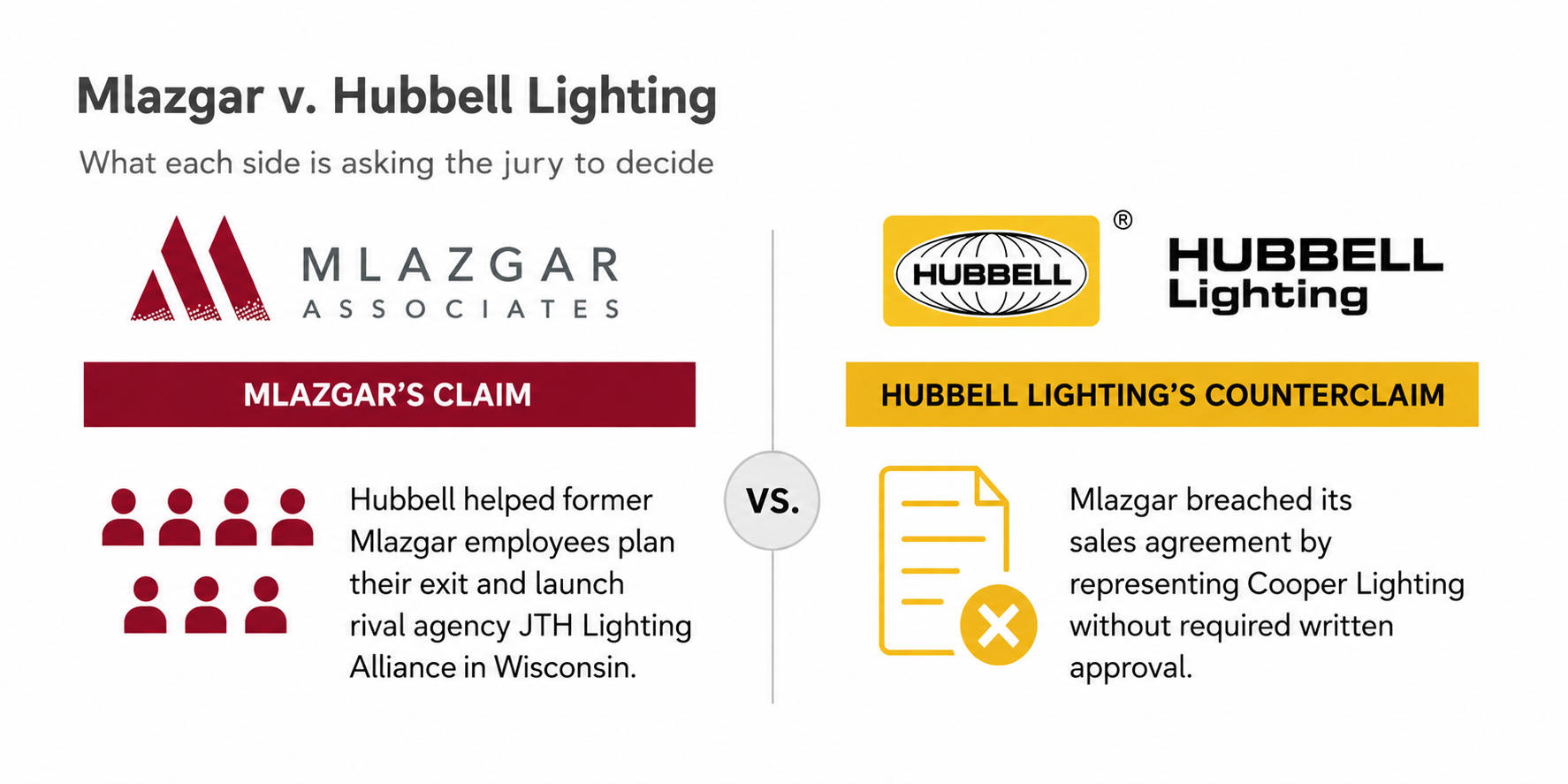
Strip away the volume of paper this case has generated, the depositions, the motions, the years of discovery fights, and what remains for this jury to decide comes down to two questions.
The first is whether Hubbell Lighting aided and abetted a breach of fiduciary duty. In plain terms: did Hubbell cross a line by helping former Mlazgar employees plan their exit to launch a rival agency, JTH Lighting Alliance, in Wisconsin? Nobody in the courtroom is seriously disputing that some of those departing employees did things on their way out that they should not have done. That much appears baked into the case. What's contested is whether that alleged misconduct can be pinned on Hubbell, as though the company knew what was unfolding and helped it along.
Press Millen, of Womble Bond Dickinson, lead counsel for Hubbell Lighting, returned more than once last week to an example built around a single image: the telephone call. His argument, distilled, is that Mlazgar’s theory required Hubbell to do something no company actively searching for new representation would realistically do: hang up the moment departing then-Mlazgar employee Justin Hendrickson reached out.
Hubbell was actively looking for new representation in the territory at the time. Of course someone picked up. Of course they stayed on the line. That, Millen's argument goes, is ordinary business conduct, not conspiracy, and turning it into aiding and abetting liability asks the jury to penalize the act of answering a phone.
The second question is HLI's counterclaim: that Mlazgar itself breached the Exclusive Sales Representative Agreement governing the relationship, first by allegedly failing to use its best efforts to sell Hubbell's lines, and second by taking on a directly competing manufacturer, Cooper Lighting, without the written approval the contract required.
Mlazgar's answer is that damages should be scrutinized: a company cannot claim to have been harmed by its own decision to end a relationship. If Hubbell chose to terminate the agreement, Mlazgar's lawyers argue, Hubbell cannot then turn around and bill Mlazgar for the consequences of that choice. It is the lighting agent equivalent of quiet quitting, an argument that the damage was self-inflicted, dressed up as someone else's fault.
The Number: $11.7 Million
Mlazgar's damages expert took the stand on Friday and put a figure on what the agency says it lost: $11.7 million. The methodology leaned on ConstructConnect construction data layered against baseline commissions earned across a long roster of lighting brands that left Mlazgar's book of business, extrapolated out across 2021 through 2028. The theory underneath the number is expansive, not limited to Hubbell alone, but built on the premise that without the formation of the rival JTH office in Wisconsin, none of those ten other manufacturer relationships would have left Mlazgar for JTH:
- Focal Point
- Kenall
- Amerlux
- B-K Lighting
- BEGA
- Kelvix
- Luminii
- Meteor Lighting
- Structura
- Vode
The most significant piece of that total is a single sub-figure: $7.38 million, which the expert attributed specifically to projected commissions of Hubbell Lighting sales through Mlazgar, growth the model assumes would have continued even while Mlazgar was simultaneously representing Cooper Lighting, a direct competitor, in the same territory. That assumption sits at the exact fault line of Hubbell's counterclaim, which argues the dual representation itself was a contract violation that would have ended the relationship regardless of anything JTH did.
What St. Marie Said, and What the Paper Trail Says
The week's sharpest moment arrived with Scott St. Marie, president of Mlazgar, on the stand.
St. Marie described the agency's 2020 acquisition of Elan Lighting assets and the arrival of the Cooper Lighting line, a deal he framed as building a larger, stronger team, one capable of continuing to sell Hubbell product alongside the new business. Then came two questions that, on the page, look almost identical, and answers that, taken together, look considerably harder to defend.
Q (Mlazgar's attorney):
Was it Mlazgar's intent to represent Cooper after the Elan acquisition?
A (Scott St. Marie):
Yes.
Q:
Was it Mlazgar's intent to represent Hubbell after the Elan acquisition?
A:
Yes.
Both lines simultaneously, according to St. Marie, under oath. Both lines simultaneously, according to the documents Hubbell's team put in front of the jury. But according to other court exhibits, contractually impossible at the same time without Cooper and Hubbell permission.
The Hubbell sales agreement barred representation of competing lines without prior approval. So did the Cooper contract, a document St. Marie himself signed, and one that named Hubbell Lighting explicitly among 28 manufacturers Cooper prohibited its representatives from carrying.
St. Marie claims he was not familiar with the terms and conditions of the Hubbell Lighting contract at the time he signed the Cooper contract. Hubbell’s attorney appeared taken aback, repeatedly pressing St. Marie on how the agency’s president could be unfamiliar with the terms governing one of its most important manufacturer relationships.
A Mlazgar line card was entered into evidence showing the agency's post-Elan roster with both Cooper and Hubbell products listed side by side, the very arrangement St. Marie testified was the plan. Then they displayed an email from Mark Mlazgar to two Cooper executives, Joe Melchiors and Shane Bickley, with an attachment showing a projected line card for the same period. Every Hubbell brand had been stripped out. No Columbia. No Kim. No Dual-Lite. No KV.
Two documents, two different stories, both seemingly authored by the same company within the same window of time. It is a striking exhibit for a jury weighing whether Mlazgar understood, going in, that it could not do what its president testified it intended to do, and it goes directly to the heart of Hubbell's counterclaim.
The Man in the Room
If a single figure dominated the courtroom, it was not a witness. It was Press Millen, lead attorney for Hubbell Lighting.
Litigation has an element of theater, and Millen appears to command the stage better than anyone else currently occupying it. He does not raise his voice. He does not need to.
His delivery is unhurried, almost soft, and it is backed by a Duke and Yale pedigree that shows up in the architecture of his arguments, which arrive preassembled and seem hard to dismantle. Next to him, Mlazgar's legal team has, at moments, looked discombobulated, not incompetent, but outmatched in organization and presentation, if not sometimes in substance.
None of this is supposed to matter to the ten people in the jury box. They are instructed to weigh evidence, not charisma. But anyone who has spent time in a courtroom knows that instruction and human nature do not always travel together, and Millen's presence is, at minimum, worth noting.
The Wider Battlefield
This is not Mlazgar's only fight.
The agency separately sued JTH Lighting Alliance directly, seeking monetary damages over the same territorial dispute; that case settled out of court, on undisclosed terms. A parallel case, Mlazgar against Focal Point and its parent company, Legrand, remains active in federal court in Wisconsin, built on overlapping allegations involving the same cast of former employees and their migration to JTH, with Mlazgar reportedly seeking millions there as well.
Hubbell's attorneys have made that pattern part of their own argument to the jury: that Mlazgar is, in their telling, attempting to extract money from every party even tangentially connected to its loss of business, and that Hubbell should not be made to answer for a chain of events with several other actors in it.
What's Next
The trial continues this week with additional expert testimony and a heavy slate of video depositions, from former Mlazgar employees now at JTH, a JTH principal, and a Current regional vice president, among others.
It is not yet clear when Mark Mlazgar, CEO of Mlazgar Associates, will take the stand, but he is expected to testify before the trial concludes.
What is clear after the opening week is that this jury has been asked to do something genuinely difficult: absorb an industry's internal logic in real time, weigh an $11.7 million damages theory built on assumptions about counterfactual history, and decide whether a company's own internal emails can be squared with the sworn testimony of the man who partially presided over it.