


June 4, 2026
Nanoleaf Acquired in $40 Million Deal
Shenzhen robotics firm targets North American retail channels
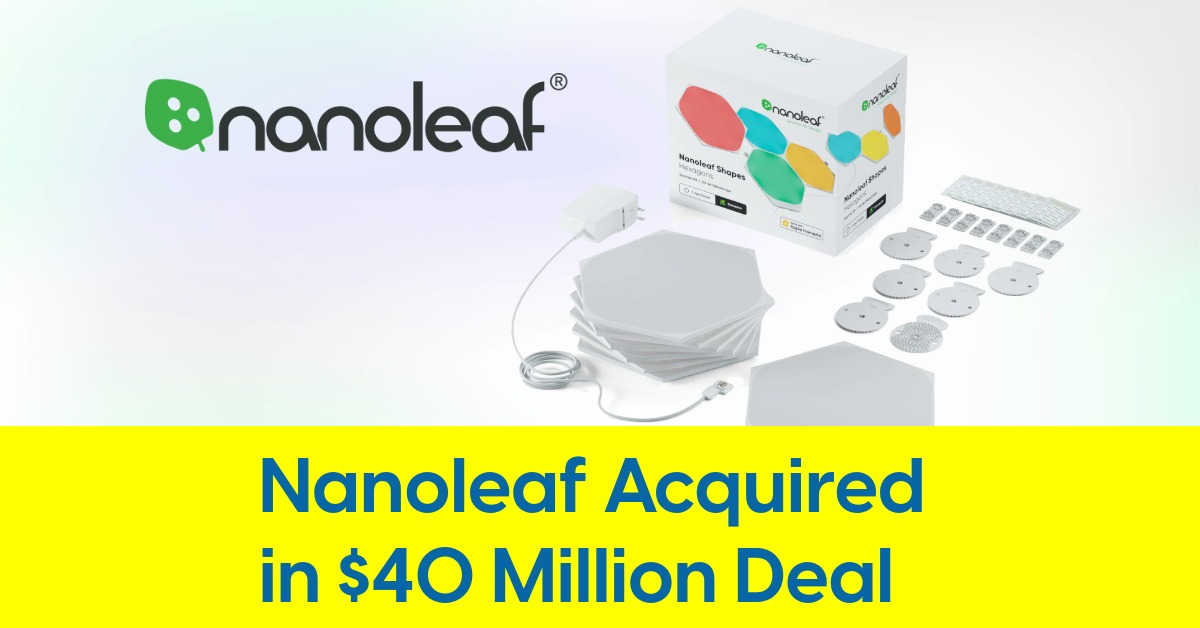
Nanoleaf Limited, a Cayman Islands-incorporated smart lighting company with operations in Canada, is set to become a wholly owned subsidiary of OneRobotics, a Shenzhen-based AI robotics company listed on the Hong Kong Stock Exchange, under a roughly $40.5 million deal announced May 15. The acquisition unfolds across four closings stretched over 24 months and gives OneRobotics full control of a brand best known for modular light panels sold at Best Buy, Costco, and Apple retail stores across North America.
Co-founders Gimmy Shen Chu and Christian Yan are contractually required to remain as chief executive and chief operating officer, respectively, for at least three years after the first closing.

A Channel Play, Not a Technology Bet
OneRobotics is candid about what it is buying. The investment announcement filed with the Hong Kong exchange makes clear that Nanoleaf's technology is secondary to its shelf space. Nanoleaf holds retail partnerships with Costco, Best Buy, and Home Depot, has entered Apple's global official retail channels, and maintains local operations teams in North America and Europe. For a Chinese robotics company with an established Japanese and European footprint, those relationships represent a faster path to North American distribution than building from scratch.
The strategic framing centers on "channel complementarity" and "localized operational synergy," language that will be familiar to anyone who has watched Chinese manufacturers use Western brand acquisitions as distribution vehicles. OneRobotics, which listed on the Hong Kong Stock Exchange in December 2025 and bills itself as the world's first publicly traded company focused on AI embodied home robots, intends to use Nanoleaf's retail network to push its sports robotics, companion robotics, and home service robotics products into the same stores currently carrying light panels.
The company's product philosophy, built around a proprietary AI brain called OneModel and a "One Brain, Multiple Embodiments" architecture, is squarely aimed at household robots that cook, exercise with you, and keep you company. Where a modular LED panel fits into that vision is a question the announcement does not directly answer.
The Numbers Behind the Deal
Nanoleaf posted revenue of approximately $30.9 million in 2025, up slightly from $29.7 million the prior year. But the company has not turned a profit, recording a net loss of roughly $1.7 million in 2025 after a deeper loss of $6.4 million in 2024. OneRobotics applied a price-to-sales valuation methodology, arriving at an implied transaction multiple of approximately 1.3x revenue after applying a 28 percent discount for lack of marketability.
The deal arrives at an awkward moment for Nanoleaf. The company settled two separate patent disputes in the fall of 2025, including a seven-month suit brought by Signify under its EnabLED enforcement campaign, both resolved quietly and without disclosed terms. Whether new ownership simplifies or complicates Nanoleaf's IP posture remains an open question.