


June 5, 2026
Are Remote Workers Left In The Dark?
Researchers found remote workspaces routinely missed basic lighting benchmarks
A peer-reviewed study published this month in Scientific Reports measured the lighting conditions at five home office workstations and found that none of them met basic workplace lighting standards. Not one. The worst case was a designer doing precision CAD work for eight or nine hours a day, sitting under light so dim and uneven that it would have triggered an immediate corrective action order in any commercial office subject to occupational health inspection.
The study, led by researchers at Lodz University of Technology in Poland, is framed primarily as a legal and ergonomic problem: employers cannot inspect private homes without consent, so nobody checks, so standards go unmet. That framing is accurate as far as it goes. But there is a more commercially pointed question sitting just beneath it, and the authors may not have intended to ask it.

A Market That Materialized and Then Disappeared
Remote work did not create a small lighting problem. By some estimates, tens of millions of workers in North America and Europe now spend the majority of their working hours at desks their employers have never seen, under luminaires their employers did not specify, producing illuminance levels their employers cannot measure. The commercial lighting industry had exactly nothing to do with most of those installations.
That is a market that exists and is almost entirely unserved. Lighting designers specify offices. Ergonomists audit offices. Controls manufacturers sell into offices. The home office, despite housing a substantial fraction of the white-collar workforce, remains largely outside the industry's field of view, still lit by whatever chandelier came with the apartment and whatever desk lamp was on sale.
What the Study Actually Found
The Lodz researchers took in-situ measurements at five residential workstations used by students, a designer, and a remote worker, ranging from 6.7 to 10.75 square meters. All five failed on both average illuminance and uniformity. The worst performer was also the most demanding use case, a setup doing precision design work with corrective lenses. The best performers still fell roughly 12 percent short on illuminance and ran uniformity at about half the required level.
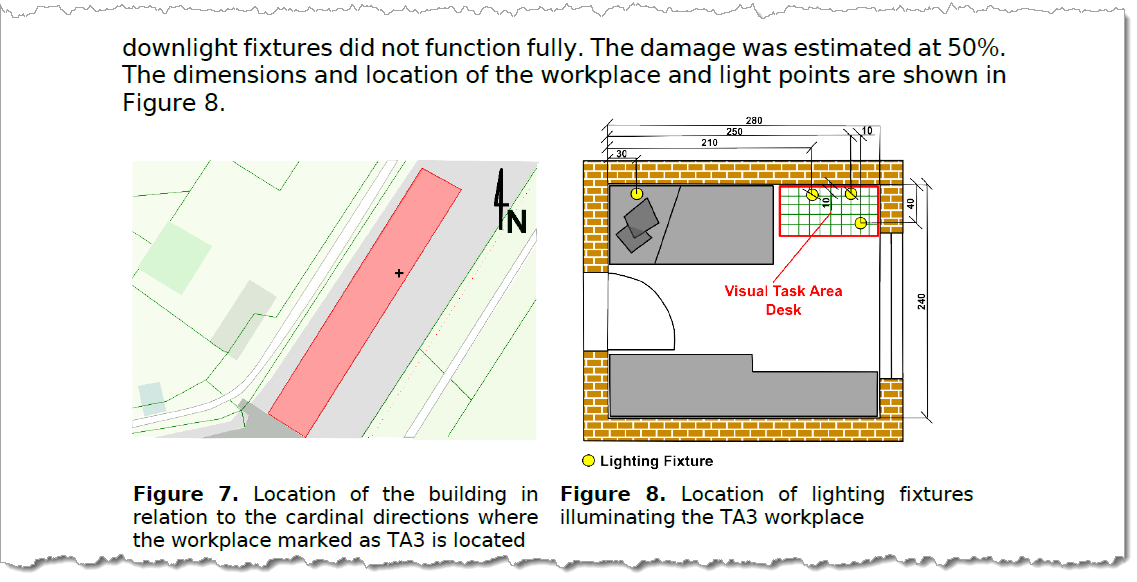
Above: Floor plan of a home office workspace, showing lighting fixture placement and visual task area. (Sikora et al., Scientific Reports, 2026)
The sample size was extremely small, making the study unsuitable for estimating how widespread the problem is. However, the findings raise a legitimate question about how many remote workers may be spending their workdays in lighting conditions that would fail basic workplace standards.
The authors note, almost in passing, that the workers themselves largely lacked any framework for assessing what they had. They did not know what lux meant, did not understand color temperature as a performance variable, and made purchasing decisions based on price and wattage. After 20 years of LED transition, the industry has successfully moved the market off incandescent. It has not meaningfully moved consumer understanding of lighting quality.
That gap belongs to the industry as much as to the workers sitting in inadequate light. Whether anyone decides to do something about it is a different question.