


April 9, 2026
Schréder Expands U.S. Footprint With NLS Acquisition
Deal boosts domestic production and expands reach in area and roadway lighting
Schréder has acquired NLS Lighting, adding another U.S.-based outdoor brand to its growing North American portfolio. The deal expands its domestic manufacturing footprint and strengthens its position in specification-grade outdoor lighting, a segment where scale and responsiveness increasingly matter .
The move comes from Schréder’s U.S. organization, but ultimately traces back to its Belgian parent, a multigenerational, family-owned company that has been steadily expanding its presence in North America. Terms of the deal were not disclosed.
The broader context is hard to ignore. The outdoor lighting category is crowded, with dozens of established brands competing across municipal, commercial, and architectural projects. In that environment, acquisitions like this are less about entering new markets and more about capturing share within existing ones. Adding NLS gives Schréder more coverage across project types, customer preferences, and pricing tiers without needing to build those capabilities organically.

Filling Gaps Across Design and Price Points
NLS brings a product portfolio rooted in performance and practicality. Its fixtures are widely specified across roadway, site, and area applications, with an emphasis on optical control, durability, and speed to market. There is design intent, but it tends to be restrained, shaped by project demands rather than architectural expression.
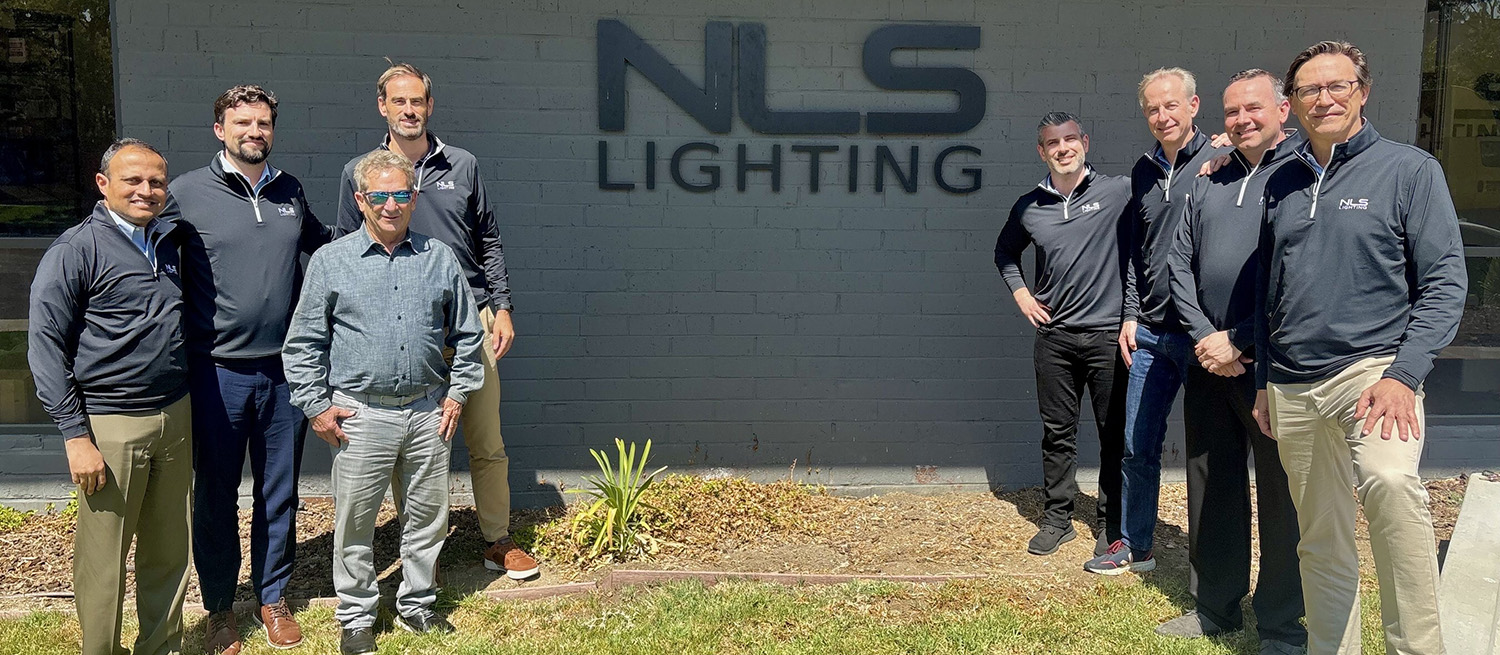
Left to right: Syed Raza, Senior Vice President, NLS Lighting; Maximilien Schréder, Schréder Family; Bill Hein, Founder, NLS Lighting; Nicolas Keutgen, Schréder Family; Ryan Goldstein, President, NLS Lighting; Renaud Gryspeerdt, Schréder Family; Steve Mills, President, Schréder North America; Olivier Chapelle, Chairman, Schréder Group. Image courtesy of Schréder
That contrasts with Schréder’s legacy portfolio and its earlier acquisition of Ligman Lighting USA, both of which lean more heavily into design-forward architectural aesthetics. The result is a broader spectrum. At one end, more expressive, design-forward products. At the other, solutions that prioritize function, cost efficiency, and ease of specification.
For lighting people working across different project budgets, that range can be useful. Municipal roadway jobs, commercial developments, and high-design public spaces do not all require the same visual language or price point. Owning multiple brands allows Schréder to participate across those layers rather than forcing a single approach into every application.
Independence on Paper, Questions in Practice
Schréder has stated that NLS will continue to operate independently, with no changes to leadership or agent networks . That continuity is important, particularly for a company like NLS that has built its reputation on service and lead times.
At least three agencies — Boston Light Source, Creative Lighting Solutions in South Carolina, and RKL Sales in New Mexico — already partner with both Schréder and NLS, an early sign that “no consolidation” may still involve some shared ground in the field. When two brands under the same ownership compete for similar specifications, differentiation has to be clear. Otherwise, the decision shifts from product fit to internal preference or pricing strategy.
This is where multi-brand strategies tend to get tested. Independence at the organizational level does not eliminate competition at the project level.
A Portfolio Strategy Taking Shape
Taken together with the Ligman acquisition, this deal points to a consistent approach. Schréder is building a layered outdoor lighting portfolio in the U.S., one that spans decorative, architectural, and utilitarian applications while aligning with domestic manufacturing requirements.
The strategy offers flexibility. It also adds complexity. Success will depend on how well those brands are positioned relative to one another and whether the distinctions hold up in real-world specification scenarios.
For now, the direction is clear. In a fragmented market with many capable players, scale is being built one acquisition at a time.