


April 30, 2026
ETI Lighting Takes Patent Fight to Cooper’s Front Door
What started as a Signify patent lawsuit has spawned a second case; this time with ETI on offense
When Signify filed separate suits against ETI Solid State Lighting and LITON Lighting on May 2, 2025, the lighting giant might have expected a familiar playbook: assert patents, press for a license, collect. LITON eventually followed that script, settling with Signify quietly months later. ETI did not.
What it got instead was a counterpunch that has now landed Cooper Lighting, Signify's wholly owned subsidiary headquartered in Peachtree City, Georgia, as a defendant in its own federal lawsuit.
Signify's original complaint, filed in the Northern District of Georgia, accused ETI of infringing nine patents covering LED downlights, wall packs, and configurable lighting systems.
ETI answered in July 2025, but it didn't just defend itself. It went on offense, bringing Cooper Lighting into the case as a counterclaim-defendant and accusing it of infringing three ETI patents covering manually controllable LED correlated color temperature (CCT) light fixtures, the selectable-CCT technology that has become a staple of the commercial and residential recessed lighting market.

Using Signify's Own Words Against It
ETI's theory was straightforward and strategically elegant. Cooper Lighting is a wholly owned Signify subsidiary. Signify had already told the court in its own complaint that Cooper is headquartered in Georgia and that its products light local landmarks across the Northern District. ETI used Signify's own words to argue that the court had jurisdiction over Cooper. If you're going to bring me into your backyard, ETI was essentially saying, I'm bringing your subsidiary with me.
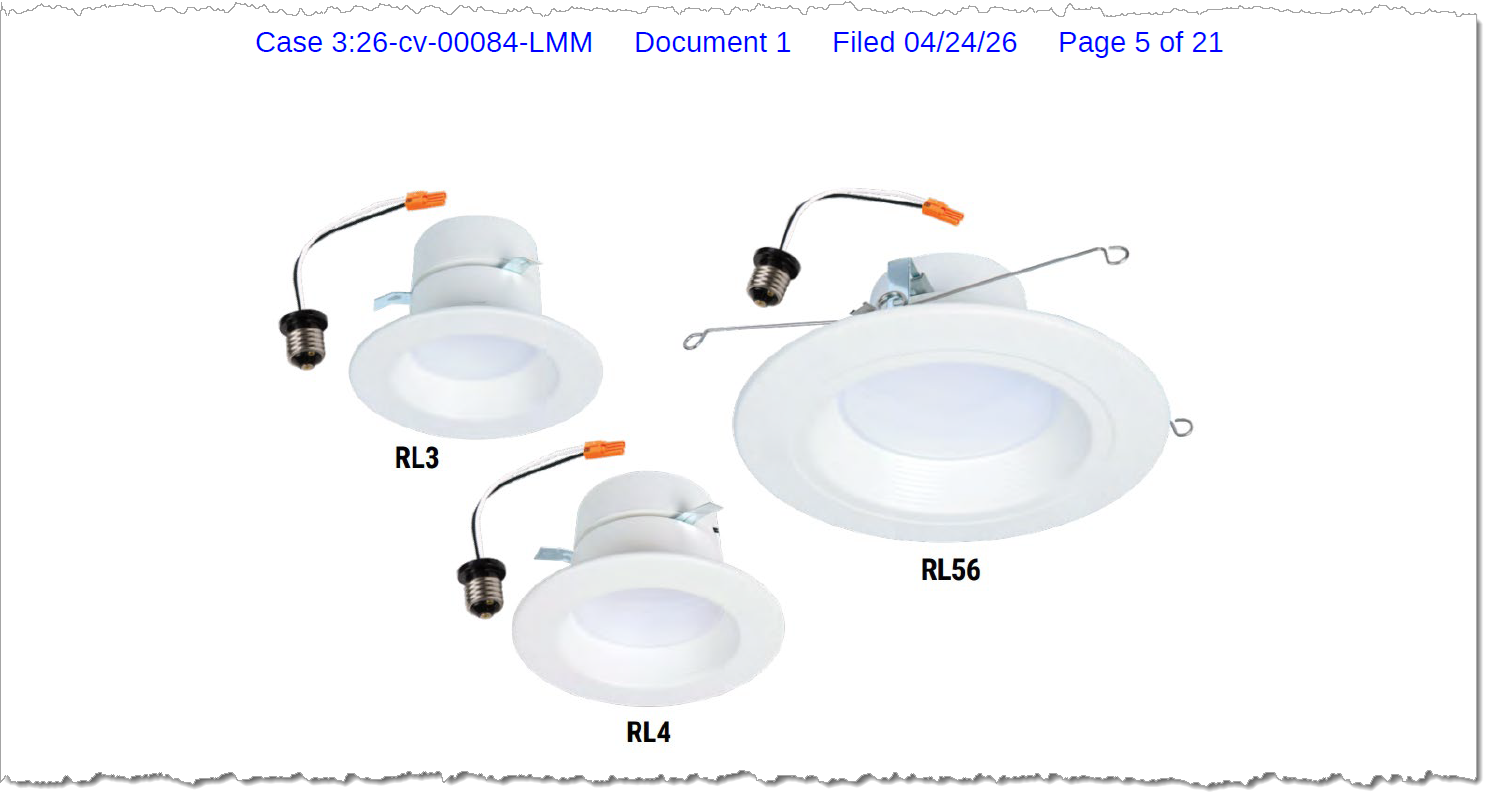
Above: Cooper Lighting's HALO RL downlight series, one of the brand's more popular and longstanding LED recessed lines, is the target of ETI's patent claims.
ETI asserted three patents, each targeting a different angle of the same core technology:
- U.S. Patent No. 10,462,871 covers an LED light fixture with a manually controllable CCT switch that is concealed when the fixture is mounted for operation. ETI's charts showed Cooper's HALO RL switch becoming inaccessible once installed, satisfying this specific claim limitation directly.
- U.S. Patent No. 10,492,262 covers the electrical architecture behind selectable CCT, specifically the subcircuit arrangement that connects different LED groups to produce distinct color temperatures. ETI tore down the HALO RL board and mapped each subcircuit to the patent's claim language, showing how the 2700K, 3000K, 3500K, 4000K, and 5000K settings each correspond to a separately wired LED group.
- U.S. Patent No. RE49,030 is a reissue patent that broadens and refines coverage of the same manually controllable CCT fixture concept, adding claim language around digitally operable actuating members. ETI pointed to the small selector toggle on the Cooper board as satisfying that limitation.
The infringement charts in the counterclaims were detailed, with teardown photography showing the LED boards, subcircuits, and CCT switches inside Cooper's own product.
Cooper Lighting, contacted by Inside Lighting on April 28, declined to comment, citing its policy of not discussing pending litigation.
A Procedural Speed Bump, Not a Dead End
The judge dismissed ETI's Cooper counterclaims without prejudice, finding that Cooper had been improperly joined under Federal Rule of Civil Procedure 21, a rule governing when parties can and cannot be bundled into existing litigation. The court also identified the Newnan Division as the proper venue for claims against Cooper. That ruling didn't kill ETI's case. It just forced a clean refiling.
On April 24, 2026, ETI did exactly that, filing a standalone complaint against Cooper Lighting in the Newnan Division asserting the same three patents against the same HALO RL product family.
What Comes Next
ETI's new complaint signals this is not starting from zero. The parties had already completed discovery, exchanged infringement and invalidity contentions, and finished claim construction briefing in the original Signify case. ETI is telling the new judge that Cooper had full notice and that willfulness is already baked in.
Signify spent years as the aggressor in patent enforcement. ETI has now used Signify's own lawsuit as the vehicle to put Cooper Lighting on the receiving end of a patent complaint.