


March 20, 2026
Lighting-Related Programs Drift Inside New DOE Structure
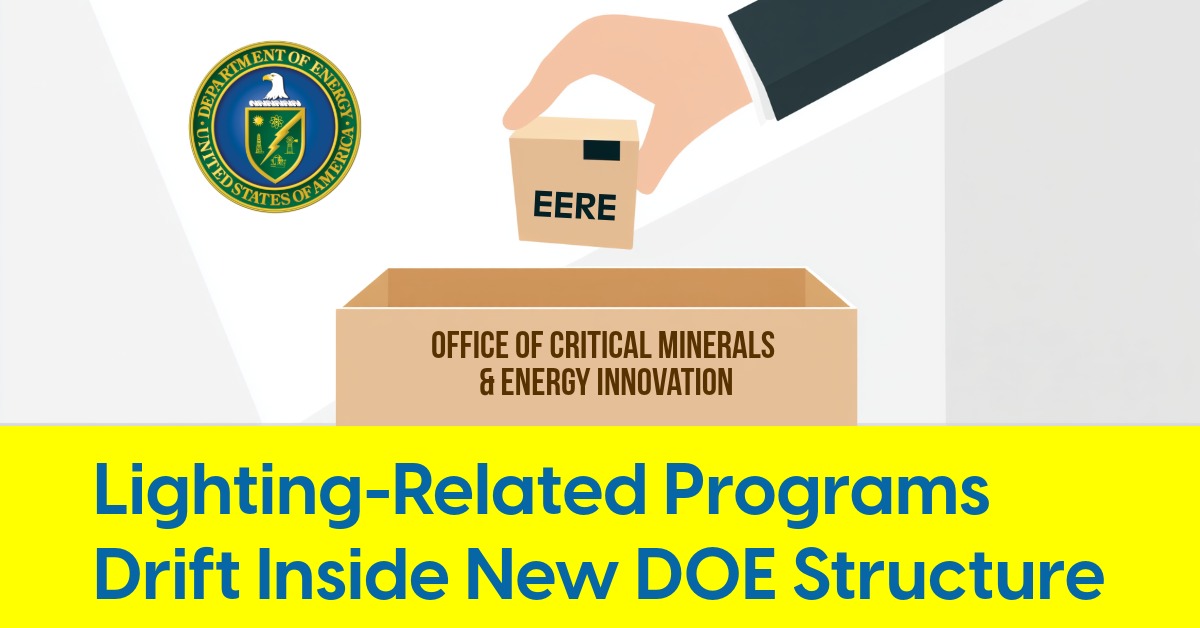
Federal efficiency office disappears, leaving lighting programs scattered inside new energy bureaucracy
For three decades, the United States lighting industry had a predictable partner in Washington. It wasn’t glamorous and rarely made headlines, but the Department of Energy’s Office of Energy Efficiency and Renewable Energy quietly shaped everything from LED research to appliance standards.
That partner is now gone.
In November 2025, the Department of Energy removed EERE as a standalone office, folding most of its responsibilities into the newly created Office of Critical Minerals and Energy Innovation. The reorganization came alongside a proposal to slash the office’s roughly $3.46 billion annual budget by nearly three quarters, while eliminating dedicated programs for solar, wind, and hydrogen research. Congress ultimately rejected the deepest cuts, preserving roughly $3.1 billion in funding, but the institutional architecture that drove federal efficiency policy for decades has been dismantled.

Lighting, historically housed inside EERE’s Building Technologies Office, now sits inside a much broader structure whose stated priorities include mineral supply chains, nuclear power, and fossil energy infrastructure. In bureaucratic terms, lighting didn’t disappear. But the center of gravity moved.
That distinction matters.
For the lighting sector, EERE functioned as more than a funding source. It was the federal government’s technical nerve center for lighting science, standards development, and efficiency policy. Programs like Solid-State Lighting research, the CALiPER testing program, and federal purchasing guidance for efficient fixtures all flowed from the same institutional home. The reorganization did not formally eliminate those functions overnight, but it removed the office that championed them.
Above: The EERE News webpage used to be part of Inside Lighting’s daily rounds as we scour the globe for lighting-related happenings
Inside Lighting has been tracking the ripple effects since late 2025. Programs technically exist, but their direction and long-term support are increasingly unclear.
Where Lighting May Feel the Impact
The practical consequences for the lighting industry are still emerging, but several areas are already coming into focus:
- EERE's Building Technologies Office (BTO): Once the primary federal home for lighting R&D and policy. BTO managed the SSL (Solid-State Lighting) program, which for two decades co-funded R&D with lighting manufacturers on LED and OLED efficiency improvements, funded the CALiPER testing program (independent performance testing of early commercial LED products), supported the DesignLights Consortium (DLC) through technical guidance, and published the widely-cited DOE SSL reports and product databases. That program now sits inside CMEI's "Office of Energy Technology" pillar — with leadership drawn from the oil and gas world and no stated priority for lighting specifically.
- National lab expertise could be at risk. Layoffs and budget pressures at laboratories such as Pacific Northwest National Laboratory, NREL, and Lawrence Berkeley National Laboratory could threaten decades of accumulated lighting research expertise.
- Appliance and equipment standards face delays. DOE’s appliance standards program, which governs lamps, ballasts, and lighting equipment under federal law, now sits inside a politically contested regulatory framework that may slow or halt new rulemakings. Advocates of less government regulation may see this as a positive development.
- ENERGY STAR remains but with a new home. The voluntary efficiency label program is transitioning from EPA oversight to DOE management, introducing potential policy shifts and administrative growing pains. Once very relevant for lighting, today this is more applicable to appliances and HVAC.
- Public-sector lighting programs may stall. State energy programs and federal building efficiency initiatives historically used DOE technical guidance to specify efficient lighting systems in government buildings.
- The L-Prize competition remains unresolved. The $10 million DOE lighting innovation prize entered its final phase in 2024, but the reorganization has left the program’s future unclear.
None of these developments individually guarantees a dramatic shift for lighting manufacturers or specifiers. But taken together, they signal something larger: the quiet dismantling of the federal policy engine that helped guide lighting efficiency for a generation.
Lighting didn’t lose its place in the Department of Energy overnight.
It may simply have lost the room where its advocates used to sit.