


March 30, 2026
Court Ends Nine Year Kenall - Cooper Lighting Dispute
Editor’s note: The author worked at Cooper Lighting from 2006 to 2013 in sales leadership roles, including involvement with product lines referenced in this article.
Pre-LED contract terms narrow Kenall's financial recovery despite infringement finding
Some disputes in the lighting industry burn hot and fast. Others, like the long-running fight between Kenall and Cooper Lighting, linger with the slow persistence of a ballast on its last legs. This one stretched nearly a decade in court, outliving the very fluorescent technology at its center.
On March 24, 2026, the U.S. District Court for the Northern District of Illinois finally issued its ruling, roughly fifteen months after a December 2024 bench trial. The outcome lands somewhere between vindication and compromise. Cooper must pay royalties on infringing sales of its Fail-Safe Harmony Vandal-resistant Linear (HVL) fluorescent fixtures, but the broader financial exposure Kenall sought never materialized.
For Lighting People who watched this case crawl through ownership changes, product shifts, and a full market transition to LED, the ending feels less like a decisive victory and more like a negotiated ceasefire delivered by a judge.
The Ruling: Liability Without the Windfall
The court’s findings read like a checklist of what Kenall proved and what it could not. Yes, Cooper breached its agreement and infringed patents tied to modular fluorescent fixtures. But no, Kenall did not meet the bar for lost profits. Instead, the court imposed a 5% reasonable royalty across two periods: breach of contract from 2009 to 2011, and patent infringement from 2011 to 2017.
There was a wrinkle. The court found willful infringement only after September 2015, when Cooper was formally notified. That triggered a 1.5× enhancement to 7.5%, but only for the final stretch of the infringement window.
Attorneys' fees were denied. Cooper's sanctions motion was also rejected — though not before the court confirmed that Kenall's own counsel had shown its President at the time, David Michals, documents designated Highly Confidential under the protective order without permission. The court declined to punish it, finding no bad faith. Cooper was right about the facts; it just couldn't turn them into consequences.
Damages, notably, are still being calculated. After nine years, the industry is left waiting a bit longer for the final number, and this time FLASH isn't to blame.
Given the years of litigation, including motions, discovery, and depositions, the Cooper sales tied to this narrow band of Fail-Safe HVL luminaires would likely need to reach well into the tens of millions of dollars for Kenall to recover its legal costs.

The Product at the Center: A Narrow Target
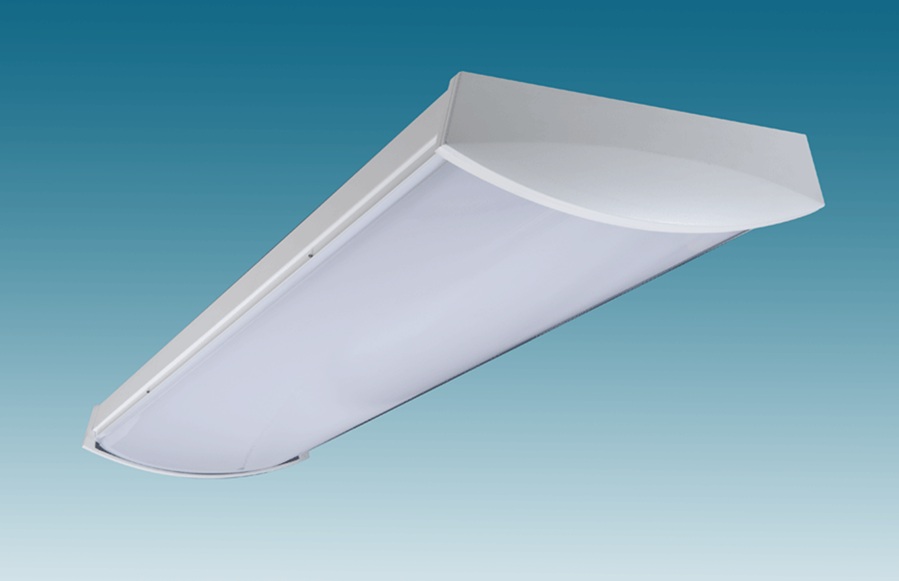
Above: Fail Safe HVL circa 2012
Considering the two multi-billion-dollar companies sparring in the case, the actual product scope was remarkably tight. The dispute focused on fluorescent versions of Cooper’s Fail-Safe HVL “Singles” fixtures, specifically 2-foot and 4-foot configurations using a two-piece, screw-on end cap system.
The patented feature was not the fixture as a whole, but a mechanical detail: a modular end-cap design that allowed units to connect into continuous runs. LED versions were excluded. So were redesigned products after 2016. Even 8-foot fixtures fell outside the scope.
In other words, this was not a sweeping indictment of a product family. It was a surgical strike on a legacy configuration that, by the time of the ruling, had largely faded from relevance.
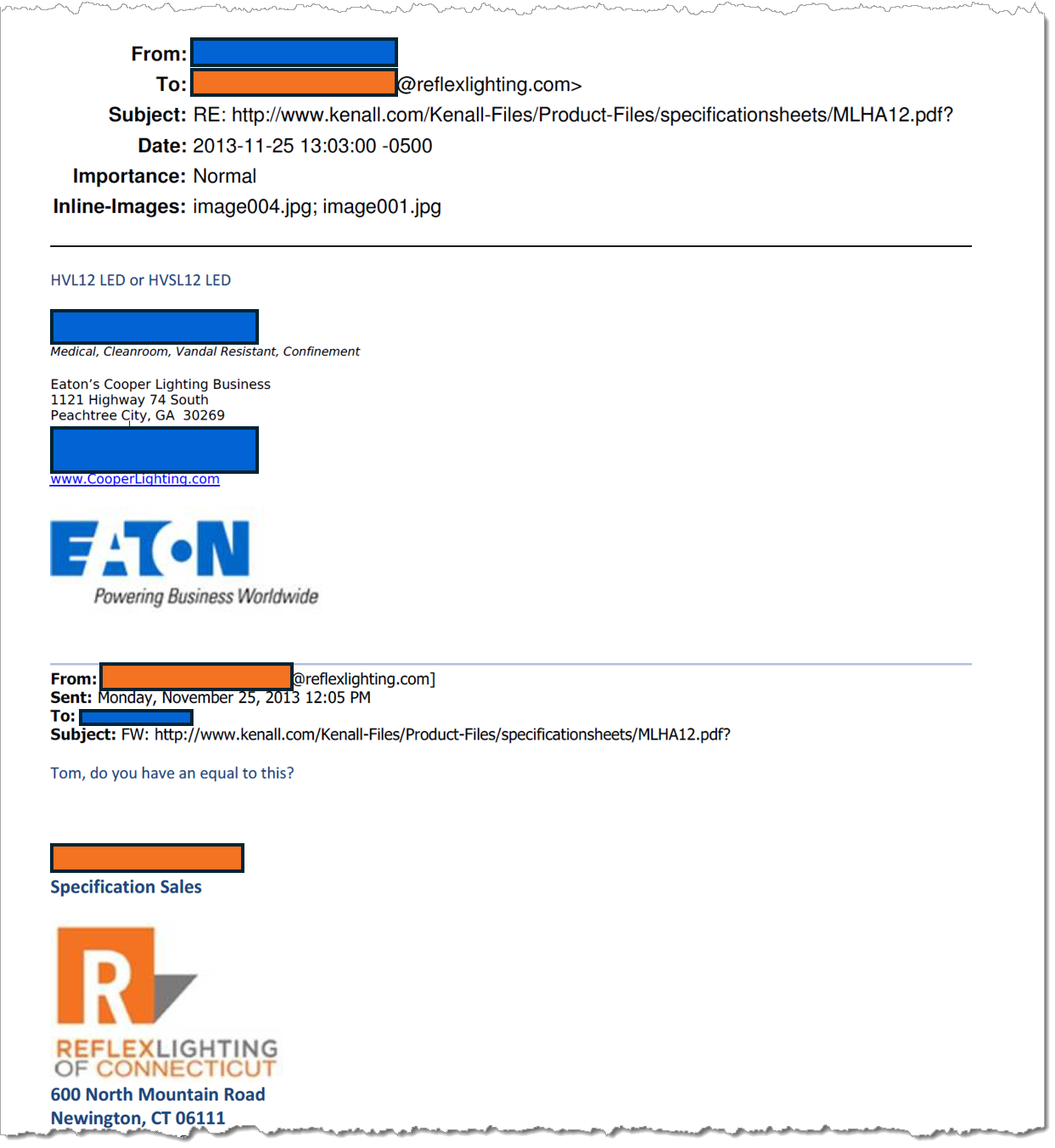
Above: A Cooper Lighting agent requests a crossover recommendation from Fail-Safe personnel to compete with the Kenall 12-foot Millenium Stretch luminaire.
The Strategic Constraint No One Could Escape
That narrow scope was not simply the result of judicial trimming. It was baked into the case years earlier.
A 2019 ruling made clear that the dispute would be confined to a “fixed set” of products defined in a 2007 settlement and license agreement — specifically, fluorescent HVL fixtures that existed at the time. Not similar products. Not future iterations. And critically, not LED.
Kenall’s strategy carried a certain logic. By limiting its claims to those defined “Subject Products,” it secured a powerful litigation advantage: Cooper was contractually restricted from challenging the validity or enforceability of the patents. It simplified the path to liability. But it also imposed a ceiling — one that became increasingly consequential as the market evolved.
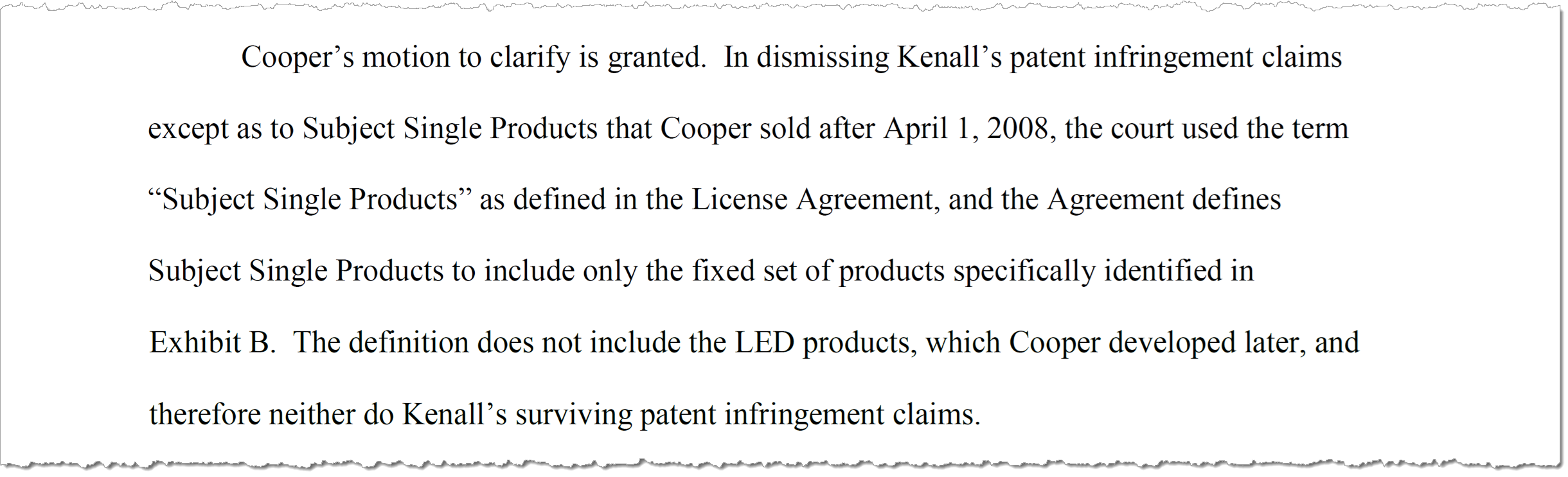
Because the definition was fixed in 2007, it excluded the very products that would come to define the next decade of the industry. As LED adoption accelerated, the case remained anchored to fluorescent technology, a shrinking slice of the market with diminishing commercial relevance.
The court did not soften the implication. “Kenall must live with the consequences of that choice.”
By the time the case reached trial, the boundaries were already set. The products at issue were not just narrow; they were historical. A dispute about yesterday’s technology, adjudicated in a market that had already moved on.
Seen through that lens, the outcome feels less like a surprise and more like an inevitability — a case whose result was structurally predetermined by a contract decision made before LED reshaped the industry.
Why the Money Stayed Modest
If there is a central lesson in the ruling, it lies in what the court believed customers actually cared about. Kenall argued that the patented modular design drove demand. The court disagreed.
Testimony pointed elsewhere. Buyers chose these fixtures for their durability, aesthetics, and warranty — not for the modular end-cap system itself. That distinction proved decisive. Without a clear link between the patented feature and purchasing decisions, Kenall’s claim for lost profits unraveled.
The court instead leaned on industry benchmarks. Evidence showed that comparable licensing deals in the lighting sector typically fell between 3 percent and 5 percent. Kenall’s push for a 15 percent royalty found little support in its own licensing history.
The result was predictable, if not satisfying for either side: a middle-ground royalty reflecting industry norms rather than courtroom ambition.
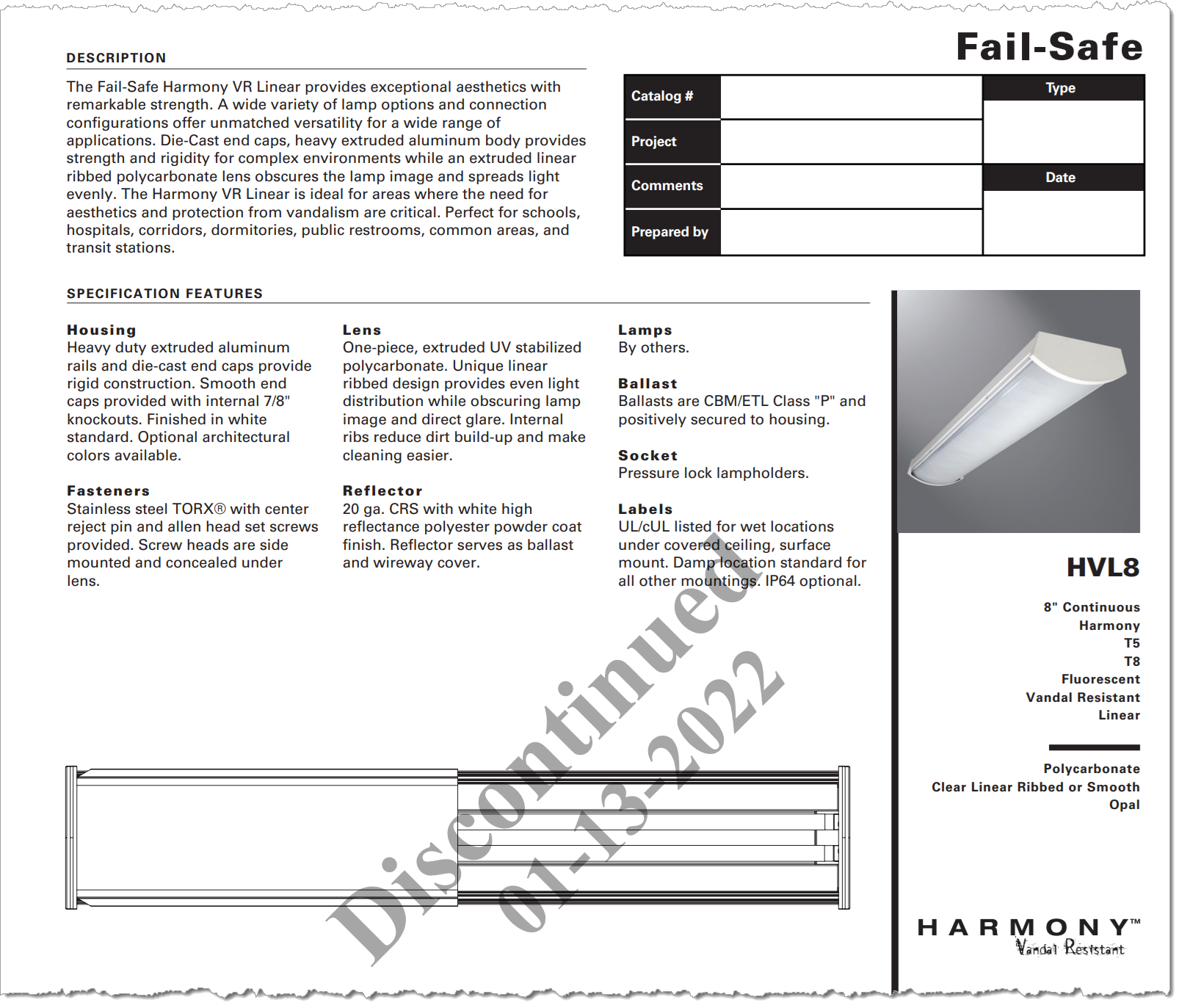
Image credit: Signify
A Case That Outlasted Its Context
There is something almost poetic about the timeline. The infringement period ran roughly from 2009 to 2017. The litigation stretched from 2017 to 2026.
During that time, Cooper itself changed hands multiple times, moving from Cooper Industries to Eaton and eventually to Signify. Meanwhile, fluorescent technology steadily gave way to LED, reshaping the competitive landscape.
Depositions taken in the mid-2020s featured former executives and product managers who had long since left, some reappearing at competing manufacturers. The institutional memory of the decisions at issue had dispersed across the industry.
By the time the ruling arrived, it was addressing a market that no longer quite existed.
Competing Narratives of “Winning”
Both sides claimed a version of victory, which tells you everything about how this landed.
Cooper framed the outcome as validation:
“Cooper Lighting Solutions respects the Intellectual Property of others and was at all times willing to compensate Kenall. The Court viewed this dispute for what it was, the result of nothing more than mere oversight and awarded damages accordingly. Indeed, the damages awarded are less than an early settlement offer made by Cooper Lighting Solutions. Ultimately, as the prevailing party, Cooper Lighting Solutions feels vindicated in its good faith approach.”
— Cooper Lighting spokesperson
Legrand, Kenall’s parent, took a quieter tone. It highlighted the court’s agreement that compensation was justified, while noting that final dollar calculations remain unresolved.
“We are pleased with the judge’s finding that compensation is justified. Since this is an ongoing complex litigation, we will work with the parties to resolve remaining issues.”
— Legrand spokesperson
What This Means for the Industry
For manufacturers and spec-driven segments like corrections, healthcare, and transit, the implications are clear.
First, not all patents carry equal economic weight. If a feature is not central to the buying decision, its infringement may still be actionable, but the damages will be constrained.
Second, time is not neutral. Litigation that stretches close to a decade risks becoming detached from the market realities it seeks to remedy. By the end, the technology may be obsolete, the players reshuffled, and the stakes diminished.
And finally, there is a quieter takeaway. In an industry where differentiation often lives in subtle engineering details, proving the commercial value of those details can be harder than proving the infringement itself.
That gap, more than anything, defined this case.