


January 19, 2026
Lighting Controls Get Rebate Boost in Latest DLC Guidelines
by Craig DiLouie, LC, CLCP and C. Webster Marsh, CLCP of the Lighting Controls Association
Updated rules reflect growing demand for integrated lighting intelligence
The DesignLights Consortium (DLC) recently released Version 6.0 of its Solid-State Lighting (SSL) Technical Requirements, the first major update in over five years, as well as Version 2.0 of Light Usage for Night Applications (LUNA), the DLC program designed to promote responsible outdoor lighting. The updates recognize advances in LED technology while promoting controllability as a strong path to energy savings.
By satisfying the Technical Requirements and successfully passing review, manufacturers’ LED products may be listed in the DLC’s SSL Qualified Products List (QPL), which is offered as a resource for energy efficiency programs. Similarly, manufacturers of lighting controls and horticultural lighting may apply for listing on the DLC’s Networked Lighting Controls (NLC) and Horticultural Lighting QPLs. The SSL QPL is widely used; about 70 percent of commercial lighting programs, nearly 700 in all across North America, rely on the QPL to qualify LED products for rebate and incentive eligibility.

Controllability Requirements in SSL Version 6.0
In the last version of the SSL Technical Requirements (5.1), controls information, e.g. dimmability and color tuning, was required for all possible variations of a given LED product. Based on feedback, the DLC is now collecting specifics of controls variations in Version 6.0.
To support this effort, the DLC has introduced a new control options table for each listed product, based on information collected from manufacturers. Each table lists all control variations of an LED product and various control attributes, including driver type, type of dimming and minimum dim level, type of integral controller and/or sensor, receptacle type, integral sensor functionality and maximum mounting height, and the product ID for a compatible DLC-listed networked lighting control system, if applicable. Below is an example:
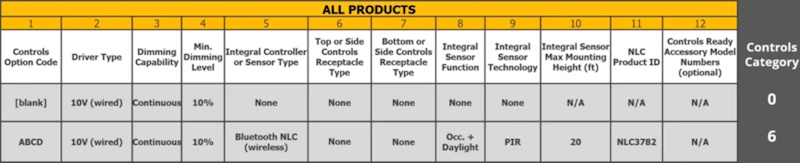
Based on this information, the DLC will categorize products according to their integral control capabilities and display these on the SSL QPL:
Category 0: No integral controls in the product
Category 1: Controls-ready (includes a receptacle for future field installation)
Category 2: Integral non-DLC-listed networked lighting controller
Category 3A: Integral occupancy or traffic sensor only
Category 3B: Integral daylight or photocell sensor only
Category 4A: Integral occupancy or traffic sensor and integral daylight or photocell sensor
Category 4B: Integral traffic or photocell and/or part-night dim sensor functions
Category 5: Integral DLC-listed networked lighting controller
Category 6: Integral DLC-listed networked lighting controller and two or more integral sensor functions (luminaire-level lighting controls or LLLC)
While useful as a controls capabilities shorthand for lighting practitioners, these categories were primarily developed to facilitate promotion of integral lighting controls in energy efficiency programs by helping to simplify incentive applications and review processes.
The SSL QPL also categorizes products as either “Standard” or “Premium” based on product features. For an LED product to be considered a DLC Premium product, it must be in one of the Control Categories from 1 through 6 (feature integral controls or a receptacle enabling it to be controls-ready).
This controls information will be displayed in the SSL QPL search results and on the control options table shown on the product detail page, as shown in the examples below:
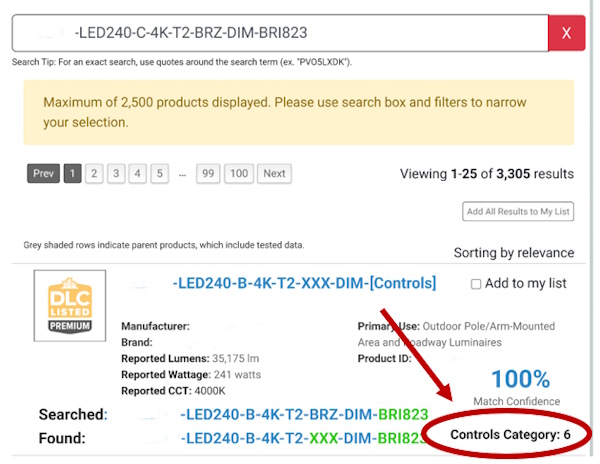
Conceptual example of the Controls Category results when a listed V6.0/LUNA V2.0 product model number is searched for on the SSL QPL.
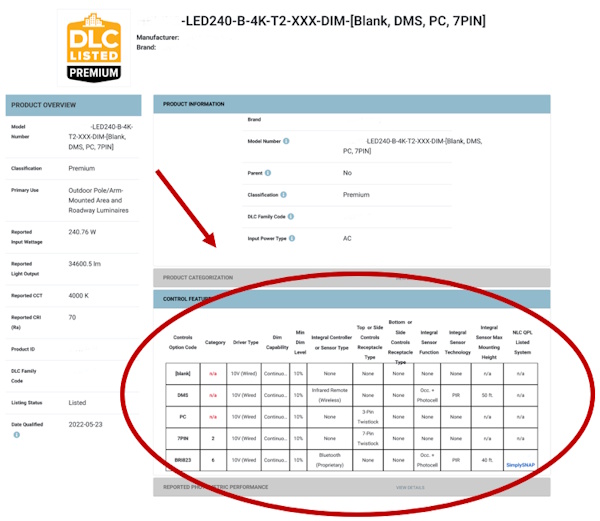
Conceptual draft of the Product Detail Page from the SSL QPL showing an example of the Controls Options Table that will be available for SSL V6.0/LUNA V2.0 listed products.
“Using the control categories, we are helping our members provide more controls rebates and support incentive tiers—by making it easier for energy efficiency programs to connect integral lighting controls with control savings factors,” said Leora C. Radetsky, Senior Lighting Scientist/LUNA Program Director, DLC. “Controls categories and the new controls option tables will also be helpful where codes or rebates require application-level controls usage such as daylight harvesting, high-end trim, and occupancy/vacancy sensing because the specific integral control capability will be shown in the table.”
Why this is important
The need for energy savings is ongoing as demands on the electrical grid continue to increase. Lighting’s traditional role as low-hanging fruit for incentive program energy savings is diminishing, however, as LED adoption increases and the remaining market becomes more challenging to capture. As a result, rebate programs are evolving to expand their energy-saving opportunities and maximize the energy-saving value of each rebate transaction.
Energy efficiency programs are increasingly regarding lighting controls as a more important component in achieving energy savings. A first sign of this is seen in lighting control rebates, which have typically been relegated to the back of the rebate catalog, now being increasingly positioned alongside and integrated with LED rebates. According to BriteSwitch, 20 percent of rebate programs now include controls rebates alongside their lighting rebate offerings.
As an example, in 2025, Energize Connecticut offered side-by-side rebates for controlled and non-controlled luminaires: $25 for a 2×4 linear LED luminaire, $70 for the same luminaire with an integrated dual sensor, and $90 if the luminaire was fitted with luminaire-level lighting controls (LLLC).
Another sign that lighting controls are achieving more focus in rebate programs is that some programs are now requiring that all luminaires be controlled in order to qualify for a rebate. As an example, Mass Save changed its prescriptive downstream rebate program to incentivize luminaires only if they include integral controls.
Meanwhile, networked lighting control rebates continue to grow in availability. The flexibility of this type of system can produce substantial energy savings, making it attractive for adoption by rebate programs. In 2025, networked lighting control rebates continued to gain traction, with 474 programs incentivizing this control option in both prescriptive downstream and some midstream rebates.
Lighting Requirements in SSL Version 6.0
SSL Version 6.0 increases the minimum requirement for LED product efficacy (lumens/W) by an average 14 percent across the board, varying from four percent for some LED replacement lamps to 19 percent for some outdoor product types.
The table below compares historical efficacy requirements for a number of LED product types. For example, compared to Version 3.1 (2015), 4-ft. LED replacement lamps must now provide 30 percent higher efficacy. Compared to Version 3.1 an area/roadway luminaire must now provide 79 percent higher efficacy.
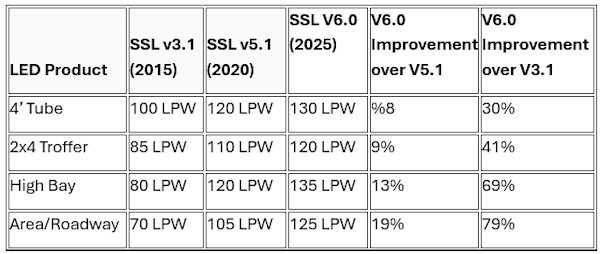
Table 1. DLC efficacy requirements for key LED product categories, 2015-2025.
Version 6.0 also includes these enhancements:
- Removed the tabular Unified Glare Rating (UGR) requirements for linear ambient and high- and low-bay luminaires but retained it for troffers, where it is considered more predictive of performance in the field.
- Incorporated efficacy allowances for products with low CCTs and for those delivering elevated quality-of-light thresholds for glare control and color rendering ability.
- Revised the requirements for field-adjustable LED products to enable more comprehensive reporting.
- Capped correlated color temperature (CCT) for outdoor products at 5000K, with some exceptions.
- Added eligibility for amber and low-CCT (1800-2000K) products as long as they deliver required efficacy and lumen maintenance and provide color information.
- Added solar-powered outdoor lighting with reporting required for grid, battery, and solar panel performance.
- Added optional sustainability reporting.
The new SSL Technical Requirements
After an intensive process involving feedback from nearly 1,400 comments from more than 50 organizations, the DLC’s Version 6.0 SSL Technical Requirements reflect advancing technology and the high energy savings potential of LED products with integral lighting controls. The new QPL is likely to accelerate the emerging trend of integrated lighting-control rebates and incentives.
The DLC will begin accepting applications under Version 6.0 Technical Requirements on January 5, 2026. Previously qualified products will not be delisted from the SSL and LUNA QPLs until December 2026.
To access the DLC’s QPLs at no cost (registration required), visit DesignLights.org.
The Lighting Controls Association is a council of the National Electrical Manufacturers Association that provides education about lighting control technology and application, including articles, videos, design awards, news, resources, and Education Express, a free, 24/7 series of online courses covering everything from technology to design to commissioning.