


September 2, 2026
DLC’s Controls Update Gives Lighting More Control
Author: Craig DiLouie, LC, CLCP is education director for the Lighting Controls Association
Craig DiLouie examines V5.2’s push toward lighting-HVAC integration and deeper savings
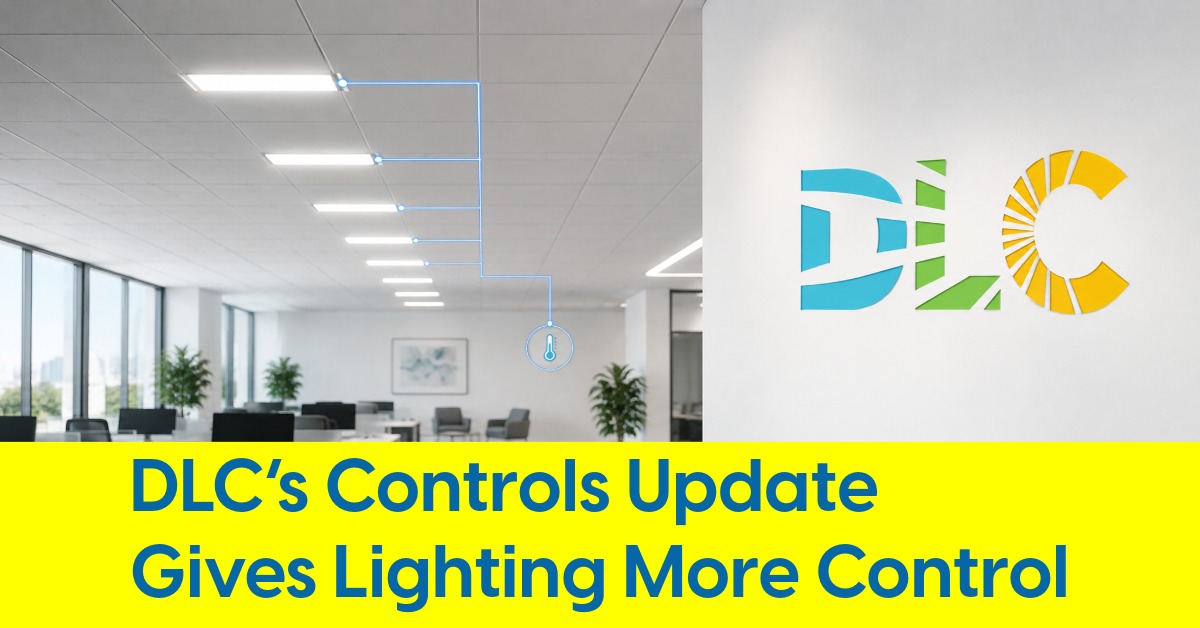
The DesignLights Consortium (DLC) has released the Technical Requirements for Networked Lighting Controls (NLC) Systems V5.2, which took effect August 17, 2026. The updates reinforce the role of NLCs as a foundation for integrated building controls and deeper energy savings and decarbonization in buildings, notably by encouraging opportunities for NLC-HVAC integration.
Background
The DLC defines an NLC as a lighting control system in which devices are networked for communication, enabling capabilities such as layered control strategies, centralized programming, zoning/rezoning using software, integration with other building systems, and storage and analysis of data for non-energy benefits such as enhanced energy and space management. This communication may be wired, wireless, or a combination of the two. Devices may be installed within or remote from luminaires.
The DLC analyzed hourly energy data monitored in 1,200 zones in 114 commercial buildings in which NLCs were installed to produce an average estimate of 47 percent energy savings, resulting in a 2017 report. In 2020, the DLC updated its estimated to 49 percent for an NLC and 63 percent for NLC with luminaire-level lighting controls (LLLC) based on data collected in 194 buildings.
Based on these substantial energy savings, the DLC initiated a Qualified Products List (QPL) for NLCs in 2016 to support adoption of the technology by energy efficiency programs. As of July 2026, the QPL currently lists 96 systems from 61 manufacturers that satisfied the Technical Requirements related to Required (must be satisfied for listing) and Reported (additional system details) capabilities. In 2026, more than 200 commercial lighting rebate programs are offering dedicated rebates for NLC, according to rebate fulfillment firm BriteSwitch—7 percent more than 2025—with prescriptive rebates typically structured as a rebate adder per controlled luminaire. Many more would consider them under their custom rebate programs. According to the DLC, NLC incentives are available in 46 states and three Canadian provinces. In 31 of these markets, incentives are granted only if the NLC system is listed on the DLC’s QPL.

As LED technology has largely displaced traditional lighting systems in commercial buildings, particularly in regions of the country with high energy costs, rebate programs are expanding their focus to deliver energy savings. NLCs can maximize energy savings in a lighting upgrade, whether it is replacement of remaining traditional lighting systems or an LED-to-LED upgrade. Some energy efficiency programs are heavily emphasizing lighting controls. For example, only 4 percent of linear luminaires sold through the Rhode Island Energy midstream program in 2022 included LLLC, whereas in 2026, 75 percent include LLLC.
Additional substantial energy savings can be gained by integrating the NLC with the HVAC system, traditionally deployed in large buildings with a building automation system (BAS). With the introduction of smart thermostats able to be directly integrated with occupancy sensors via a protocol such as Bluetooth NLC, adoption has become practical even in smaller buildings without a BAS, where early results from the Northwest Energy Efficiency Alliance suggest occupancy data from an LLLC-based NLC system can save up to 11 percent of cooling energy and up to 21 percent of heating energy in a well-maintained building.
“The DLC sees a strong continuing rebate opportunity for commercial lighting,” said Levin Nock, PhD, Senior Technical Manager, DLC. “Historically, commercial lighting incentives have focused on simple lamp and fixture upgrades with little or no controls. The DLC sees networked lighting controls—especially luminaire-level lighting controls (LLLC)—and systems that integrate with other building control systems as a major pathway for ongoing lighting incentives.”
NLC Technical Requirements V5.2
The original 2016 NLC Technical Requirements created a credible, third-party, unified performance specification for NLCs to support a QPL and subsequent deployment by energy efficiency programs.
“The requirements addressed early market barriers such as inadequate performance data, lack of performance requirements, limited standardization, inadequate documentation, and difficulty comparing complex control systems,” Nock said. “They gave energy efficiency programs a structured way to understand, evaluate, compare, and qualify advanced lighting control products.”
The QPL does the same for lighting practitioners, providing a valuable industry resource for discovering appropriate solutions for projects.
The initial Technical Requirements helped standardize continuous dimming, digital networking, individual addressability, and sufficient documentation. NLC 5.0 took a significant leap by requiring cybersecurity certification. NLC 5.1 made minor adjustments. NLC 5.2, the next iteration, encourages opportunities for NLC-HVAC integration, supports greater consistency in configuration reporting, improves alignment between NLC and solid-state lighting (SSL) product information, and overall helps make the NLC QPL more useful for efficiency programs, manufacturers, specifiers, and building owners.
“The main changes for NLC V5.2 are that the NLC Technical Requirements now recognize NLC systems that support easy thermostat integration for digital occupancy control and systems that can generate ANSI/NEMA C137.9 configuration reports,” Nock noted. “Both of these new capabilities are Reported—that is, optional. We’re also updating the QPL so that LLLC systems on the DLC NLC QPL will now be directly associated with one or more LLLC luminaires or kits listed under SSL V6.0 on the DLC SSL QPL.”
In addition, language was updated to accept all systems that satisfy NLC requirements, even if a system also supports horticultural lighting control, in addition to minor language modifications.
Thermostat integration: In NLC V5.2, thermostat integration appears as part of the NLC system’s External Systems Integration capability. As there is no QPL for thermostats at this time, these devices are treated as an integrated feature, with compatible product information listed. By using the QPL, utilities and lighting practitioners can more confidently match an NLC system with a thermostat designed to work with it, specifically by being able to digitally receive occupancy data required to put HVAC zones into occupied-standby mode for flexible response and resulting energy savings. This permits integration in the large number of buildings that rely on standalone, programmable thermostats for HVAC control.
“With occupancy data from NLC sensors, thermostats can automatically save HVAC energy whenever spaces are unoccupied,” Nock noted. “This saves energy in buildings with highly variable occupancy such as schools and even in buildings with regularly scheduled occupancy such as retail, if nobody ever programs the thermostat to match the schedule. These capabilities will enable energy efficiency programs to better serve small- and medium-sized commercial buildings, which are a major focus for many programs. Small- and medium-sized businesses and buildings are notoriously hard to reach compared to large buildings, but this sector is important for addressing equity and high potential energy savings. By using occupancy data from lighting controls to inform thermostat operation, integration can unlock HVAC energy savings of 8 to 21 percent while also delivering lighting energy savings from the retrofit.”
ANSI/NEMA C137.9 configuration reports: This standard provides a consistent data format for reports generated by interior intelligent lighting systems, making it easier to track how energy is saved and how the system is programmed. The report clearly lists the system’s setup at a given time, which specific control strategies are being enacted, wattage data at the zone or individual luminaire level, and key system information required to verify energy savings. This provides a “common language” and format when documenting whether a project was configured as intended. As rebate programs are likely to adopt a requirement for C137.9 reporting, this system capability will become important to specify and verify.
Above: DLC NLC V5.2 Required and Reported capabilities for indoor systems. Thermostat integration is covered under “External Systems Integration.” Additionally, “Configuration Reporting” must now be reported.
Above: DLC NLC V5.2 Required and Reported capabilities for outdoor systems.
NLCs are a platform for energy efficiency
NLC V5.2 recognizes NLC’s evolution to becoming a platform for energy efficiency broader than lighting control, more useful as part of the whole building, while making performance and resulting energy savings more verifiable.
“Occupancy data from lighting systems can help HVAC systems operate more intelligently, and standardized configuration reports can help utilities verify that control settings will save energy,” Nock said. “Together, these changes can make advanced lighting control projects more compelling for customers, contractors, and incentive programs.”
The Lighting Controls Association is a council of the National Electrical Manufacturers Association that provides education about lighting control technology and application, including articles, videos, design awards, news, resources, and Education Express, a free, 24/7 series of online courses covering everything from technology to design to commissioning.