



March 27, 2026
L.A.’s 60,000 Solar Streetlights: Tipping Point or Temporary Fix?
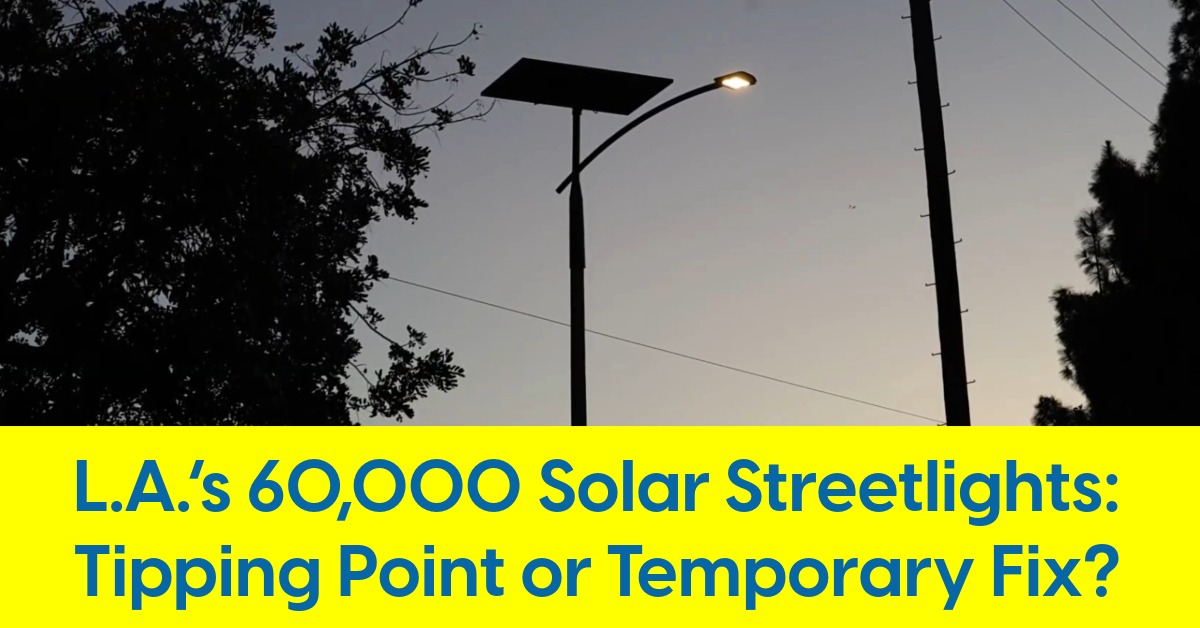
Image credit: City of Los Angeles
Unplugged: Mass solar deployment signals structural change in municipal lighting strategy
Los Angeles has tried to out-engineer a copper wire theft crisis. It buried copper deeper. It welded access points shut. It installed cameras. And still, the lights kept going out.
Now the city is taking a different approach: removing the problem entirely.
Mayor Karen Bass has launched a plan to install up to 60,000 solar streetlights, a sweeping overhaul that would touch more than a quarter of the city’s roughly 220,000 fixtures, according to the Los Angeles Bureau of Street Lighting. It is, by any measure, one of the largest municipal solar lighting deployments in the United States.
On March 24, the Los Angeles City Council authorized a $65 million investment for this deployment of the solar-powered streetlights. For Lighting People, the scale is striking. The motivation is more revealing.

From Experiment to Default
We have been here before, just on a smaller stage.
In 2024, Los Angeles faced nearly 26,000 dark streetlights, driven largely by vandalism and theft, as we previously reported. Early solar pilots, including a 104-unit installation in Van Nuys, a neighborhood in Los Angeles, were positioned as a workaround. The premise was simple: no power wires, nothing to steal.
The results were quietly persuasive. City officials expanded deployments into Watts and Historic Filipinotown, reporting fewer maintenance calls and minimal vandalism. By 2025, solar was no longer a test case. The solar streetlights sourced from Fonroche North America were a validated option.
This latest move signals something more consequential. Sixty thousand units is not experimentation. It is policy.
The Real Driver: Infrastructure Failure
City Hall has framed the initiative around sustainability and resilience. Both are true. Neither is the real story.
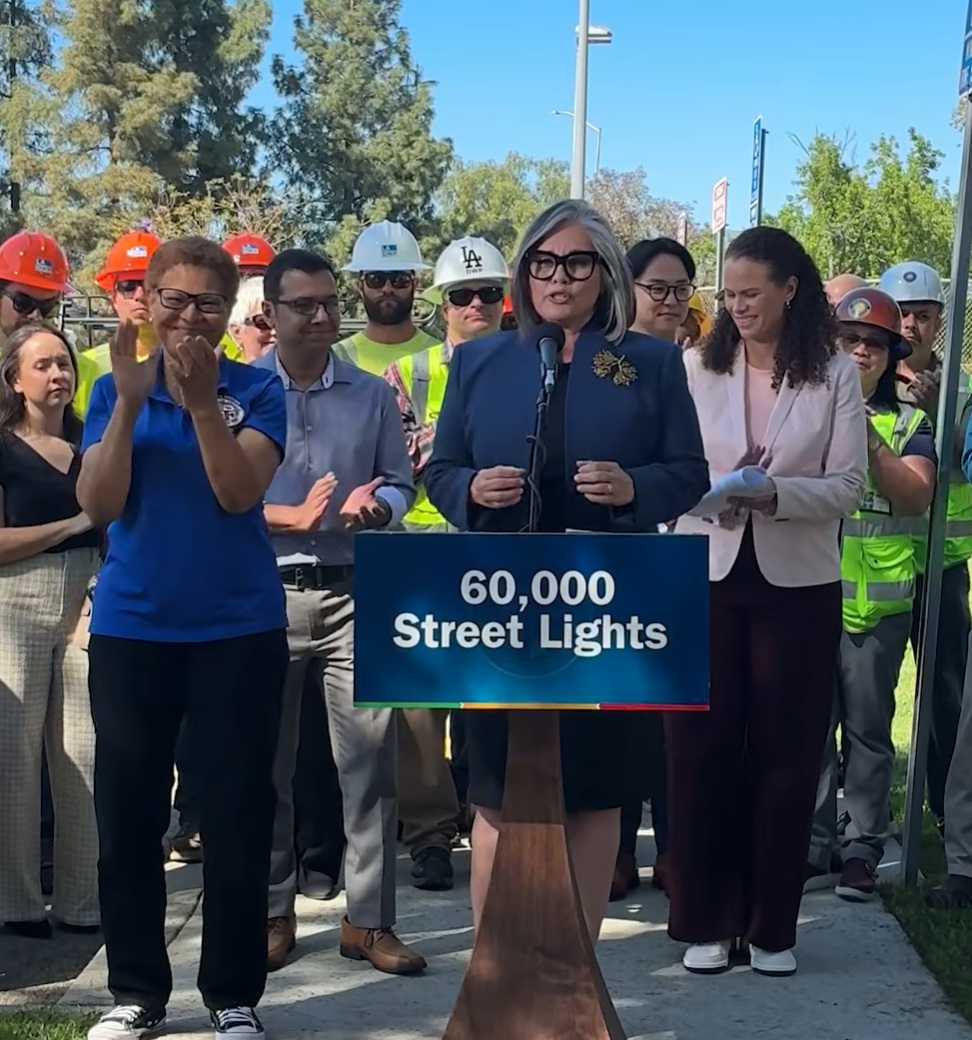
Above: Mayor Bass (left) with Councilwoman Monica Rodriguez (center) at Thursday press conference.
Image credit: City of Los Angeles
Copper theft is.
Los Angeles has seen a 1,200% increase in copper wire theft over the past decade, according to the Mayor’s office. Repairs tied to those incidents cost at least four times more than standard maintenance. Theft-related damage alone drove tens of millions in annual repair costs.
The effect is visible. Entire neighborhoods have endured years-long outages. A system designed for reliability has become a recurring liability.
Solar changes the equation by eliminating wire entirely. That is less an innovation than an evasion tactic. When the grid becomes a target, going off-grid starts to look pragmatic.
The Cost Question That Won’t Go Away
The economics are less tidy.
During the pilot period, L.A. stated that solar streetlights typically carry upfront costs between $3,000 and $5,000 per unit — a clear premium over traditional systems. The newly approved $65 million investment for 60,000 units, however, implies an average installed cost of roughly $1,083 per light. The gap warrants scrutiny. It could signal economies of scale—or a phased approach, with initial funding covering early deployment and additional capital likely to follow.
The cost justification rests on lifecycle savings. Fewer repair crews. No trenching. No copper replacement. Reduced exposure to theft. Over time, the argument goes, operating costs fall.
But the variables matter. Battery lifespan remains a moving target. Replacement cycles introduce new maintenance categories. And performance is not uniform. In earlier deployments, Los Angeles flagged challenges with shading and site suitability, a reminder that solar is not universally deployable across dense urban terrain.
For manufacturers and specifiers, the question is not whether the math works in theory. It is how often it works in practice.
Video: Fox 11 Los Angeles
A Shift Beneath the Fixture
There is a quieter implication embedded in this transition.
Solar streetlighting compresses what has traditionally been a distributed system. Instead of separate poles, luminaires, wiring, and controls, cities are buying integrated packages, lighting, storage, and control in one unit. That shifts both responsibility and value.
Who owns performance over time? Who replaces batteries? Who guarantees output after five years?
Los Angeles is attempting to answer those questions through phased deployment and technical validation groups. But for an industry built on standardized components and established roles, this is a structural change.
And it may not stay contained to Los Angeles.
What This Signals
This is not a breakthrough technology story. The hardware has existed for years. What changed is the pressure.
Decades of frozen funding, rising material theft, and mounting maintenance backlogs have forced a decision that might otherwise have taken years longer. Los Angeles is not adopting solar because it is new. It is adopting it because the old system stopped working.
Whether this becomes a tipping point depends on who follows. If other cities facing similar pressures make similar choices, solar streetlighting could move from niche to norm faster than expected.
For now, one fact stands out. In Los Angeles, the power grid is no longer the default. And for Lighting People, that may be the most consequential shift of all.