


December 17, 2025
If You Can’t See the Flicker, Is It Still There?
New brain imaging research challenges lighting assumptions and gives lighting people more to consider
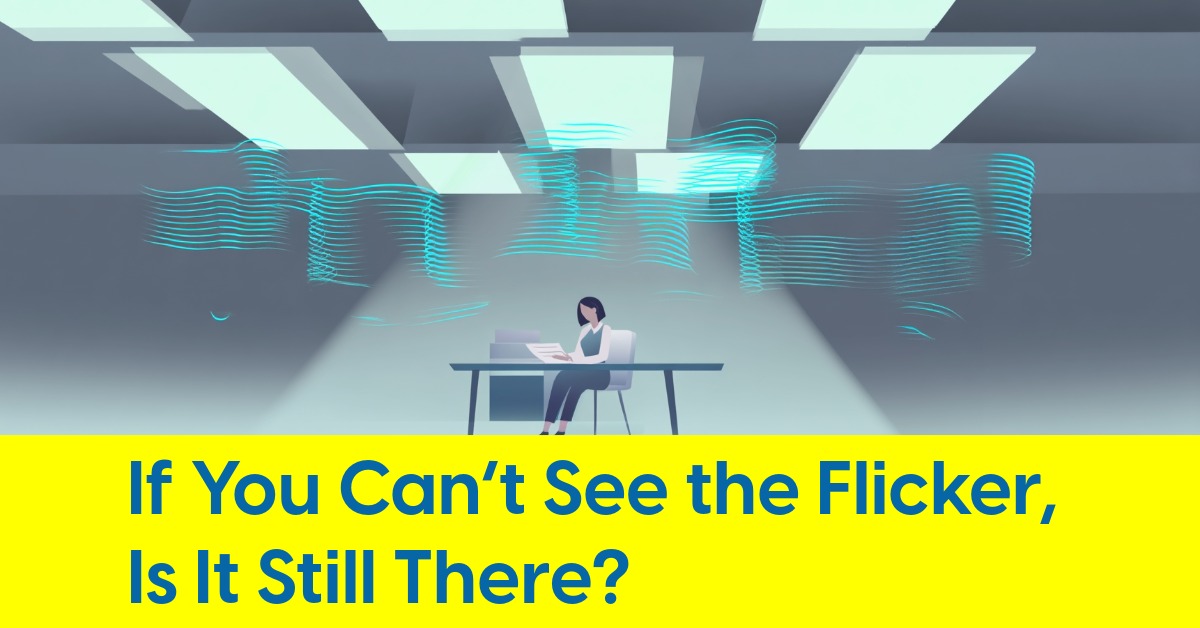
Lighting people have long treated flicker as a visual issue. If you can’t see it, it’s not a problem. But a new study, published in LEUKOS - The Journal of the Illuminating Engineering Society, offers reason to rethink that assumption. Researchers found that even flicker at 100 Hz — well above the threshold of human perception — still triggered measurable activation in the brain’s visual cortex. At 50 Hz, the response was expectedly strong. At 100 Hz, it was smaller but clearly present.
The takeaway isn’t that lighting is suddenly dangerous, or that standards like IEEE 1789 are obsolete. Using ultra–high-field 7T fMRI, which can detect much subtler brain activity than standard scanners, the study suggests that the human brain may be reacting to “invisible” flicker in ways our current definitions don’t capture — especially in environments with long exposure times, like offices, classrooms, and hospitals.

PNNL Has Been Ringing the Bell for Years
At Pacific Northwest National Laboratory, the now-retired Naomi Miller — known by some as the “Queen of Flicker” — has spent years studying the non-visual impacts of temporal light modulation (TLM). Her team’s research, funded by the U.S. Department of Energy, has explored phenomena like the phantom array effect and stroboscopic visibility at frequencies once thought to be too fast to notice.
In 2022, Miller’s group published findings showing that some subjects reported phantom array visibility at surprisingly high frequencies, even when light modulation wasn’t perceptible. More recently, her team compared migraine-prone subjects to control groups and found that migraine sufferers were significantly more sensitive to flicker, experiencing discomfort and aftereffects even when others didn’t.
And these weren’t extreme or fringe products — they were standard commercial LED systems.
Cheap Drivers Are Still Failing Basic Flicker Tests
At the low end of the market, flicker isn’t just a neurological question — it’s a visible flaw. Inexpensive LED drivers, especially those in residential-grade tape light kits or low-cost troffers, often use low-frequency PWM dimming (typically 100–400 Hz) without smoothing capacitors or analog controls. The result? Visible shimmer, strobing during motion, and eye strain in real-world applications. Try reading a book under one, or glancing at a spinning fan blade, and the flicker reveals itself immediately.
Spec sheets from these products rarely mention flicker, let alone provide flicker index, waveform, or modulation frequency. The focus is on price, not performance — and users, especially those sensitive to light, pay the price in headaches, fatigue, or worse.
Premium Drivers Do Better — But Not Always Enough
On the premium end of the market, Lutron has long been a go-to brand for reliable, high-performance drivers, especially in applications where smooth, deep dimming and visual comfort matter. Their Hi-Lume LED Driver line, for example, offers dimming down to 0.1% and is marketed as “flicker-free” — a claim backed by years of engineering consistency and real-world performance.
That said, the spec sheets we sampled don’t go deep into flicker-specific metrics. While performance is excellent, details like modulation frequency, waveform shape, or percent flicker aren’t typically published. It’s not a knock on Lutron — they’ve set the bar in many areas — but it does highlight the current gap between what top-tier drivers achieve in practice and what’s documented in terms of biological flicker transparency, especially in light of newer research.
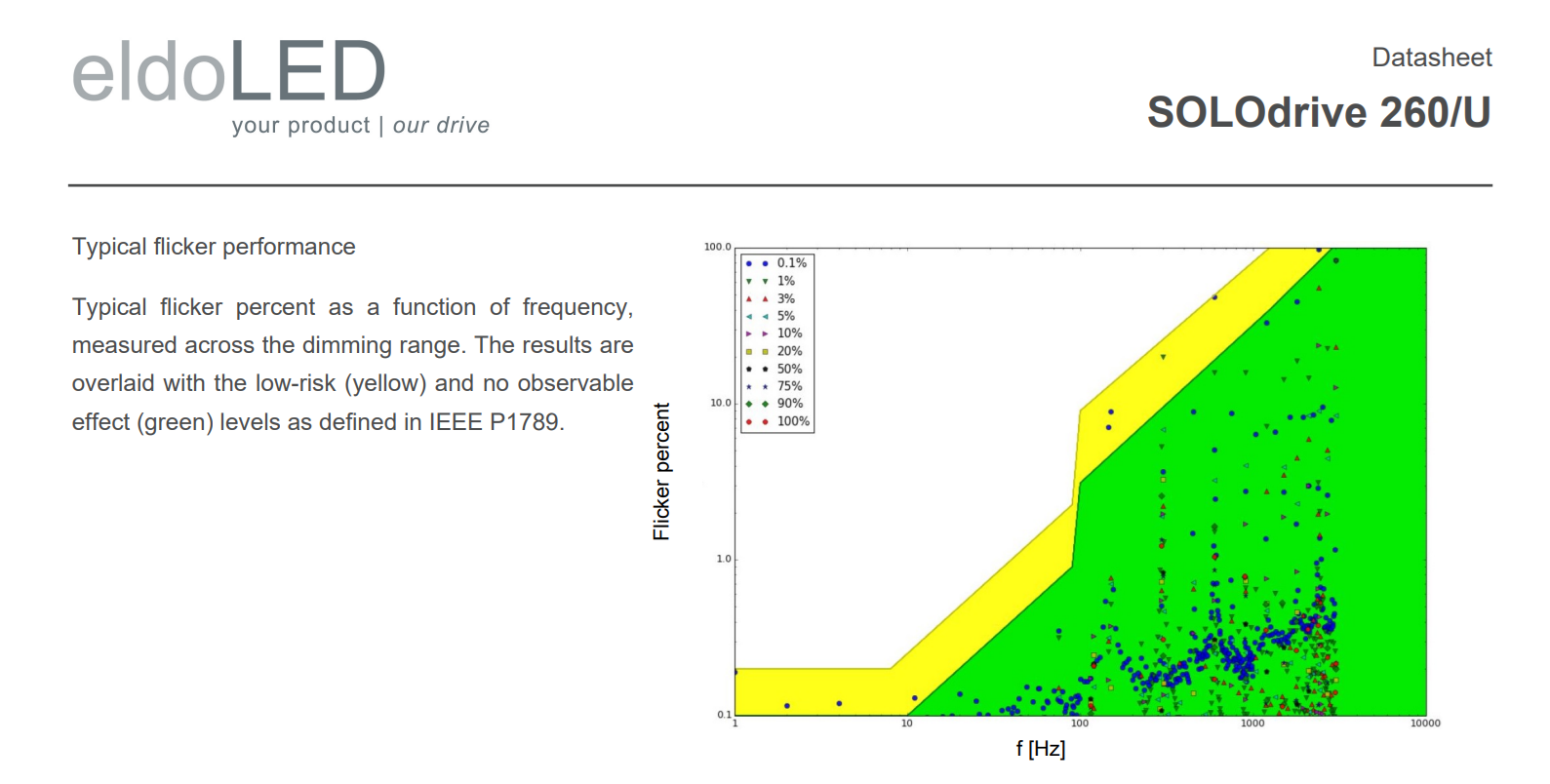
eldoLED (Acuity) driver datasheet excerpt showing published flicker and modulation performance — a rare example where detailed flicker data is clearly disclosed
An exception worth noting is eldoLED, part of Acuity Brands. Their SOLOdrive datasheet includes a helpful chart citing flicker behavior across frequency ranges. It’s refreshingly candid, plotting flicker percent across various frequencies. Yet even here, the best data points hover around 700 - 5000 Hz — high for the industry, but still below what some researchers now consider a biologically neutral range.
Lighting People Shouldn’t Panic — But They Should Dig Deeper
The study doesn’t call for new standards. Neither does PNNL’s research. But together, they expand the context. They remind us that perception isn’t the only relevant metric, and that individual variability — especially among migraine sufferers or light-sensitive users — may demand a more cautious approach.
Specifiers don’t need to abandon what works. But they can ask better questions. What’s the modulation frequency? What happens at low dimming levels? Does the driver use constant current reduction or low-frequency PWM? And can the manufacturer back up “flicker-free” with waveform data, not just marketing?
Because even if the flicker is invisible to the eye, there’s mounting evidence that the brain still sees it.