November 16, 2026
Your Lighting Controls May Be Fine. Your Laptop?
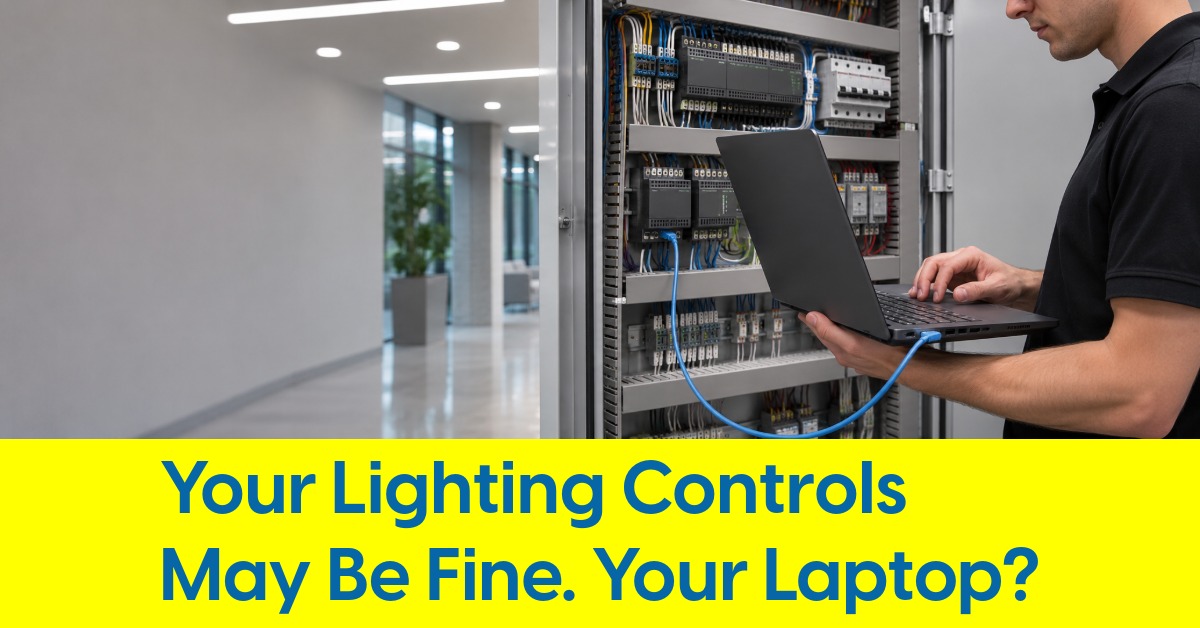
Federal cybersecurity rules have plenty to say about the commissioning crew’s computer
The $5 million settlement between Johnson Controls Inc. (JCI) and the federal government, announced by the U.S. Department of Justice on November 13, bought peace over the company’s own computer systems. No sensor, camera or building automation controller appears anywhere in it.
Controls companies doing government work answer to two cyber rulebooks at once: one for the business systems that hold government information, and one for the building control system being installed. JCI’s settlement involves the first. Lighting controls work on federal jobs runs into both.

The deal resolves False Claims Act allegations brought by two whistleblowers, Kelly Vance and David Thomas. According to the settlement agreement, the government contends that from January 2018 to August 2025, across 25 contracts and subcontracts with the Air Force, Army, Navy, NASA, the Department of Energy and the Justice Department, JCI did not adequately control access to protected information, lacked a System Security Plan that fully met contract requirements, and did not fully develop or carry out its plan to fix the gaps.
JCI admitted no liability. About $2.43 million of the $5 million is designated as restitution. The settling parties include JCI’s fire protection and security subsidiaries, the arms that put technicians on jobsites. Nothing in the agreement concerns the security of any JCI product.
The Laptop at Startup
For lighting people, the relevant moment is startup. Federal lighting controls jobs depend on a startup crew: a factory field tech, an agency’s commissioning specialist, a third-party integrator or the electrical contractor’s controls person. Each connects a company laptop to the control system, and Unified Facilities Guide Specification 25 05 11, the Defense construction spec for control system cybersecurity, has a section written for exactly that moment.
Under it, any contractor-owned computer connected to the control system during construction must run a supported, fully patched operating system and current anti-malware software. It must run a full scan daily, and again before connecting if it has touched another network since. USB drives get scanned too. Default passwords must be changed, accounts cannot be shared, and the government can demand proof of compliance at any time. Temporary startup networks cannot extend beyond the project site.
Then comes the paperwork. Each company using its own computers on the job submits a Contractor Computer Cybersecurity Compliance Statement signed by its cybersecurity representative. For a 32-person rep agency, the first question may simply be who that person is. Whether a statement that doesn’t match reality could create exposure along the lines of what JCI faced is a question for a government contracts attorney. The JCI case does show how seriously the government can treat contractual cybersecurity obligations it believes went unmet.
The Spec Knows What Lighting Is
UFGS 25 05 11 also lists “Lighting Control Systems” as its own system type alongside HVAC, fire and electronic security, with lighting-specific rules for device security documentation, access control and controller audit logging. A U.S. Army Corps of Engineers bulletin issued in February, Engineering and Construction Bulletin 2026-6, requires the spec for projects with building control systems and gives “HVAC, lighting” as examples. That bulletin covers only Corps Civil Works projects such as locks and dams.
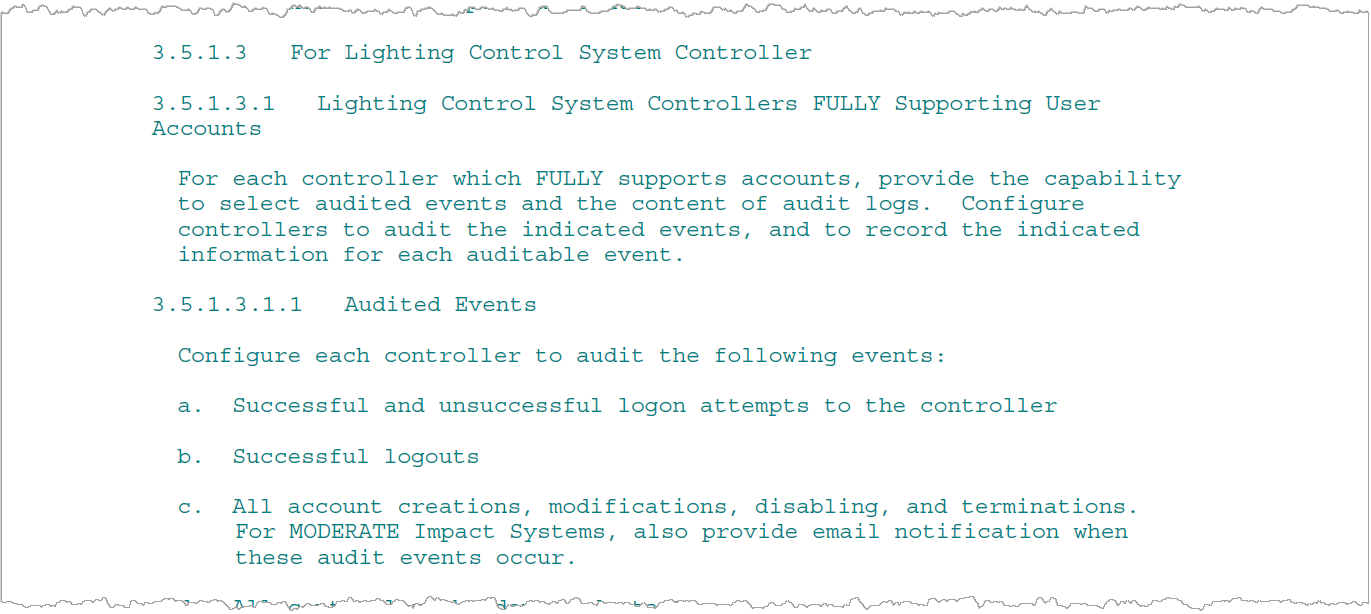
Above: UFGS 25 05 11, Section 3.5.1.3: the spec’s audit-logging rules written specifically for lighting control system controllers.
The detail most likely to land with lighting people is wireless. Unless the government explicitly authorizes it, the spec says not to use wireless or wired broadcast communication, and its definition of wireless includes ZigBee and Bluetooth. A device with a radio counts as wirelessly connected even if the radio is switched off in software; it has to be physically disabled. For moderate-impact systems, any authorized non-IP radio must meet Federal Information Processing Standard 140-2 Level 2. The spec’s own notes acknowledge that bar may effectively rule out non-IP wireless, and call that intentional.
Designers tailor the spec job by job, and the notes allow that wireless may be considered for retrofits where running wire would be prohibitive. Still, for an industry that has spent a decade selling wireless room controls as the easy retrofit, the default points the other way.
Before the Next Federal Startup
For smaller firms, the upshot is that the startup laptop, the USB stick holding the programming file and the shared commissioning login are all part of the job’s cyber footprint, whether anyone priced them in or not. Agents and contractors would be wise to ask early which spec governs the work, whether wireless has been authorized in writing, and who in their own shop is qualified to sign that compliance statement.
The Atlanta-based law firm Alston & Bird counted at least 12 cybersecurity-related False Claims Act settlements announced by the Justice Department between 2022 and late 2025, and noted that regulators have focused on enforcement based on “real or perceived cybersecurity noncompliance.”
Federal cyber enforcement has landed on some large contractors with large IT departments. The rulebook for the installed system, however, was written with the person holding the laptop in mind. On plenty of federal lighting jobs, that person works for a rep agency or an electrical contractor with no IT department at all.